Worry Time for Kids
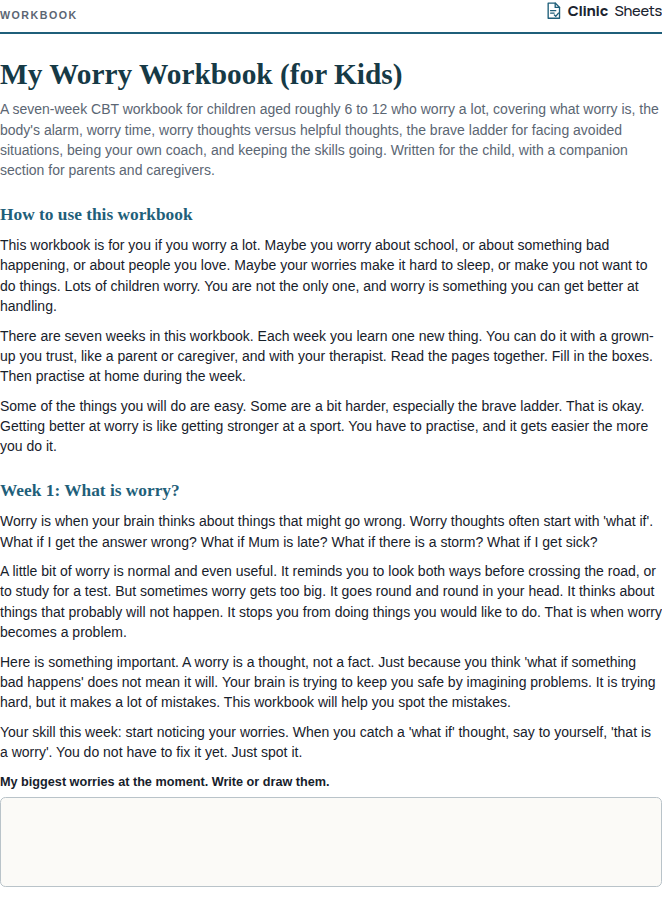
A child-friendly version of worry postponement: the child learns to park worries in a 'worry jar' during the day and open them at a short, planned Worry Time with a parent, so worry stops spreading across the whole day.
About this resource
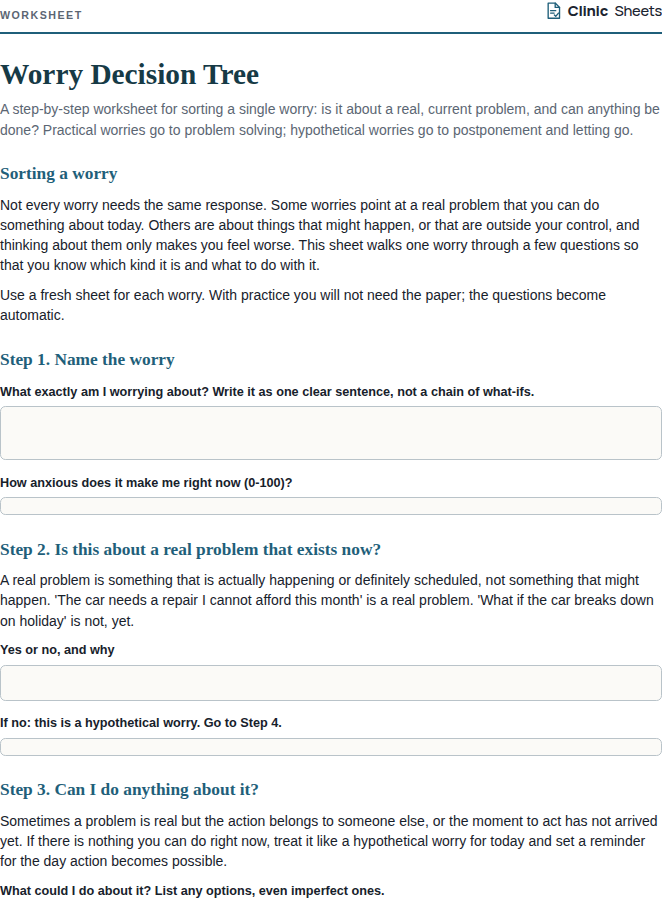
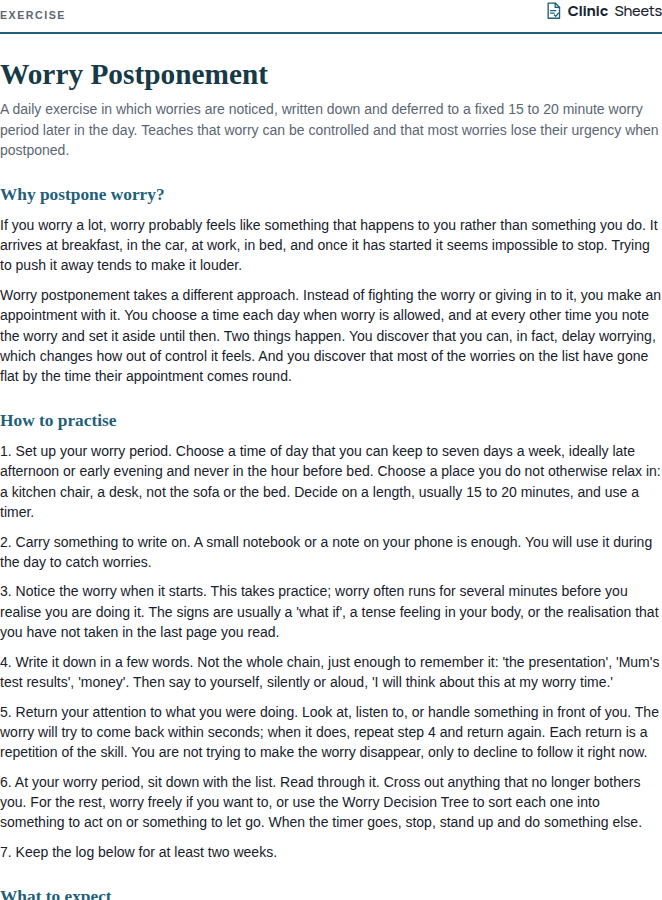
Worry postponement (sometimes called stimulus control for worry) was first described by Borkovec and colleagues in 1983. The idea is simple: instead of trying to stop worrying, the person notices a worry, writes it down, and deliberately puts off thinking about it until a fixed daily worry period. Over time the worry period becomes the only place worry is allowed to live, which weakens the link between the many cues of daily life and the worrying response. Children who worry a lot often feel that worries arrive uninvited and cannot be controlled. Learning that a worry can be caught, parked and returned to later is often the first experience they have of being in charge of their own thinking.
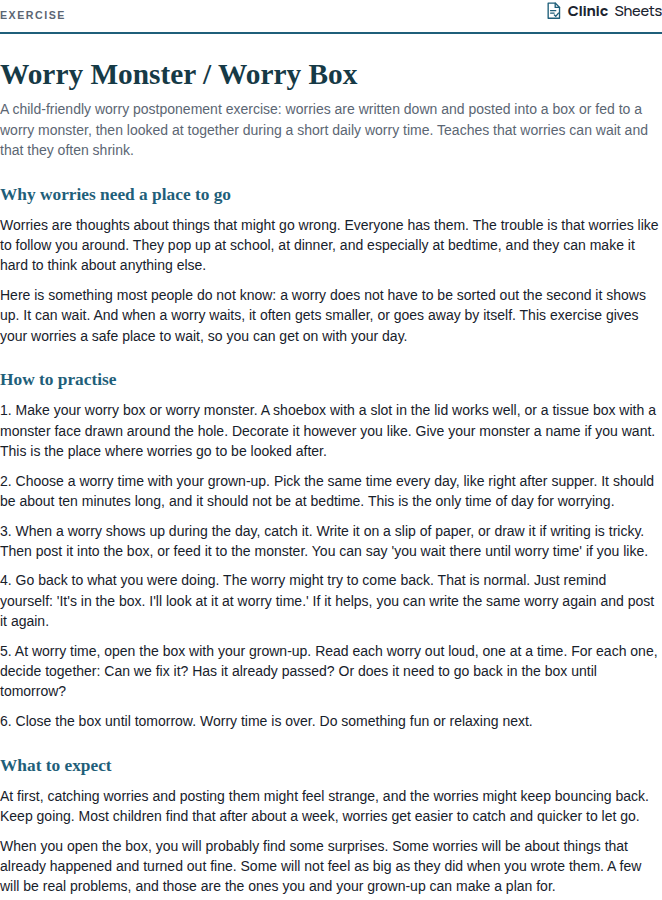
This worksheet adapts the technique for children aged roughly six to twelve, with a parent or caregiver acting as the Worry Time partner. The child has a worry jar (a real jar, box or envelope) and a stack of slips. During the day, when a worry shows up, the child writes or draws it and puts it in the jar. At Worry Time, a fixed ten to fifteen minute slot in the late afternoon or early evening, the child and parent empty the jar and sort each worry into one of two piles: worries we can do something about (which get a small plan) and worries we cannot do anything about (which get acknowledged and put back). Many worries will have gone stale by then, which is itself an important lesson.
The professional version adds guidance on choosing the timing of Worry Time (never within an hour of bedtime), on the parent's role (curious and calm, not reassuring), and on the common problem of the child who wants to open the jar early. It also notes that for children with separation anxiety or health worries, the 'can we do something about it' sort is where problem solving and exposure work can be introduced.
How to use it
- Explain to the child that worries are like pop-up ads: they appear whether we want them or not, but we can choose when to look at them. Introduce the jar as a place to keep worries safe until Worry Time.
- Agree a fixed Worry Time with the family. Ten to fifteen minutes is enough. It should be at the same time each day, with a parent present, and well before bedtime. Set a timer so it has a clear end.
- Practise catching and parking a worry in session. Have the child write or draw a current worry, put it in the jar, and notice what happens to the feeling. Naming the moment of choice ('I'm going to put this in the jar and think about it later') is the skill.
- Teach the two-pile sort for Worry Time. For 'can do something' worries, help the child make one small next step. For 'can't do anything' worries, model brief acknowledgement ('That is a worry about something we can't control. We'll let it sit.') and move on. Avoid long reassurance conversations.
- Review the worksheet each session. Look at how many worries were parked, how many had faded by Worry Time, and whether the child managed to wait. Celebrate waiting as much as sorting.
- As the skill builds, shorten Worry Time or reduce it to a few days a week. Some children move to a 'worry notebook' they manage themselves.
References
- Borkovec, T. D., Wilkinson, L., Folensbee, R., & Lerman, C. (1983). Stimulus control applications to the treatment of worry. Behaviour Research and Therapy, 21(3), 247-251.
- Rapee, R. M., Wignall, A., Spence, S. H., Cobham, V., & Lyneham, H. (2022). Helping Your Anxious Child: A Step-by-Step Guide for Parents (3rd ed.). New Harbinger.
- Stallard, P. (2019). Think Good, Feel Good: A Cognitive Behavioural Therapy Workbook for Children and Young People (2nd ed.). Wiley.