My Worry Workbook (for Kids)
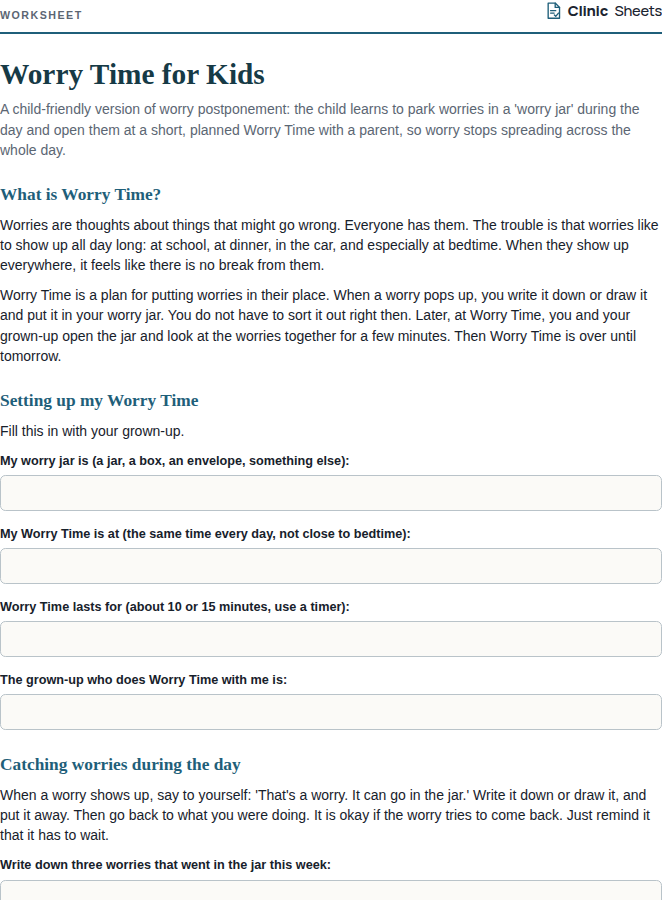
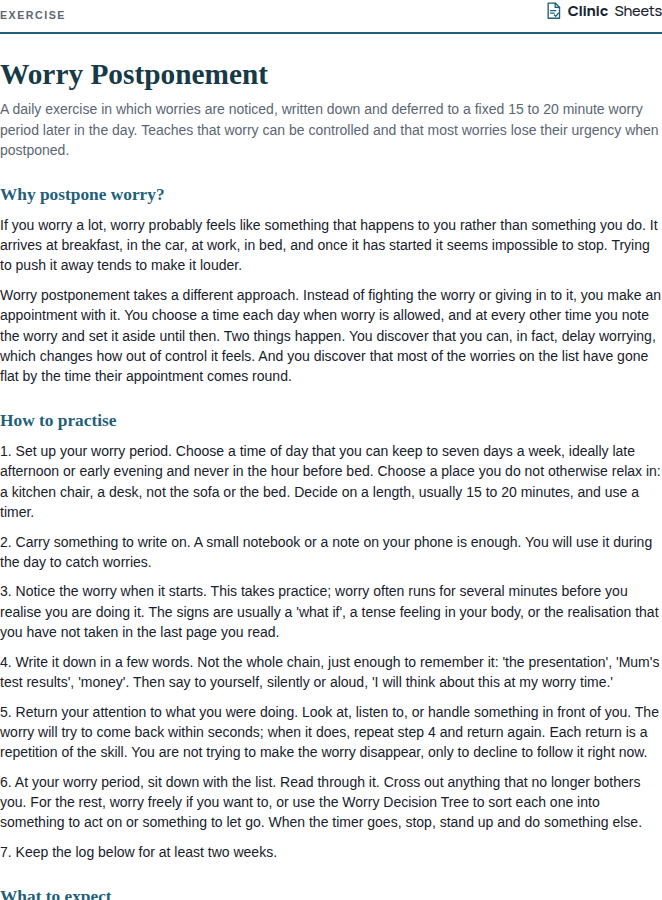
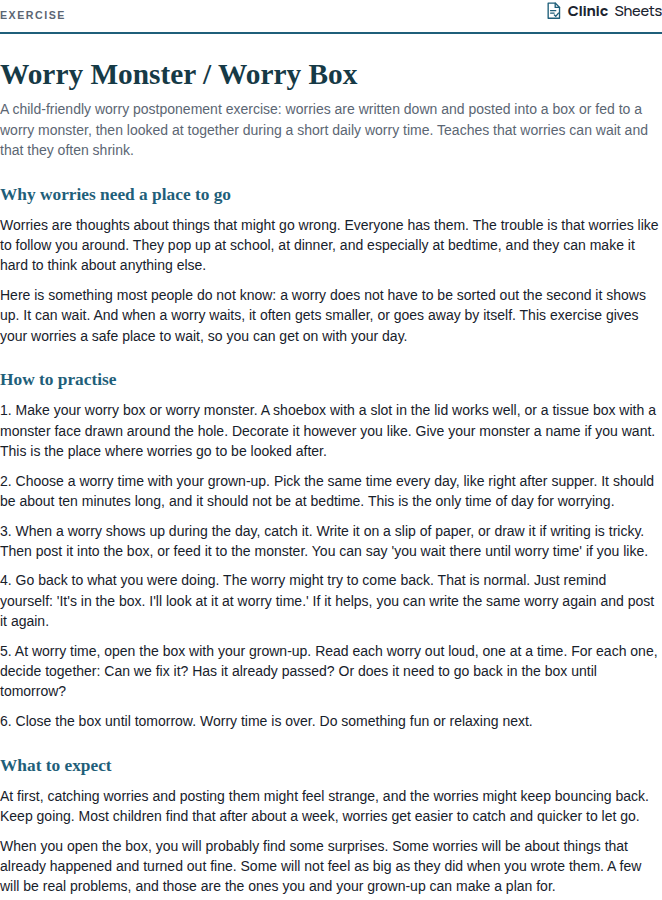
A seven-week CBT workbook for children aged roughly 6 to 12 who worry a lot, covering what worry is, the body's alarm, worry time, worry thoughts versus helpful thoughts, the brave ladder for facing avoided situations, being your own coach, and keeping the skills going. Written for the child, with a companion section for parents and caregivers.
About this resource
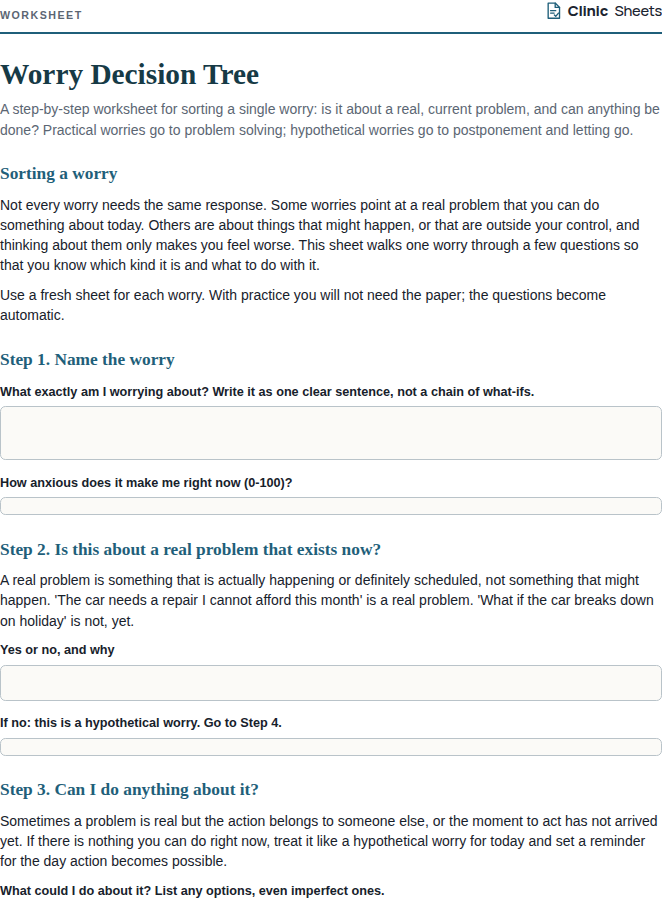
Anxiety is among the most common childhood mental health problems, and cognitive behavioural therapy is its best-supported psychological treatment. The child CBT programmes with the strongest evidence, including Kendall's Coping Cat and the parent-led approach developed by Creswell and colleagues, share a common sequence: psychoeducation about anxiety and the body's alarm response, recognition of anxious thoughts and generation of coping thoughts, graded exposure to feared and avoided situations, and reward and self-praise for brave behaviour. Worry postponement, borrowed from adult treatments for generalised anxiety, is a helpful addition for children whose anxiety takes the form of persistent 'what if' thinking.
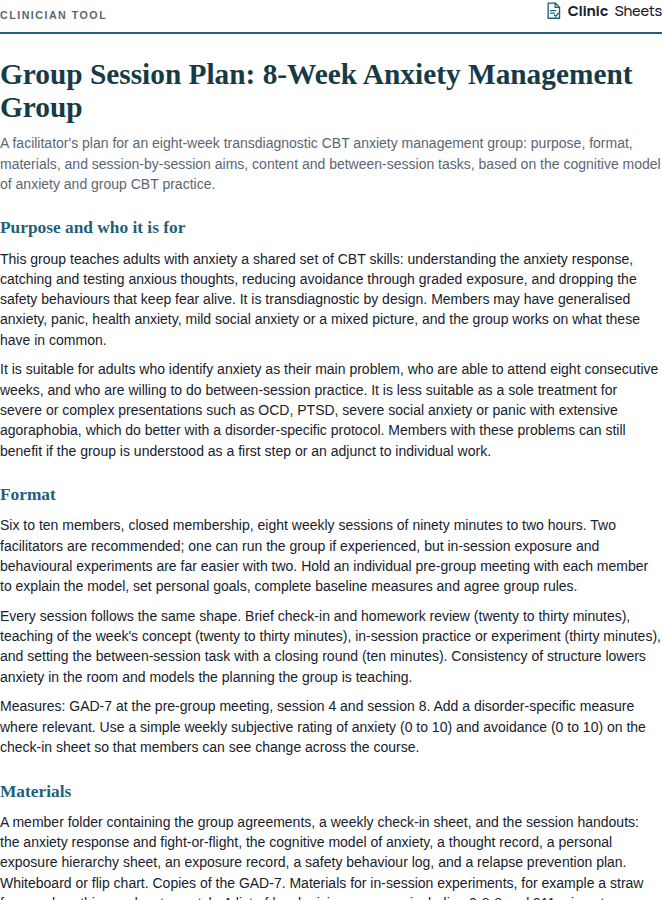
This workbook delivers that sequence over seven weeks, written directly to the child in short sentences with one idea per paragraph. Each week has a brief explanation, one skill, and two to four practice fields. The exposure component, presented as a brave ladder, occupies two weeks because it is the most important and the most demanding. A closing section for parents and caregivers explains the child's perspective, how to support brave behaviour without either forcing or rescuing, and how to reduce accommodation and reassurance in a supportive way.
The professional version includes guidance on pacing, on involving parents as co-therapists in line with the parent-led model, on choosing the first ladder steps, and on distinguishing developmentally normal worry from anxiety that warrants treatment.
How to use it
- Work through one week per session, or slower if the child needs it. Read the explanation aloud together, complete the fields in session, and set the home practice before the child leaves.
- Bring the parent or caregiver in from the beginning. Ask them to read their section first, to help with worry time and the brave ladder at home, and to practise responding to reassurance seeking as the section describes.
- Build the brave ladder collaboratively in Week 5 with steps that are specific and small enough that the child can realistically take the first one within days. Rehearse the first step in session where possible.
- Make sure every ladder step is followed by praise and, where the family uses them, a small reward for the effort of being brave, not for the outcome.
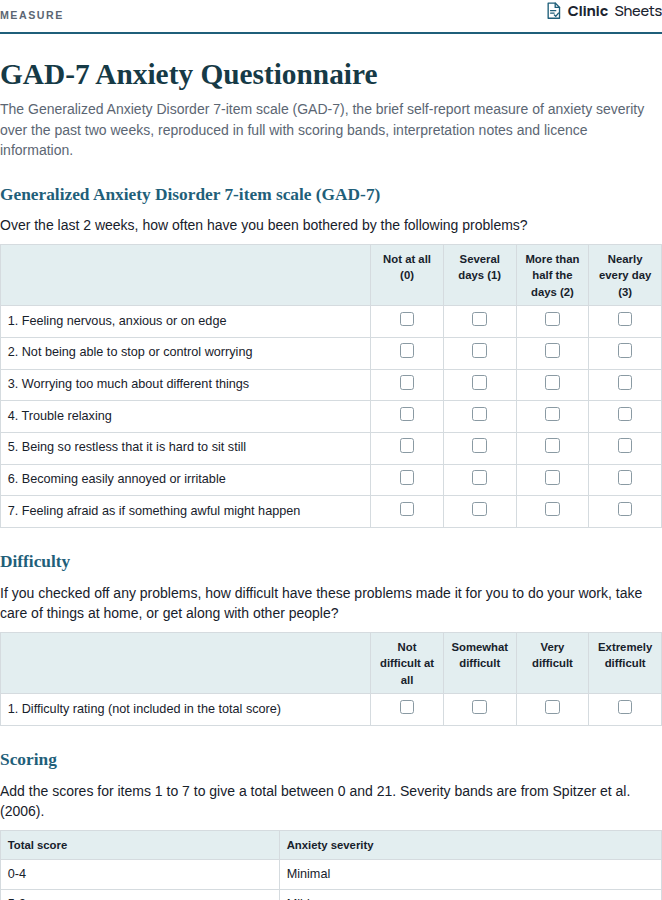
- Track progress with a child anxiety measure at the start, midway and at the end, and use the child's own thermometer ratings during exposure to show the fear coming down.
- If the child's anxiety is accompanied by significant low mood, trauma history, or developmental concerns, use the workbook within a broader assessment and treatment plan.
References
- Creswell, C., Parkinson, M., Thirlwall, K., & Willetts, L. (2019). Helping Your Child with Fears and Worries: A Self-Help Guide for Parents (2nd ed.). Robinson.
- Kendall, P. C., & Hedtke, K. A. (2006). Cognitive-Behavioral Therapy for Anxious Children: Therapist Manual (3rd ed.). Workbook Publishing.
- Rapee, R. M., Wignall, A., Spence, S. H., Cobham, V., & Lyneham, H. (2008). Helping Your Anxious Child: A Step-by-Step Guide for Parents (2nd ed.). New Harbinger.
- Stallard, P. (2019). Think Good, Feel Good: A CBT Workbook for Children and Young People (2nd ed.). Wiley-Blackwell.