Activity Scheduling Planner
A weekly planner for scheduling specific, graded activities in behavioural activation, with space to record whether each was completed and its effect on mood.
About this resource
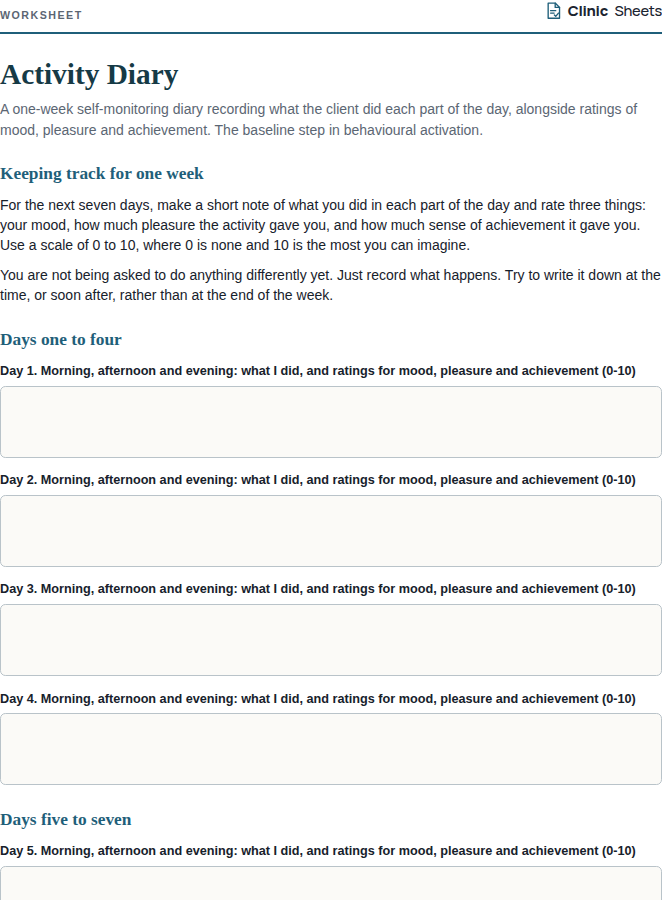
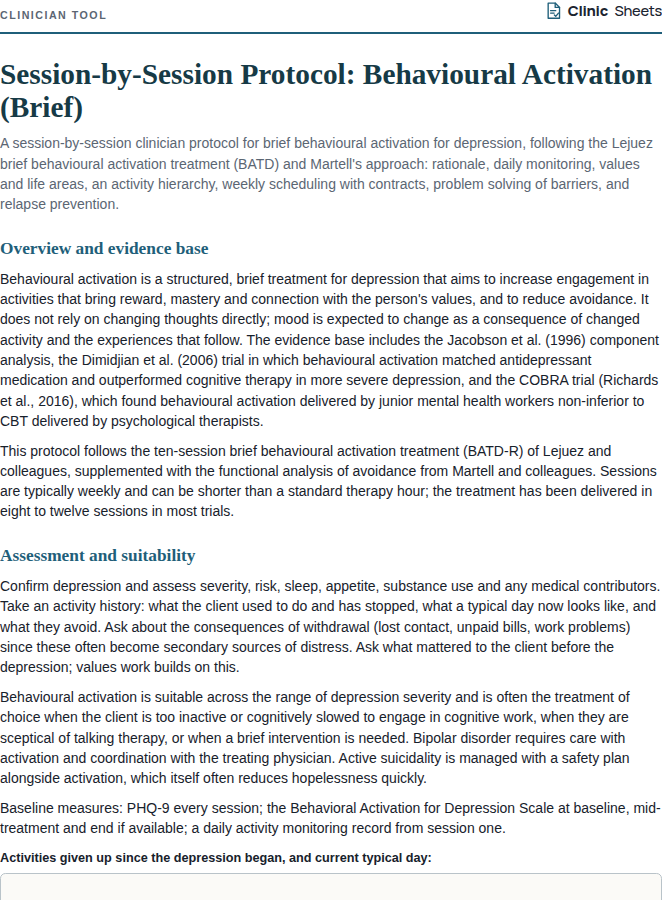
Once a baseline diary has shown how activity and mood relate, the next step in behavioural activation is to schedule activities deliberately. Scheduling matters because depressed clients are unlikely to act on intention alone; a specific plan with a time and place is far more likely to be carried out than a general resolution to do more. The planner also functions as a commitment device and gives the client and clinician something concrete to review.
This planner asks the client to choose a small number of activities for the week, grade them so that the easiest come first, and assign each to a day and time. After each is attempted, the client records whether it was done and how their mood responded. The emphasis is on completion rather than enjoyment, since mood benefit in BA is cumulative and often lags behind behaviour.
The activities should be drawn from the client's own diary data and values rather than from a generic list, and should balance pleasure, achievement and connection. Where an activity was not completed, the review focuses on what got in the way and how the plan can be adjusted, not on the failure.
The professional version includes guidance on grading, on breaking activities into smaller steps when they are repeatedly missed, and on handling the common pattern in which a client completes activities but reports no change in mood.
How to use it
- Review the completed Activity Diary and identify two to four activities linked with better mood, plus one or two that the client has been avoiding and that matter to them.
- Grade the activities from easiest to hardest and schedule the easiest ones first. Assign a specific day and time to each.
- Agree what 'done' means for each activity in advance, so that partial completion can be recognised.
- Ask the client to record completion and mood immediately after each activity. At the next session, review both what was done and what was not.
- Adjust the following week's plan based on the review. Increase difficulty gradually as completion becomes reliable.
References
- Martell, C. R., Dimidjian, S., & Herman-Dunn, R. (2010). Behavioral Activation for Depression: A Clinician's Guide. Guilford Press.
- Lejuez, C. W., Hopko, D. R., Acierno, R., Daughters, S. B., & Pagoto, S. L. (2011). Ten year revision of the brief behavioral activation treatment for depression: Revised treatment manual. Behavior Modification, 35(2), 111-161.
- Beck, A. T., Rush, A. J., Shaw, B. F., & Emery, G. (1979). Cognitive Therapy of Depression. Guilford Press.