Activity Diary
A one-week self-monitoring diary recording what the client did each part of the day, alongside ratings of mood, pleasure and achievement. The baseline step in behavioural activation.
About this resource
Self-monitoring is the first active task in behavioural activation. Before any activity is scheduled, the client records what they actually do across a week and how their mood varies with it. The purpose is twofold. It gives the clinician an accurate picture of the client's current routine, which is often very different from the client's global description of 'doing nothing'. And it shows the client, from their own data, that mood is not flat and unchanging but rises and falls in relation to activity.
This diary divides each day into morning, afternoon and evening, and asks for a brief note of activity plus ratings of mood, pleasure and achievement. Three ratings rather than one because the distinction matters: some activities lift mood through enjoyment, others through a sense of accomplishment, and depressed clients often neglect one of these categories entirely.
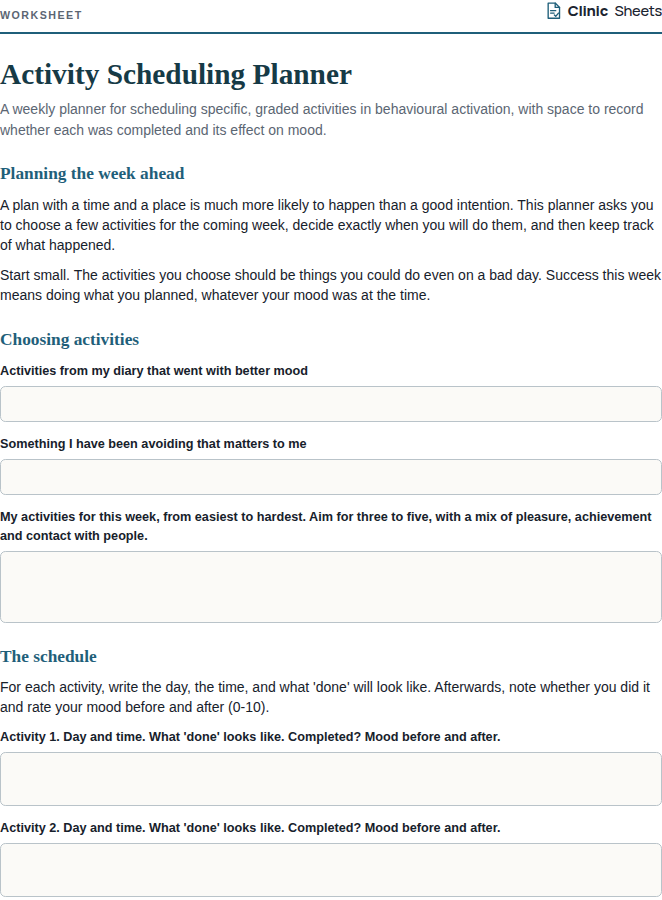
The completed diary is reviewed in session to identify activities associated with better mood, times of day that are particularly low, and patterns of avoidance. It becomes the basis for the Activity Scheduling Planner.
The professional version includes prompts for the review conversation, guidance on clients who record only negative ratings, and notes on the therapeutic value of the recording process itself, which for many clients already produces a small lift in activity.
How to use it
- Introduce after the rationale for behavioural activation has been explained. Complete the current day together in session as a model.
- Ask the client to record as close to the time as possible, even in a few words. Retrospective completion at the end of the week is much less accurate.
- Stress that there is no right answer and no expectation to do more this week. The task is only to record.
- At the next session, go through the diary looking for links between activity and mood. Ask the client what they notice before offering your own observations.
- Use the patterns identified to choose the first activities to schedule.
References
- Martell, C. R., Dimidjian, S., & Herman-Dunn, R. (2010). Behavioral Activation for Depression: A Clinician's Guide. Guilford Press.
- Lejuez, C. W., Hopko, D. R., Acierno, R., Daughters, S. B., & Pagoto, S. L. (2011). Ten year revision of the brief behavioral activation treatment for depression: Revised treatment manual. Behavior Modification, 35(2), 111-161.
- Veale, D. (2008). Behavioural activation for depression. Advances in Psychiatric Treatment, 14(1), 29-36.