Fun Activities Menu (Behavioural Activation for Kids)
A behavioural activation worksheet for children: build a menu of fun, active and connecting activities, plan a few for the week, and rate mood before and after. Reverses the doing-less, feeling-worse loop of childhood low mood.
About this resource
Behavioural activation rests on Lewinsohn's observation that depression is maintained by a loss of positive reinforcement: as a person withdraws from activity, they lose the rewarding experiences that lift mood, which deepens the withdrawal. The treatment is to schedule activity deliberately, guided by what is rewarding rather than by how the person feels beforehand. Activation is a core component of CBT for youth depression and has been adapted as a stand-alone treatment for adolescents by McCauley and colleagues. For younger children the same principle applies with more scaffolding from parents, simpler language, and a heavier emphasis on play, movement and time with people.
This worksheet helps the child build a menu of activities in three groups: things that are fun, things that get my body moving, and things I do with other people. It then asks the child to pick a small number for the coming week, decide when and with whom, and rate their mood before and after each one on a simple 0 to 10 scale. The before-and-after rating is the engine of the worksheet: it gives the child direct evidence that mood follows action, and it helps the clinician and parent see which activities are most worth repeating.
The professional version adds guidance on activity selection (mix easy wins with a few that used to matter to the child), on the problem of the child who says nothing is fun (start with movement and connection, which lift mood even without enjoyment), and on coaching parents to encourage and accompany rather than pressure. It also suggests reviewing the ratings each session to shape the following week's plan.
How to use it
- Introduce the stuck loop first (see Understanding Sadness for Kids). Frame the worksheet as the way to run the loop backwards: do a bit, feel a bit better, do a bit more.
- Brainstorm the menu together with the child and parent. Include things the child used to enjoy, things that involve moving, and things that involve other people. Aim for at least four in each group. Keep them small and doable within a normal week.
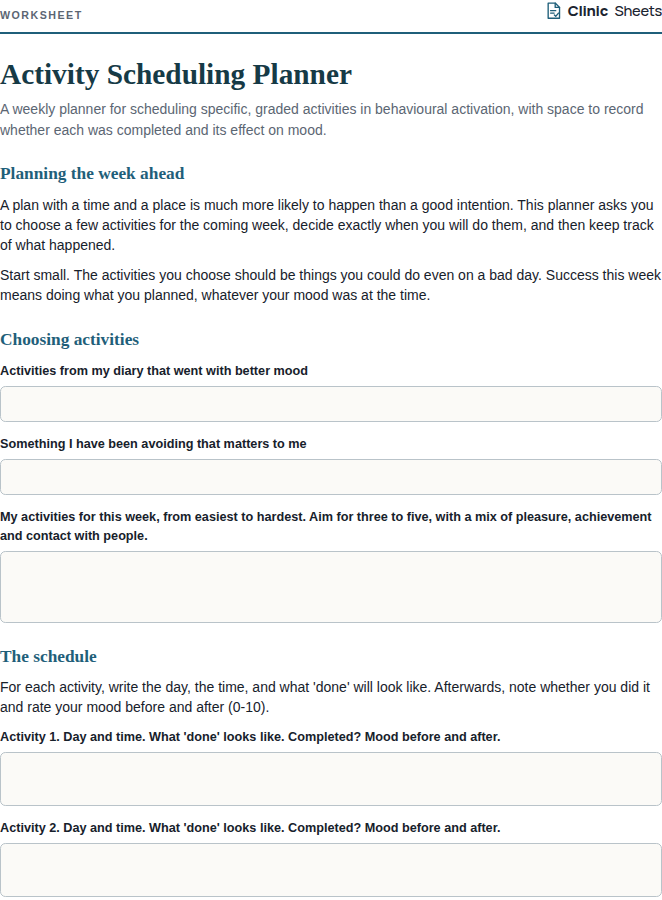
- Pick three to five activities for the week. Schedule each with a day, a time and a helper. Make the first ones easy. Enjoyment is not required; showing up is.
- Teach the mood rating: 0 is the lowest mood ever, 10 is the best. Ask the child to rate just before and just after each activity and write both numbers down.
- Review the ratings at the next session. Highlight any lift, however small. Ask what got in the way of activities that did not happen and problem-solve. Plan the next week with more of what worked.
- Coach the parent to prompt and accompany, to praise effort rather than mood, and to avoid asking 'did you enjoy it?' in a way that invites a no.
References
- Lewinsohn, P. M. (1974). A behavioral approach to depression. In R. J. Friedman & M. M. Katz (Eds.), The Psychology of Depression: Contemporary Theory and Research (pp. 157-178). Wiley.
- McCauley, E., Schloredt, K. A., Gudmundsen, G. R., Martell, C. R., & Dimidjian, S. (2016). Behavioral Activation with Adolescents: A Clinician's Guide. Guilford Press.
- Weersing, V. R., Jeffreys, M., Do, M. T., Schwartz, K. T., & Bolano, C. (2017). Evidence base update of psychosocial treatments for child and adolescent depression. Journal of Clinical Child and Adolescent Psychology, 46(1), 11-43.