Lifting Low Mood: A Behavioural Activation Guide
A complete client guide to behavioural activation for depression: how withdrawal and avoidance keep low mood going, activity monitoring, identifying values and valued activities, scheduling and grading activities, working with rumination, and building a routine that maintains recovery.
About this resource
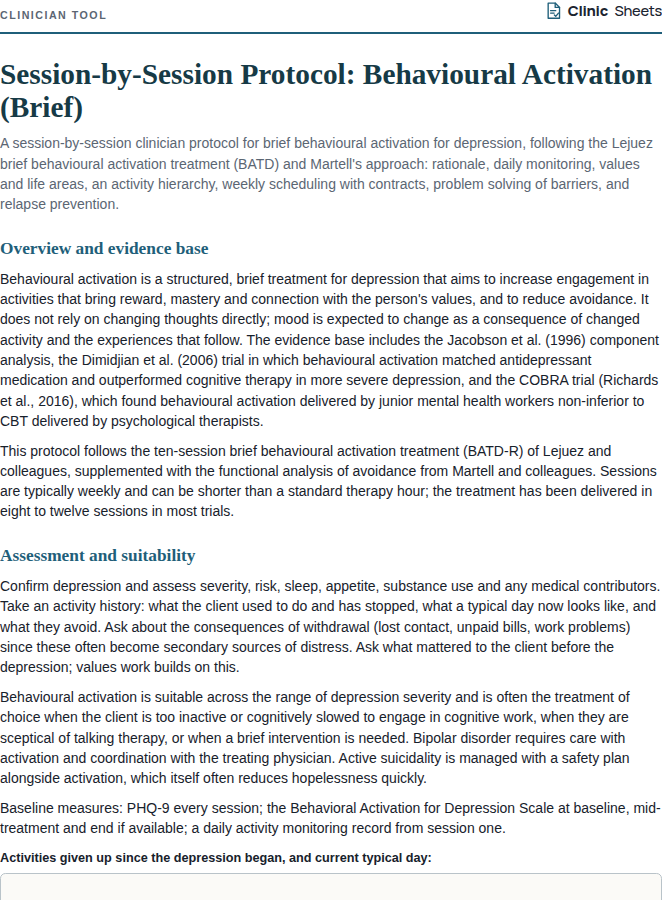
Behavioural activation (BA) treats depression by changing what the person does rather than starting with what they think. Its rationale comes from the observation that depression narrows life: as mood drops, people withdraw from activities that once provided reward and meaning, and the withdrawal removes the very experiences that could lift mood. Jacobson and colleagues' component analysis found the behavioural element of cognitive therapy to be as effective as the full package, and subsequent trials, including Dimidjian and colleagues' comparison with cognitive therapy and antidepressant medication, established BA as a first-line treatment in its own right.
Martell, Dimidjian and Herman-Dunn's contextual model, which this guide follows, treats avoidance as the central maintaining process. Withdrawal, procrastination, rumination and staying in bed all function as escape from difficult feelings, and each provides brief relief at the cost of deepening the depression. Treatment works from the outside in: the person acts according to a plan and their values rather than according to how they feel, activity is monitored and scheduled, tasks are graded so they can be done, and rumination is treated as a behaviour to be interrupted rather than a problem to be solved.
The professional version adds guidance on functional analysis of avoidance (the TRAP and TRAC sequence), on the common early problem of clients who schedule activities and do not do them, and on distinguishing activities that are pleasant from activities that are meaningful, both of which are needed.
How to use it
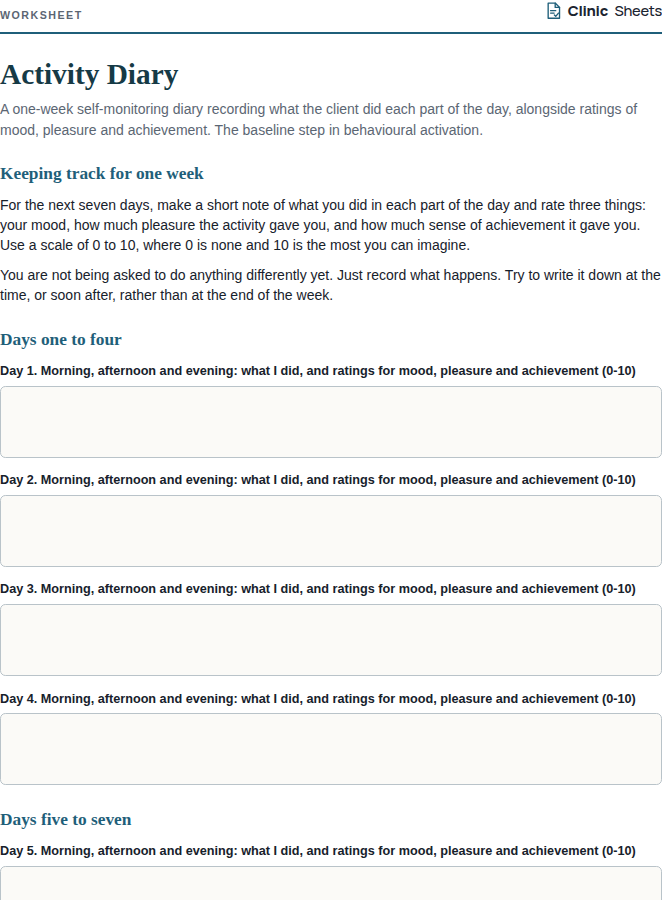
- Present the rationale in the first session using the client's own recent example of withdrawal and its effect on mood. Assign the first two sections and a week of activity monitoring.
- Review the monitoring record in detail. Look for links between activity and mood, and for patterns of avoidance. Let the client draw the conclusions.
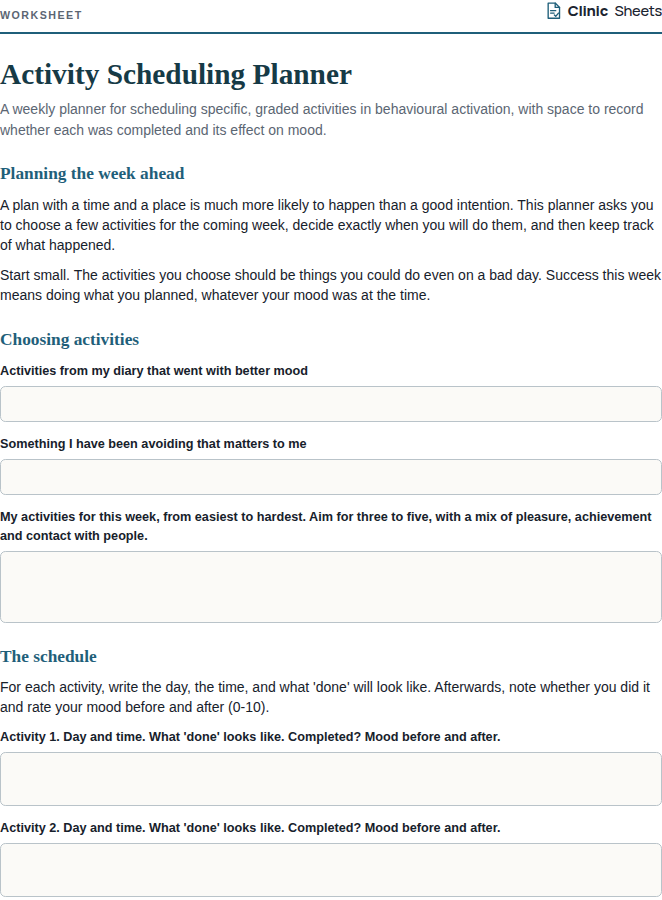
- Build the values and activities list together, then schedule a small number of specific activities for the coming week. Fewer, done, beats more, not done.
- Grade any activity the client fails to complete. The failure is information about the step size, not about the client.
- Introduce the rumination section once activity is underway, typically week three or four. Teach the client to notice rumination and shift to engagement with the task or surroundings.
- Build the maintenance plan in the final sessions around the routine that has emerged, with a clear early-warning list.
References
- Martell, C. R., Dimidjian, S., & Herman-Dunn, R. (2010). Behavioral Activation for Depression: A Clinician's Guide. Guilford Press.
- Jacobson, N. S., Dobson, K. S., Truax, P. A., Addis, M. E., Koerner, K., Gollan, J. K., Gortner, E., & Prince, S. E. (1996). A component analysis of cognitive-behavioral treatment for depression. Journal of Consulting and Clinical Psychology, 64(2), 295-304.
- Dimidjian, S., Hollon, S. D., Dobson, K. S., Schmaling, K. B., Kohlenberg, R. J., Addis, M. E., Gallop, R., McGlinchey, J. B., Markley, D. K., Gollan, J. K., Atkins, D. C., Dunner, D. L., & Jacobson, N. S. (2006). Randomized trial of behavioral activation, cognitive therapy, and antidepressant medication in the acute treatment of adults with major depression. Journal of Consulting and Clinical Psychology, 74(4), 658-670.
- Lejuez, C. W., Hopko, D. R., & Hopko, S. D. (2001). A brief behavioral activation treatment for depression: Treatment manual. Behavior Modification, 25(2), 255-286.