Social Media and Mood (for Teens)
A worksheet that helps teenagers track how different kinds of social media use affect their mood and self-view, and then plan changes that free up time for activities that lift mood, using activity scheduling.
About this resource
The research on adolescent social media use and mental health is more mixed than public discussion suggests. Overall associations with wellbeing are small, and the effects depend heavily on how a young person uses these platforms: passive scrolling, upward social comparison and late-night use are more consistently linked with lower mood and self-esteem than active, connected use. A blanket instruction to use social media less is rarely effective and often damages engagement. What helps is curiosity about the young person's own pattern.
This worksheet takes a behavioural activation stance. It asks the young person to notice, over a few days, which specific uses leave them feeling better or worse, what they are avoiding or replacing when they scroll, and which offline activities used to give them a sense of pleasure or achievement. It then plans small, specific swaps and schedules replacement activities, rather than aiming at abstinence. The framing is non-judgemental throughout.
The professional version adds guidance on the evidence base, on avoiding a lecturing stance that will close the conversation down, and on when social media use is a symptom of depression rather than a cause.
How to use it
- Introduce the topic with curiosity, not concern. Ask what the young person enjoys about their platforms before asking what bothers them.
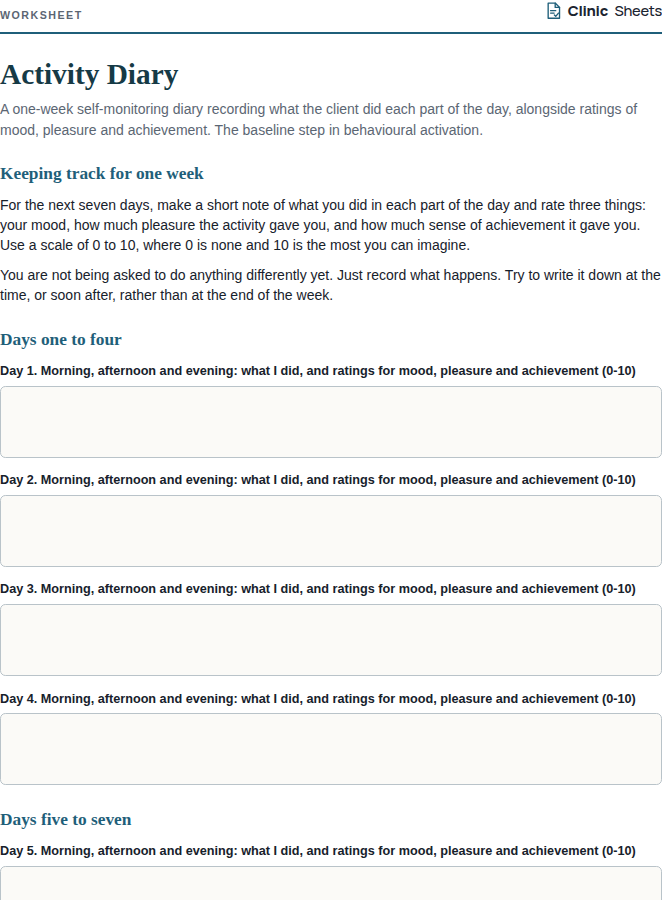
- Set up the tracking section as a short experiment for the week: three or four check-ins a day, noting what they were doing online and how they felt afterwards.
- Review the tracking together and look for patterns by type of use and time of day rather than total minutes.
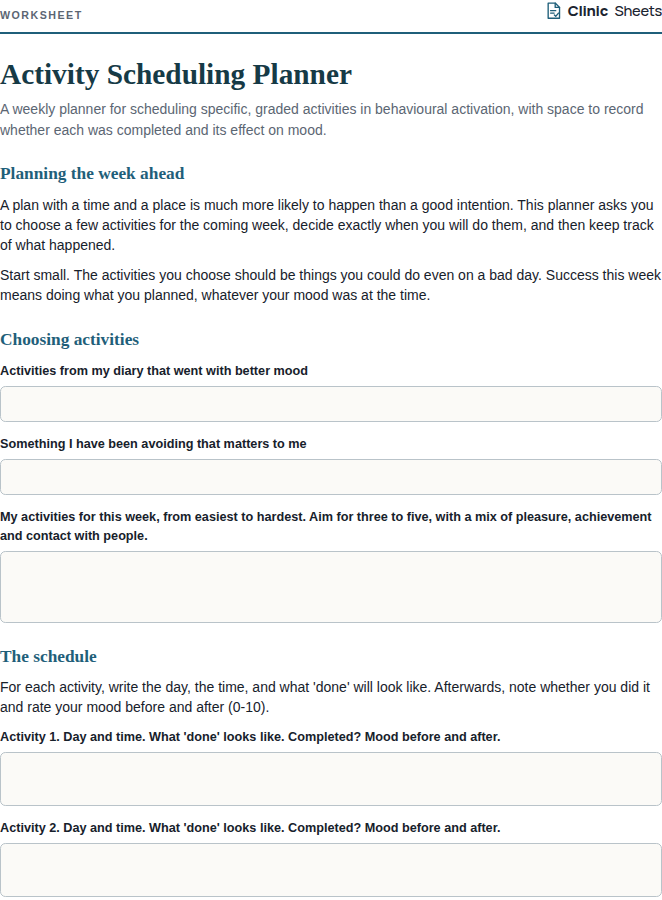
- Use the activity section to identify two or three offline activities linked to mood, achievement or connection, and schedule them into specific slots.
- Agree one or two swaps for the coming week. Review, adjust and repeat; the goal is a pattern the young person chooses and can sustain.
References
- Orben, A., & Przybylski, A. K. (2019). The association between adolescent well-being and digital technology use. Nature Human Behaviour, 3(2), 173-182.
- Odgers, C. L., & Jensen, M. R. (2020). Annual Research Review: Adolescent mental health in the digital age: Facts, fears, and future directions. Journal of Child Psychology and Psychiatry, 61(3), 336-348.
- Martell, C. R., Dimidjian, S., & Herman-Dunn, R. (2010). Behavioral Activation for Depression: A Clinician's Guide. Guilford Press.