Session-by-Session Protocol: Behavioural Activation (Brief)
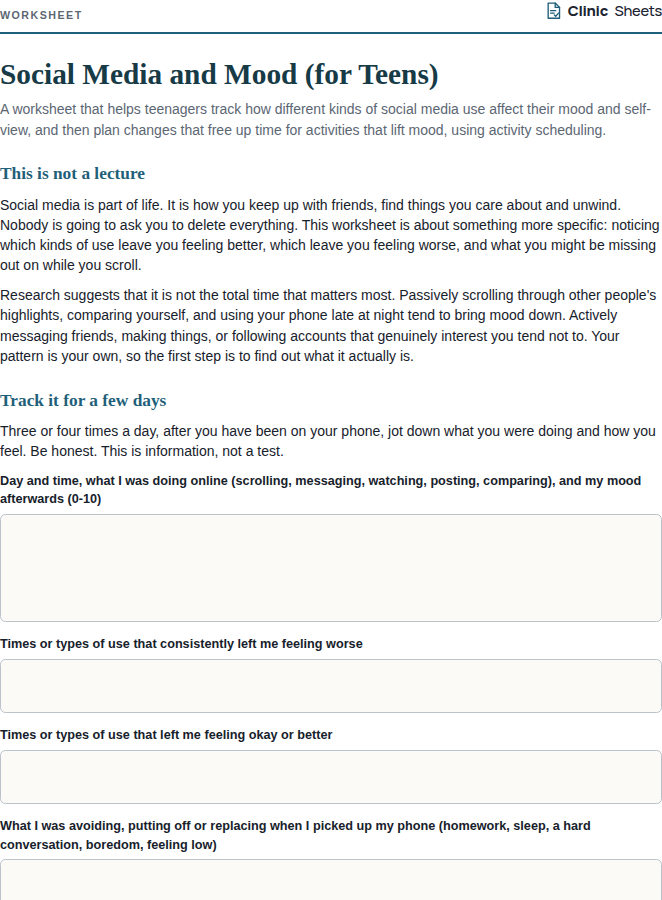
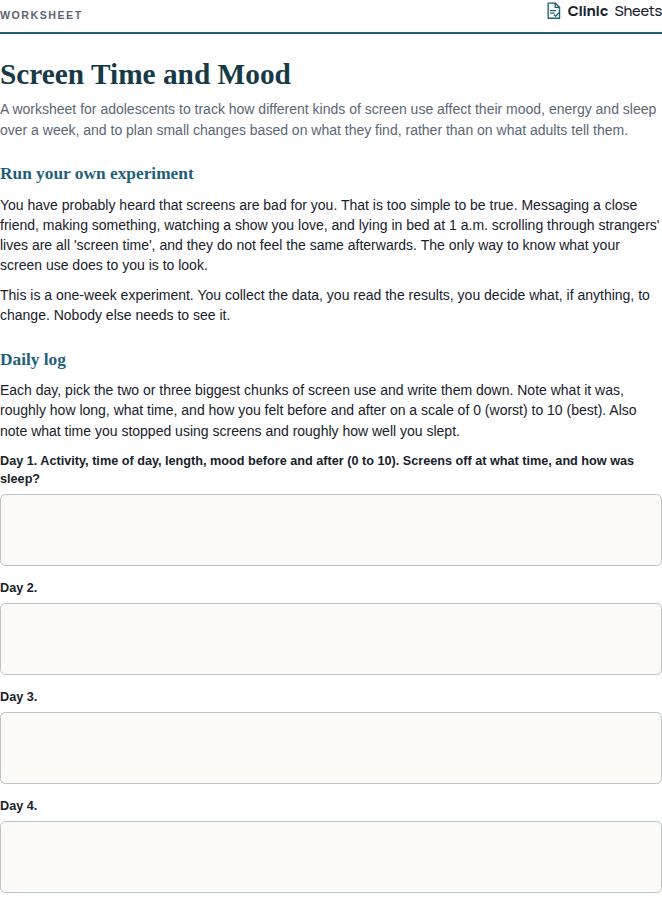
A session-by-session clinician protocol for brief behavioural activation for depression, following the Lejuez brief behavioural activation treatment (BATD) and Martell's approach: rationale, daily monitoring, values and life areas, an activity hierarchy, weekly scheduling with contracts, problem solving of barriers, and relapse prevention.
About this resource
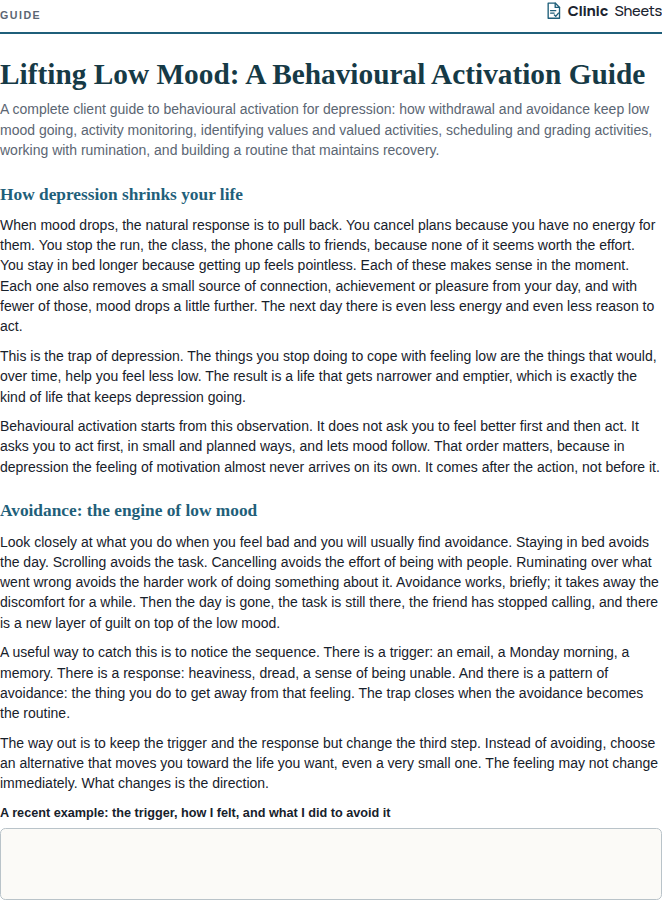
Behavioural activation treats depression by changing what the person does. In the behavioural model, low mood leads to withdrawal from activity, withdrawal removes the sources of reward and mastery in the person's life, and the loss of reward deepens the depression, while avoidance of anything effortful or unpleasant provides short-term relief and long-term worsening. Jacobson and colleagues' component analysis showed that the behavioural component of cognitive therapy performed as well as the full package, and later trials, including Dimidjian et al. (2006) and the large COBRA trial, found behavioural activation comparable to cognitive therapy and to antidepressant medication and deliverable by less specialised practitioners.
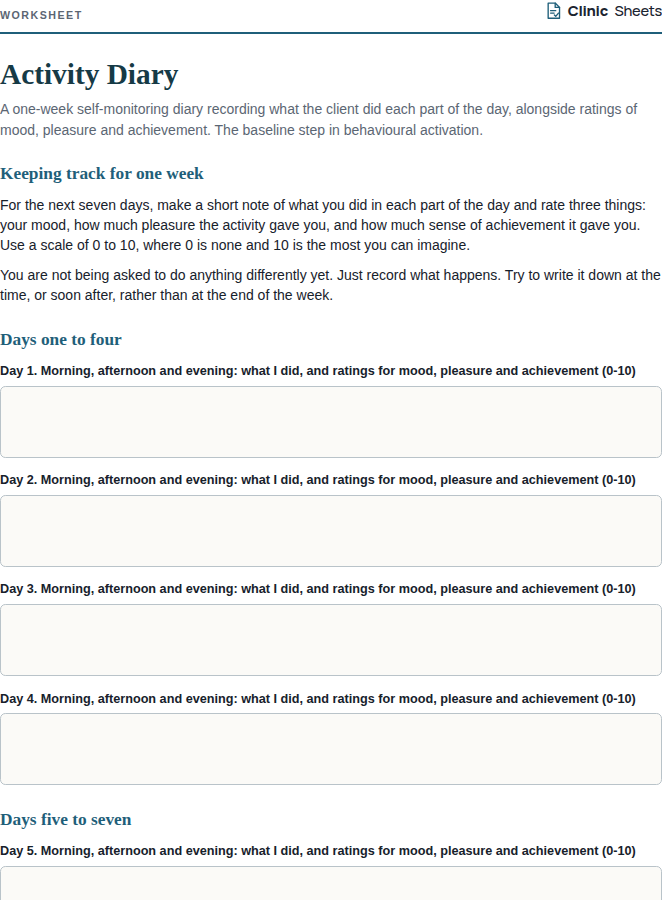
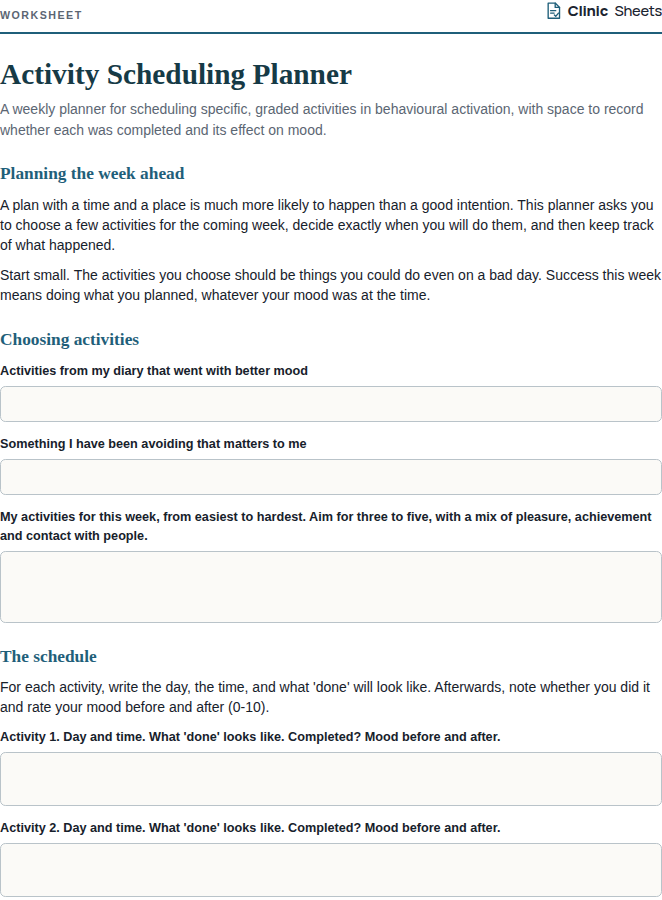
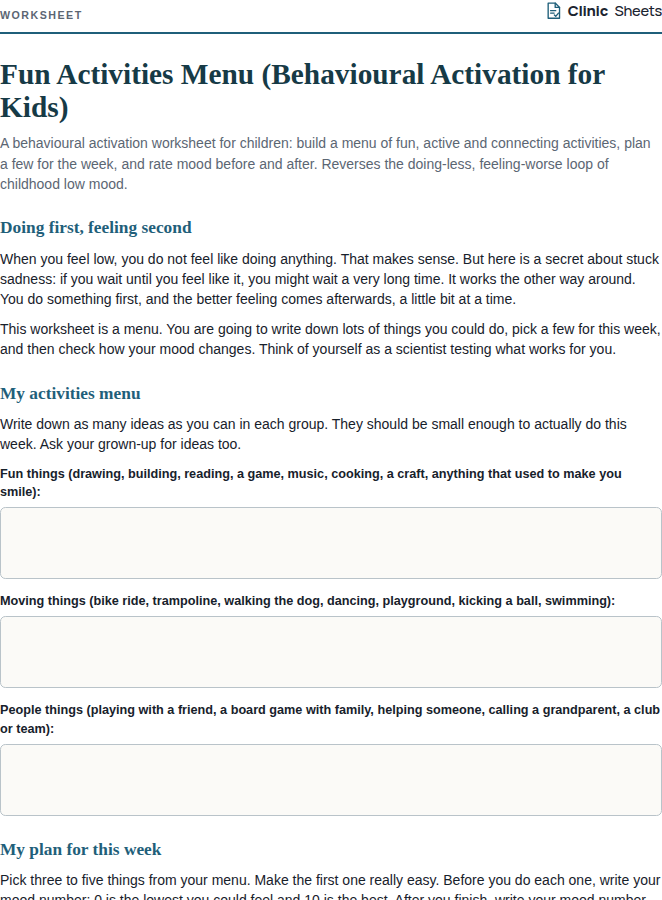
This protocol follows the brief behavioural activation treatment for depression (BATD) developed by Lejuez and colleagues, in its revised ten-session form, with elements from Martell, Dimidjian and Herman-Dunn's clinician guide for functional analysis of avoidance. The sequence is: rationale and daily activity monitoring; an inventory of life areas and values with activities drawn from them; an activity hierarchy ranked by difficulty; weekly scheduling with specific plans and, where useful, written contracts with supportive others; and an ending focused on making activation a habit.
The professional version explains how to present the rationale to a client who feels too tired to do anything, how to keep the focus on activity rather than on discussion of mood, how to use the monitoring record to spot avoidance, and what to do when scheduled activities are not completed. It also notes the measures to use and the common adaptations for older adults, comorbid anxiety and clients with very restricted lives.
How to use it
- Confirm depression as the primary problem, assess risk, and administer the PHQ-9 at baseline and every session. The Behavioral Activation for Depression Scale can be added to track activation directly.
- Present the rationale in the first session and begin daily monitoring immediately. Monitoring is the foundation for everything that follows; do not skip it.
- Build the life areas, values and activities inventory in session two, then rank activities into a hierarchy of fifteen or so items from easiest to hardest in session three.
- Schedule activities from the hierarchy each week, starting with the easiest, and review completion at the start of every session. Treat non-completion as information about barriers and avoidance, not as failure.
- Use the final sessions to review the whole hierarchy, plan for setbacks and hand over the scheduling process to the client.
References
- Lejuez, C. W., Hopko, D. R., Acierno, R., Daughters, S. B., & Pagoto, S. L. (2011). Ten year revision of the brief behavioral activation treatment for depression: Revised treatment manual. Behavior Modification, 35(2), 111-161.
- Martell, C. R., Dimidjian, S., & Herman-Dunn, R. (2010). Behavioral Activation for Depression: A Clinician's Guide. Guilford Press.
- Jacobson, N. S., Dobson, K. S., Truax, P. A., Addis, M. E., Koerner, K., Gollan, J. K., Gortner, E., & Prince, S. E. (1996). A component analysis of cognitive-behavioral treatment for depression. Journal of Consulting and Clinical Psychology, 64(2), 295-304.
- Richards, D. A., Ekers, D., McMillan, D., Taylor, R. S., Byford, S., Warren, F. C., Barrett, B., Farrand, P. A., Gilbody, S., Kuyken, W., O'Mahen, H., Watkins, E. R., Wright, K. A., Hollon, S. D., Reed, N., Rhodes, S., Fletcher, E., & Finning, K. (2016). Cost and outcome of behavioural activation versus cognitive behavioural therapy for depression (COBRA): A randomised, controlled, non-inferiority trial. The Lancet, 388(10047), 871-880.