The Anxiety Equation
A handout presenting anxiety as the product of overestimated threat and underestimated coping: anxiety rises when we inflate how likely and how bad a feared outcome is and shrink our ability to handle it.
About this resource
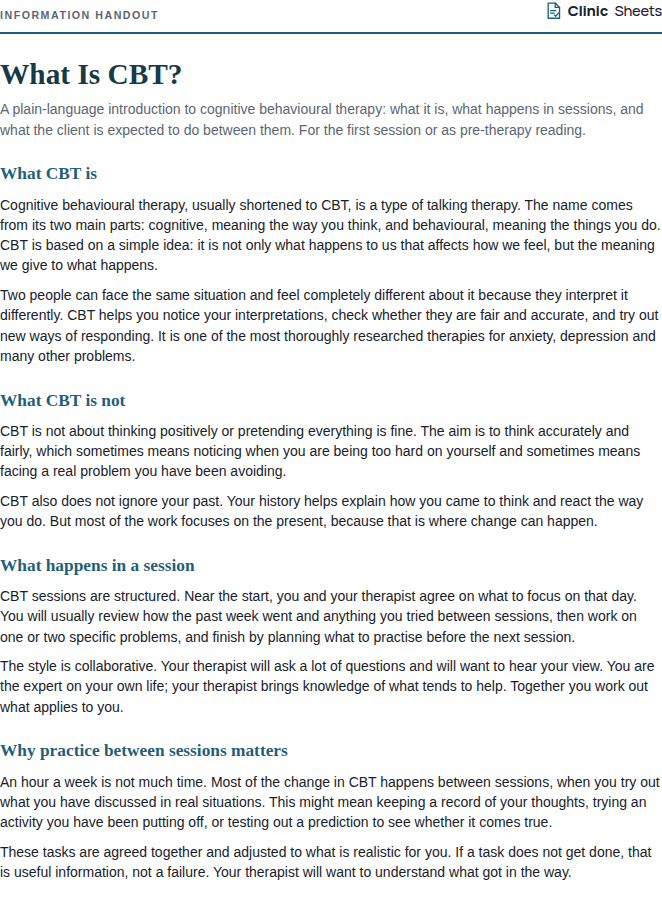
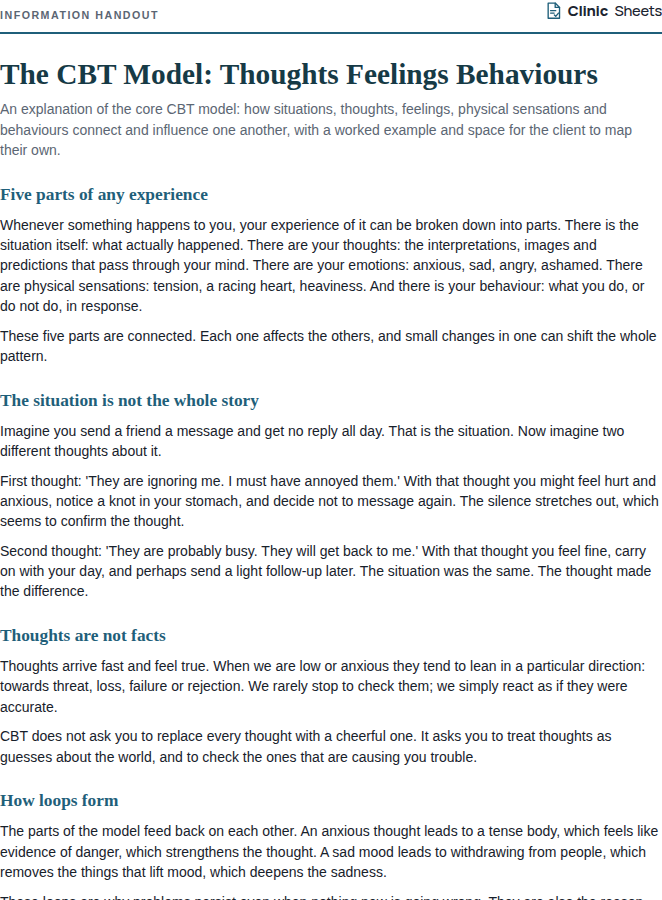
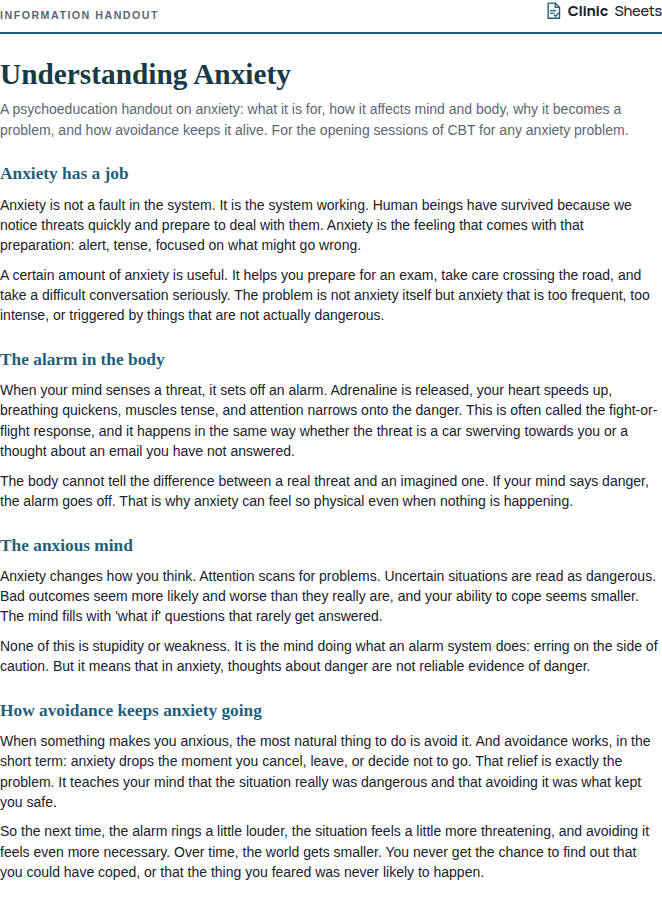
A useful way to explain anxiety to clients is as an equation. The level of anxiety a person feels in a situation depends on how likely they think a bad outcome is, how awful they think it would be, and, on the other side, how well they think they could cope and what help they think would be available. Anxiety disorders involve a systematic bias on both sides: the perceived threat is inflated and perceived coping and rescue are deflated. This framing goes back to Beck's early cognitive model and has been elaborated by Salkovskis and others.
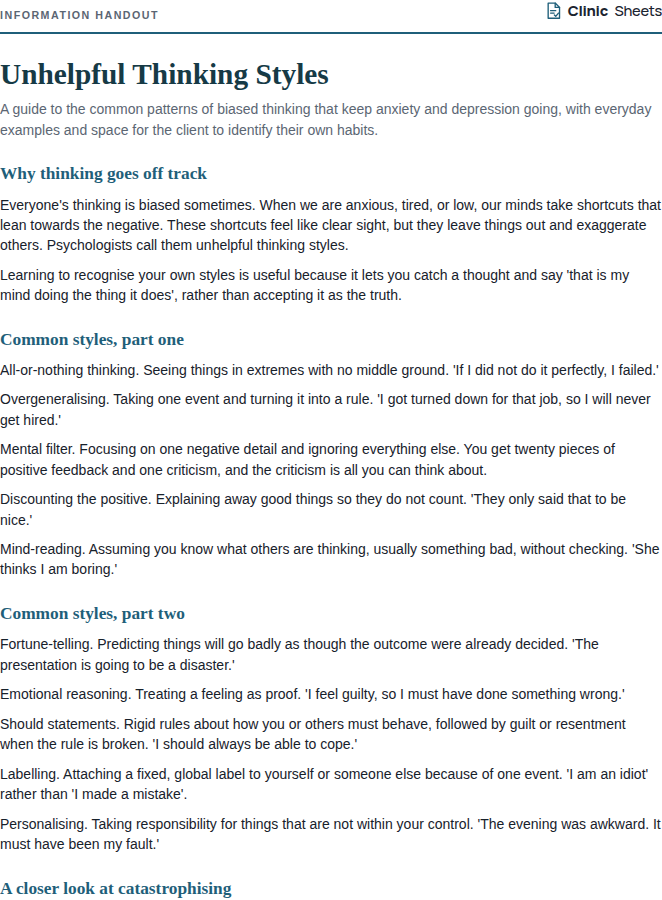
The equation is valuable because it gives the client four separate places to work, and because it explains why two people can face the same event with very different levels of fear. It also makes catastrophising concrete: catastrophising is the process of turning up the probability and awfulness dials while turning down the coping and rescue dials.
This handout presents the equation in plain terms, walks through each of the four components with everyday examples, and then asks the client to apply it to one of their own feared situations. The re-estimation section is a light form of cognitive restructuring and prepares the client for fuller thought-record work.
The professional version adds guidance on eliciting each component with Socratic questions, on the common finding that awfulness rather than probability is the driver, and on using the equation to select between cognitive and behavioural interventions.
How to use it
- Introduce once the client has a clear feared situation to work with. The equation is easier to grasp with an example than in the abstract.
- Explain the four components one at a time using the handout's examples, then ask the client to rate each for their own situation.
- Ask which component is doing the most work. This often points to the most useful intervention: probability work, decatastrophising, coping skills or building support.
- Complete the re-estimation fields together and note any change in the anxiety rating.
- Use the equation as shorthand in later sessions when the client describes a new worry.
References
- Beck, A. T., Emery, G., & Greenberg, R. L. (1985). Anxiety Disorders and Phobias: A Cognitive Perspective. Basic Books.
- Salkovskis, P. M. (1996). The cognitive approach to anxiety: Threat beliefs, safety-seeking behavior, and the special case of health anxiety and obsessions. In P. M. Salkovskis (Ed.), Frontiers of Cognitive Therapy (pp. 48-74). Guilford Press.
- Clark, D. A., & Beck, A. T. (2010). Cognitive Therapy of Anxiety Disorders: Science and Practice. Guilford Press.