Understanding Anxiety
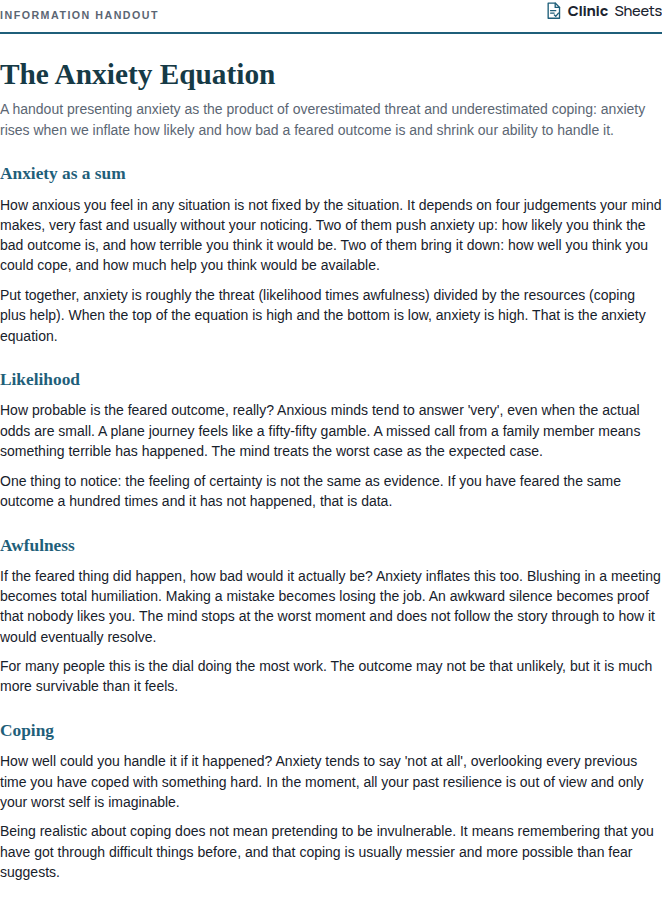
A psychoeducation handout on anxiety: what it is for, how it affects mind and body, why it becomes a problem, and how avoidance keeps it alive. For the opening sessions of CBT for any anxiety problem.
About this resource
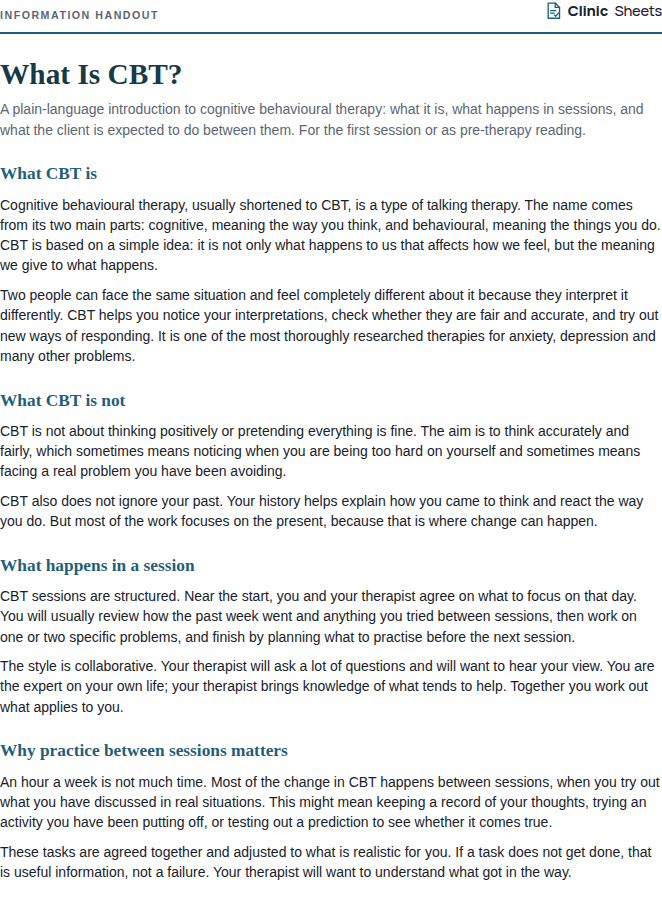
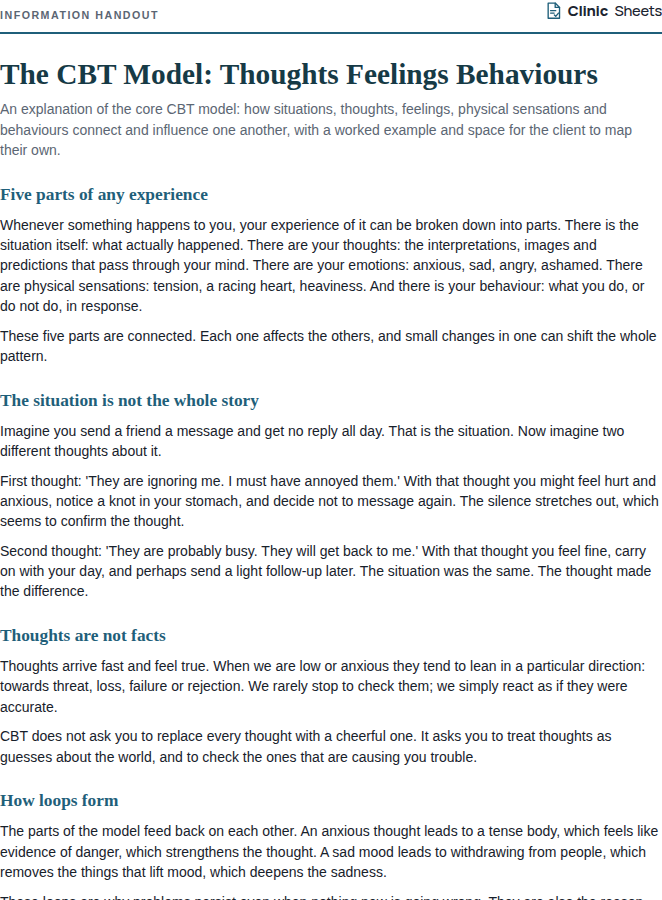
Anxiety is an adaptive response that has become miscalibrated. This handout starts from that premise, because clients who understand anxiety as a normal system firing at the wrong times find it easier to approach rather than fight. It covers the function of anxiety, its typical expression in thoughts, body and behaviour, the difference between helpful and unhelpful anxiety, and the central maintaining mechanism across anxiety disorders: avoidance.
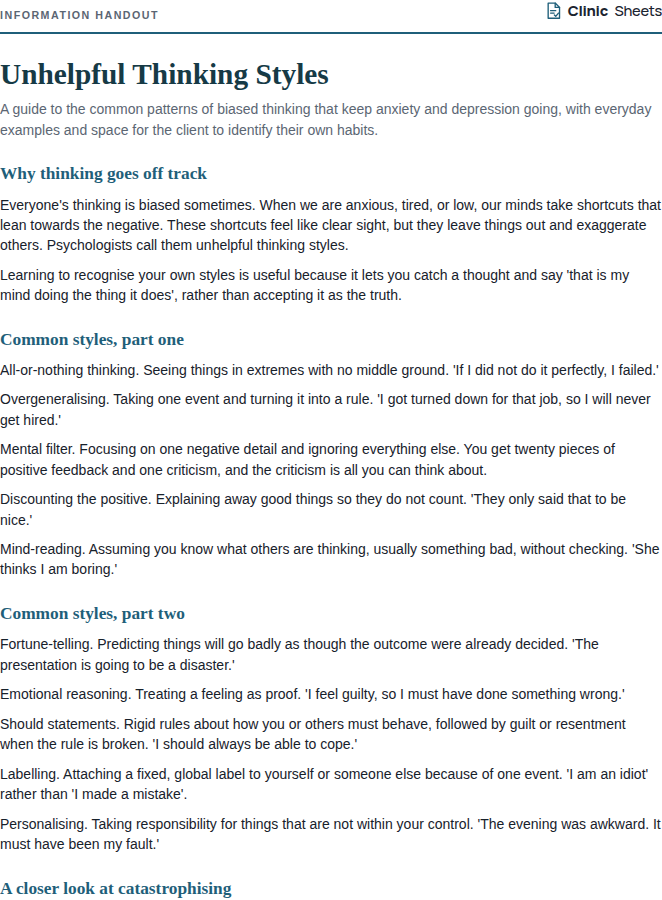
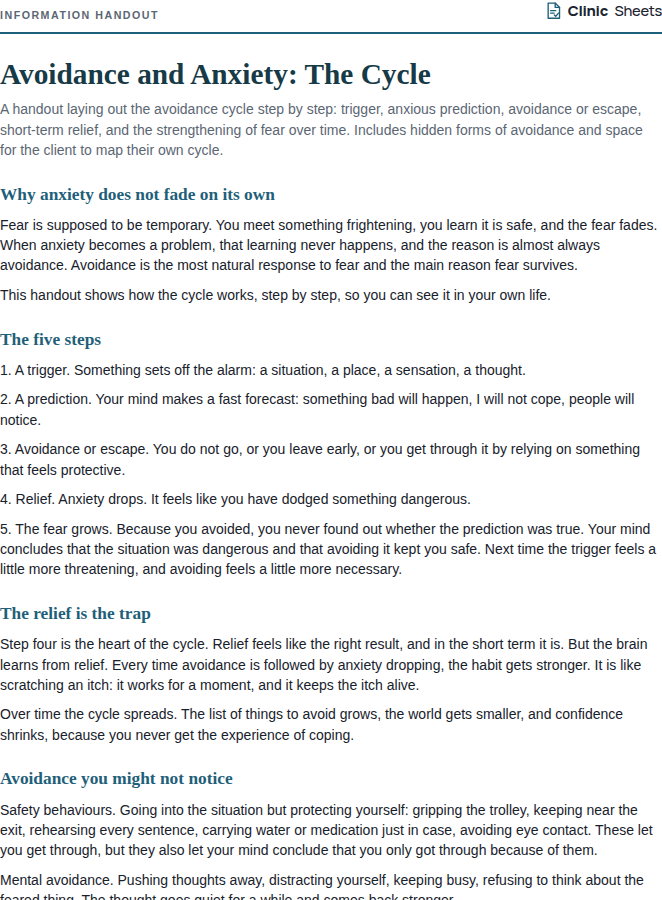
The treatment of avoidance is deliberately broad. It includes obvious avoidance (not going, not doing), subtle avoidance (going but with safety behaviours), and cognitive avoidance (distraction, reassurance seeking). The handout explains why each provides short-term relief while preventing the learning that would reduce anxiety in the long run. This sets up the rationale for exposure and behavioural experiments without yet naming them.
The handout is written to be transdiagnostic. It suits clients with generalised anxiety, social anxiety, specific phobias, health anxiety and panic, and can be followed by the problem-specific handouts in the library.
The professional version includes a short guide to eliciting the client's own avoidance profile, notes on normalising without minimising, and suggestions for linking the handout to a first exposure hierarchy.
How to use it
- Use in the first or second session once the client's main anxiety problem is clear.
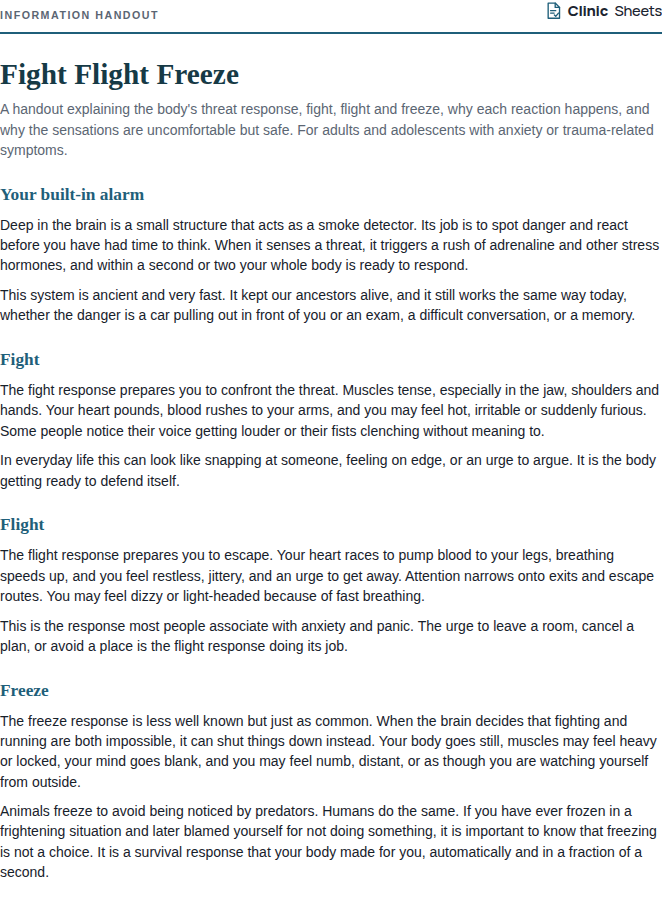
- Read the section on the alarm system and ask the client to connect it to their own physical symptoms.
- Spend most time on the avoidance section. Ask the client to list what they avoid, including subtle ways, using the reflection fields.
- Introduce the idea that treatment will involve gradually facing feared situations, and check the client's reaction to that idea.
- Follow with Fight Flight Freeze for a deeper look at the body's response, or Avoidance and Anxiety: The Cycle to develop the maintaining model.
References
- Clark, D. A., & Beck, A. T. (2010). Cognitive Therapy of Anxiety Disorders: Science and Practice. Guilford Press.
- Barlow, D. H. (2002). Anxiety and Its Disorders: The Nature and Treatment of Anxiety and Panic (2nd ed.). Guilford Press.
- Salkovskis, P. M. (1991). The importance of behaviour in the maintenance of anxiety and panic: A cognitive account. Behavioural Psychotherapy, 19(1), 6-19.