Avoidance and Anxiety: The Cycle
A handout laying out the avoidance cycle step by step: trigger, anxious prediction, avoidance or escape, short-term relief, and the strengthening of fear over time. Includes hidden forms of avoidance and space for the client to map their own cycle.
About this resource
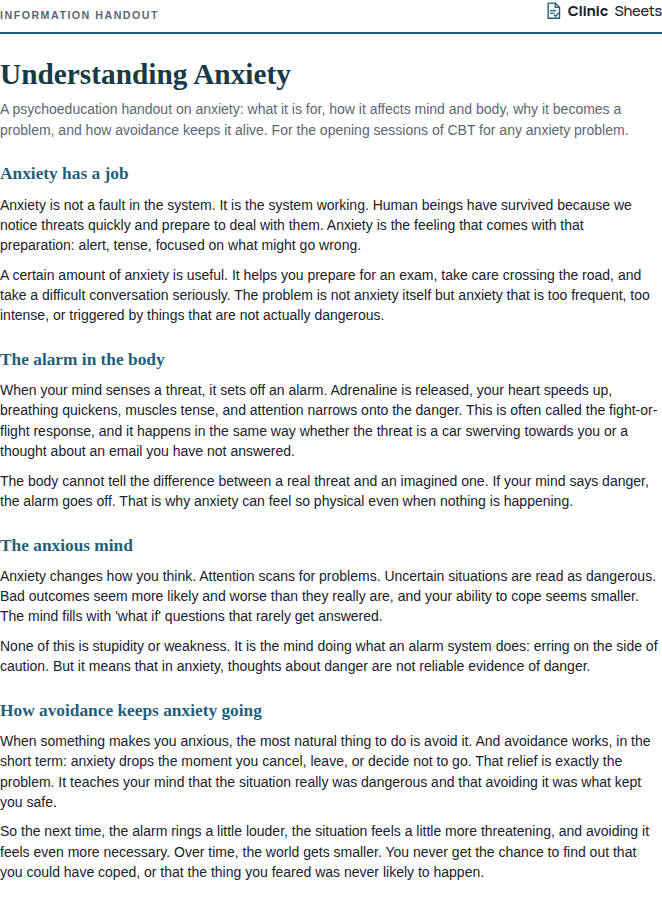
Avoidance is the common pathway by which anxiety problems persist. Whatever the specific fear, the pattern is the same: a trigger produces a threat prediction, the person avoids or escapes, anxiety falls, and the fall is experienced as relief. That relief negatively reinforces the avoidance and, critically, prevents any disconfirmation of the prediction. The person never learns that the feared outcome would not have happened or that they could have tolerated it. Over time the trigger becomes more frightening, not less, and avoidance generalises.
This handout presents the cycle as a sequence of five steps so that the client can see each link and where it might be broken. It then covers the three forms of avoidance that clients most often fail to recognise: subtle in-situation safety behaviours, cognitive avoidance such as distraction and suppression, and reassurance seeking. Each is explained in terms of the same cycle.
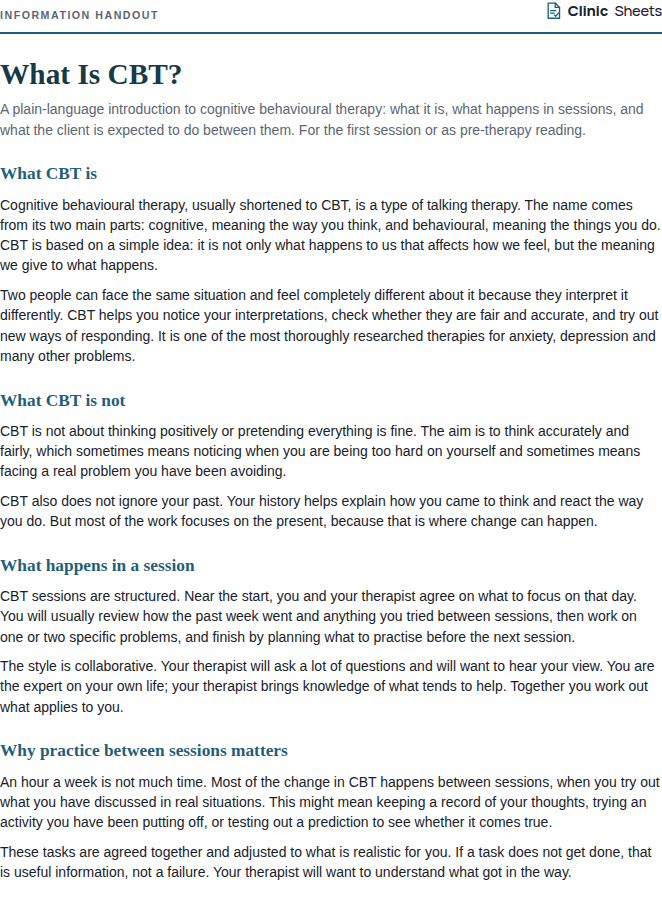
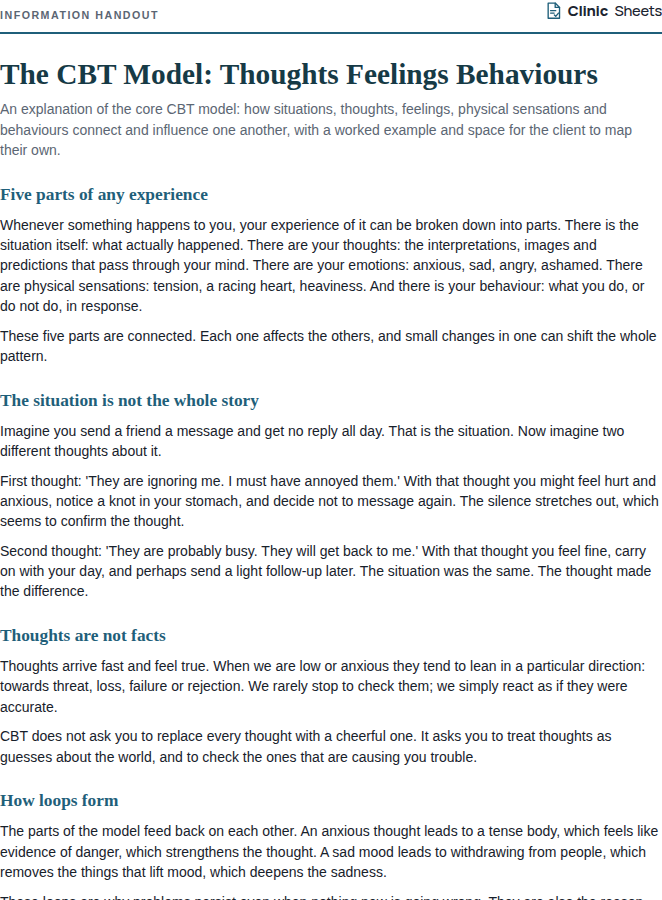
The handout is the bridge between general psychoeducation and exposure-based work. Once the client can see the cycle in their own life, the rationale for approaching feared situations, and for dropping safety behaviours while doing so, is self-evident rather than imposed.
The professional version includes prompts for a functional analysis of the client's avoidance, guidance on distinguishing avoidance from sensible precaution, and notes on presenting exposure as breaking the cycle rather than as enduring distress.
How to use it
- Use after Understanding Anxiety, once the client accepts that anxiety is not itself dangerous.
- Walk through the five steps with a recent example from the client's own life. Write each step in their words.
- Go through the hidden avoidance section carefully and ask the client to identify their own safety behaviours, distraction habits and reassurance patterns.
- Ask where in the cycle they think change is possible. Most clients identify the avoidance step, which leads naturally to planning exposure or behavioural experiments.
- Keep the completed mapping section and refer back to it when constructing an exposure hierarchy.
References
- Salkovskis, P. M. (1991). The importance of behaviour in the maintenance of anxiety and panic: A cognitive account. Behavioural Psychotherapy, 19(1), 6-19.
- Mowrer, O. H. (1960). Learning Theory and Behavior. Wiley.
- Craske, M. G., Treanor, M., Conway, C. C., Zbozinek, T., & Vervliet, B. (2014). Maximizing exposure therapy: An inhibitory learning approach. Behaviour Research and Therapy, 58, 10-23.
- Abramowitz, J. S., Deacon, B. J., & Whiteside, S. P. H. (2019). Exposure Therapy for Anxiety: Principles and Practice (2nd ed.). Guilford Press.