Bedtime Routine Builder (Kids)
A worksheet for children and parents to build a consistent, calming bedtime routine: a fixed bedtime and wake time, a short sequence of wind-down steps, a bed-is-for-sleep rule, and a plan for what happens if the child gets up.
About this resource
Behavioural approaches to childhood sleep problems are well supported. For school-aged children, the core elements are a consistent sleep schedule, a predictable pre-sleep routine, removal of stimulating activity and screens before bed, and a bed that is associated with sleep rather than with play, worry or long negotiations. These are the child-appropriate forms of stimulus control and sleep scheduling from adult CBT-I: a regular wake time anchors the body clock, and a bed used only for sleeping becomes a cue for sleep. Mindell and Owens's clinical guide and Meltzer and Crabtree's behavioural treatment manual set out these principles, and a review by Mindell and colleagues found behavioural interventions for bedtime problems effective across the large majority of studies.
This worksheet turns those principles into a plan the child helps design, which greatly improves cooperation. The child and parent agree a bedtime and wake time that stay the same all week, choose four to six calming steps in a fixed order (for example: bath, pyjamas, teeth, one story, lights out), decide where devices sleep, and agree what a parent will do if the child calls out or comes out of bed. There is a short section for a 'worry parking' step for children whose mind gets busy at lights-out, and a log to track how it is going. It is not designed for infants or for children under about five, where different approaches apply.
The professional version adds guidance on choosing a realistic bedtime (a bedtime earlier than the child can fall asleep produces long wake periods in bed and resistance), on gradually moving bedtime earlier once sleep onset is quick, on a consistent, boring, low-attention response to getting out of bed, and on when to consider medical review, for example where snoring, restless legs or daytime sleepiness suggest something other than a behavioural problem.
How to use it
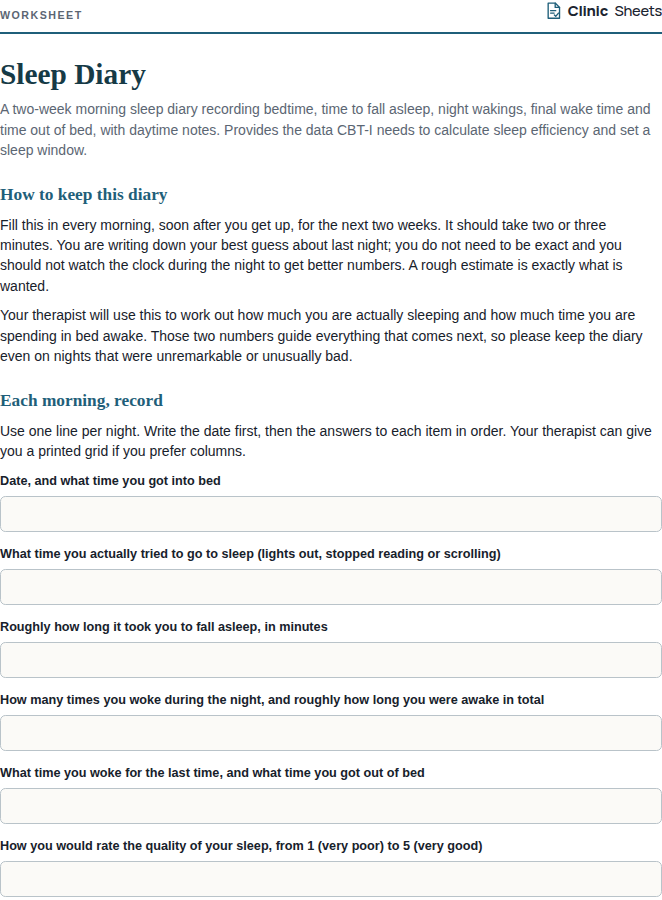
- Take a brief sleep history first: current bedtime, time to fall asleep, night wakings, wake time, naps, screens and caffeine, and what currently happens at lights-out. Consider a one-week sleep diary before building the plan.
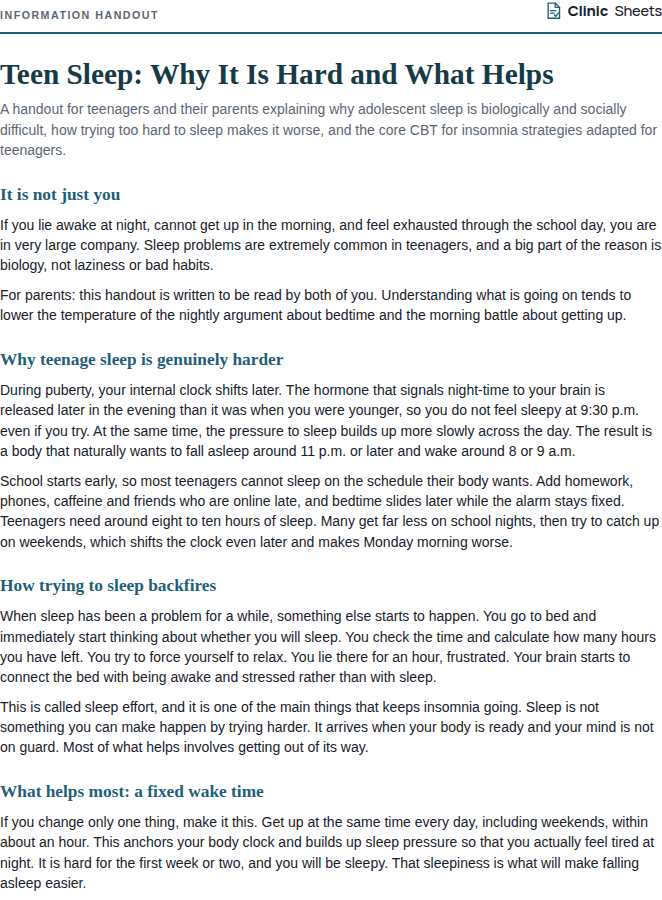
- Set the wake time first and keep it the same seven days a week. Choose a bedtime close to when the child currently falls asleep, so they fall asleep quickly, then move it earlier by fifteen minutes every few nights once sleep onset is reliably short.
- Build the routine with the child. Four to six steps, the same order every night, taking twenty to thirty minutes, ending in the bedroom with a low-key final step. Screens off for at least an hour before and out of the bedroom.
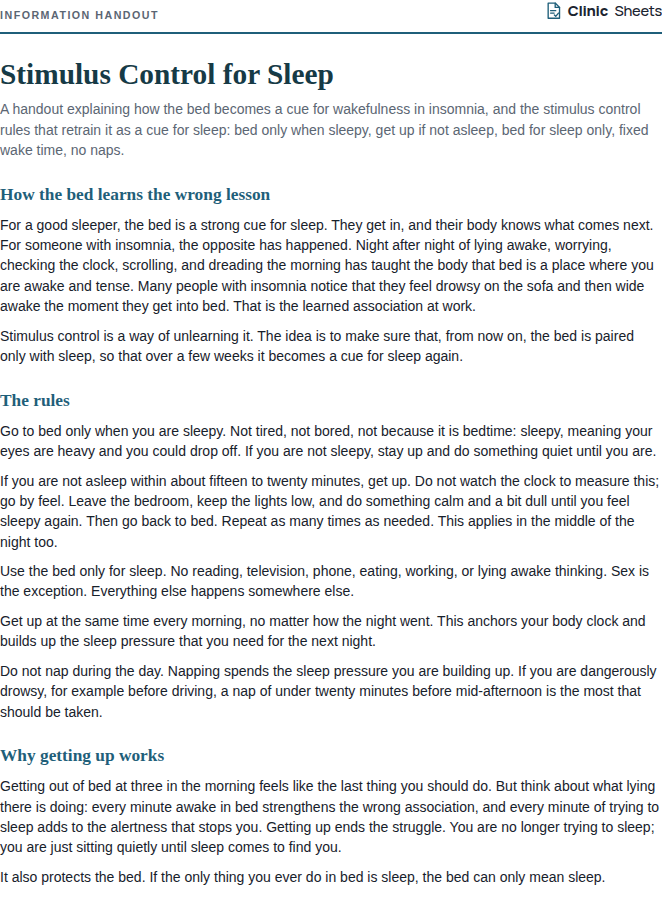
- Agree the get-up plan with the parent: a calm, brief, repeated return to bed with minimal talk and attention. Consistency matters more than the exact wording.
- For a child with busy thoughts at bedtime, add a short worry-parking step earlier in the routine, not in bed. Link this to Worry Time for Kids if the family is using it.
- Review the log weekly. Expect some protest in the first few nights, and coach parents to hold steady. Consider medical review if there is loud snoring, pauses in breathing, restless legs or marked daytime sleepiness.
References
- Mindell, J. A., & Owens, J. A. (2015). A Clinical Guide to Pediatric Sleep: Diagnosis and Management of Sleep Problems (3rd ed.). Lippincott Williams and Wilkins.
- Meltzer, L. J., & Crabtree, V. M. (2015). Pediatric Sleep Problems: A Clinician's Guide to Behavioral Interventions. American Psychological Association.
- Mindell, J. A., Kuhn, B., Lewin, D. S., Meltzer, L. J., & Sadeh, A. (2006). Behavioral treatment of bedtime problems and night wakings in infants and young children. Sleep, 29(10), 1263-1276.