Sleep Diary
A two-week morning sleep diary recording bedtime, time to fall asleep, night wakings, final wake time and time out of bed, with daytime notes. Provides the data CBT-I needs to calculate sleep efficiency and set a sleep window.
About this resource
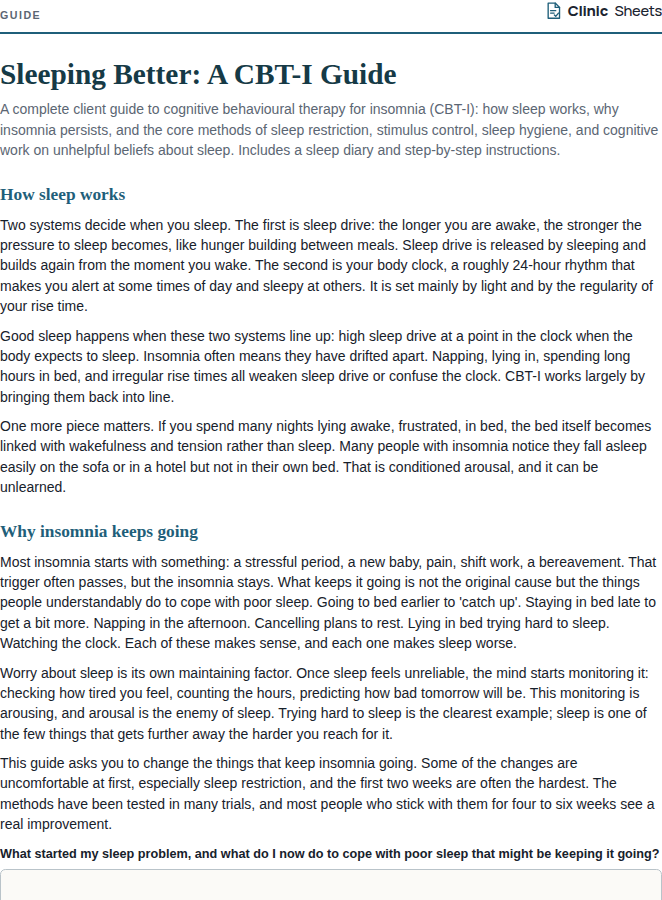
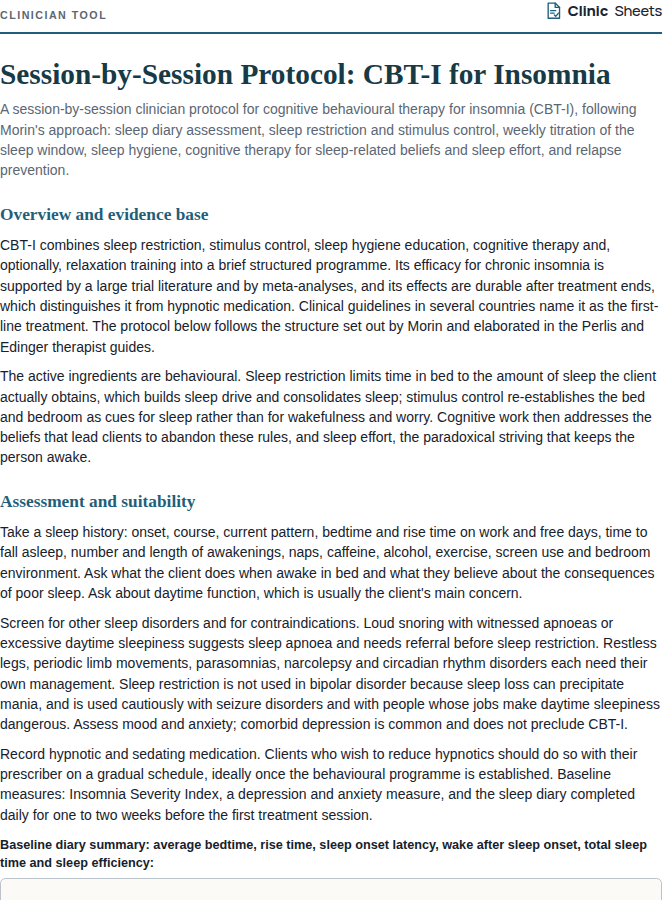
The sleep diary is the essential measurement tool in CBT for insomnia. Retrospective estimates of sleep are unreliable, particularly in people with insomnia who tend to underestimate total sleep and overestimate time awake. A prospective diary completed each morning produces a usable record of time in bed, estimated total sleep time, and sleep efficiency (the proportion of time in bed actually spent asleep), which is the figure that guides sleep restriction and tracks progress.
This diary follows the structure of the Consensus Sleep Diary, which standardised the core items across research and clinical practice. The client records the time they got into bed, the time they tried to sleep, how long it took to fall asleep, the number and total duration of awakenings, the final wake time and the time they got out of bed, along with a rating of sleep quality and brief notes on daytime factors such as naps, caffeine and alcohol. Two weeks of baseline data are gathered before sleep restriction begins, and the diary continues throughout treatment.
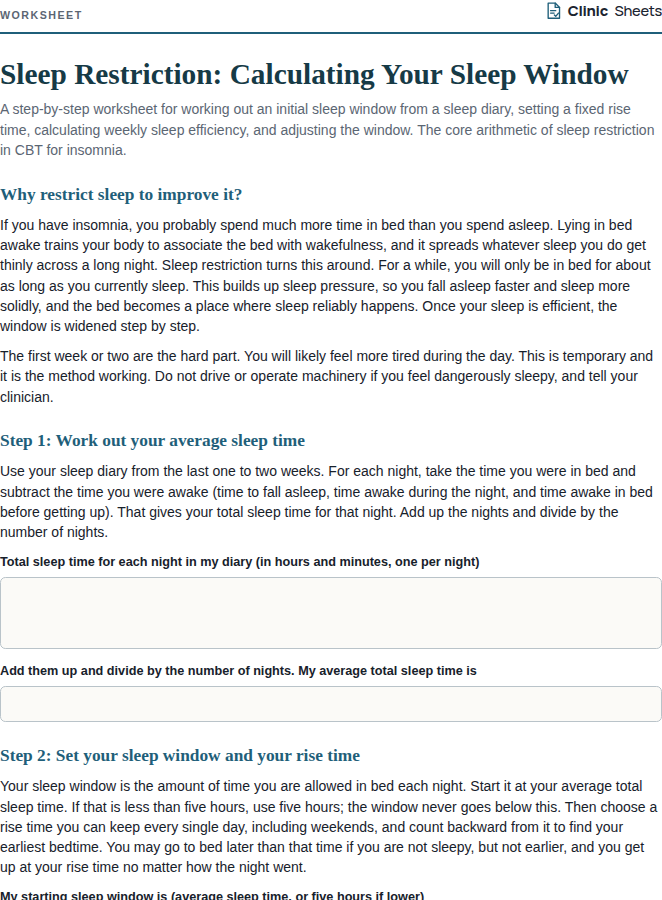
Suitable for adults in CBT-I or in any treatment where sleep is a target. The professional version includes the sleep efficiency calculation, worked guidance on setting the initial sleep window from diary data, and the rules for titrating the window up and down week by week.
How to use it
- Introduce the diary in the first session and ask the client to complete it every morning, within an hour of getting up, for at least two weeks before making any changes to their sleep schedule.
- Stress that entries are estimates. The client should not check the clock during the night to improve accuracy; a rough guess in the morning is what is wanted.
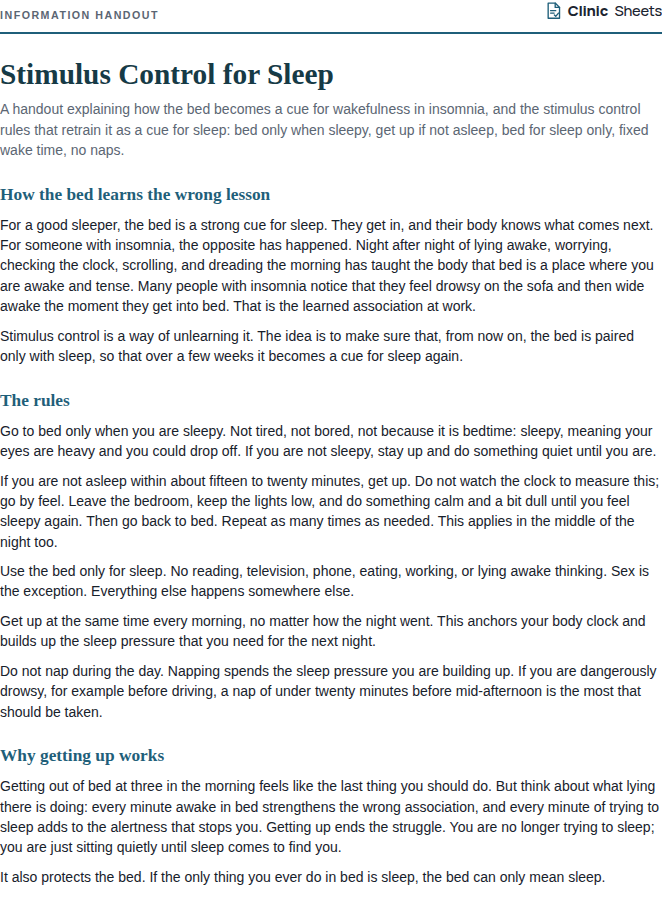
- At each session, calculate average time in bed, average total sleep time, and sleep efficiency (total sleep divided by time in bed, times 100). Below 85 percent is the usual threshold for sleep restriction.
- Set the initial sleep window equal to the average total sleep time (with a floor of around five to five and a half hours) and anchor it to the client's fixed wake time. Review weekly: when efficiency is above 85 to 90 percent, extend the window by fifteen minutes; when it is below 80 percent, reduce it.
- Continue the diary throughout treatment and use it in the final sessions to show the client the change over time.
- If the client finds daily recording increases their preoccupation with sleep, simplify the diary to the three or four core items and keep the morning-only rule.
References
- Carney, C. E., Buysse, D. J., Ancoli-Israel, S., Edinger, J. D., Krystal, A. D., Lichstein, K. L., & Morin, C. M. (2012). The consensus sleep diary: Standardizing prospective sleep self-monitoring. Sleep, 35(2), 287-302.
- Spielman, A. J., Saskin, P., & Thorpy, M. J. (1987). Treatment of chronic insomnia by restriction of time in bed. Sleep, 10(1), 45-56.
- Morin, C. M., & Espie, C. A. (2003). Insomnia: A Clinical Guide to Assessment and Treatment. Kluwer Academic/Plenum.