Sleep Restriction: Calculating Your Sleep Window
A step-by-step worksheet for working out an initial sleep window from a sleep diary, setting a fixed rise time, calculating weekly sleep efficiency, and adjusting the window. The core arithmetic of sleep restriction in CBT for insomnia.
About this resource
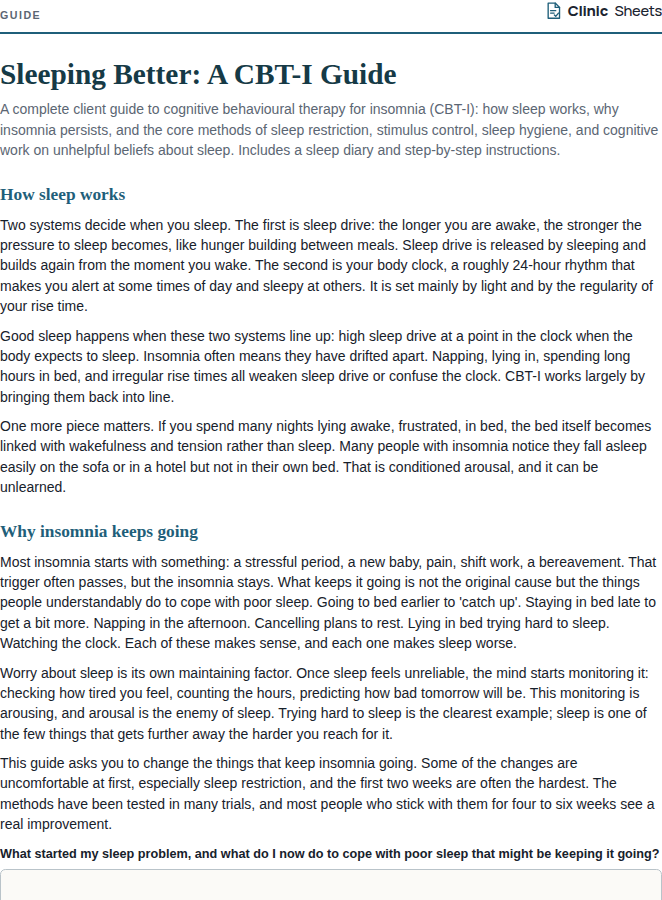
Sleep restriction therapy, introduced by Spielman and colleagues, is one of the two behavioural pillars of CBT for insomnia. People with insomnia commonly spend far longer in bed than they spend asleep, and this excess time in bed is where light, broken and frustrating sleep lives. Sleep restriction temporarily limits time in bed to roughly the amount of sleep the person is actually getting. The resulting mild sleep deprivation raises sleep pressure, so sleep becomes faster to arrive and deeper, and the bed is re-learned as a place where sleep happens. The window is then widened gradually as efficiency improves.
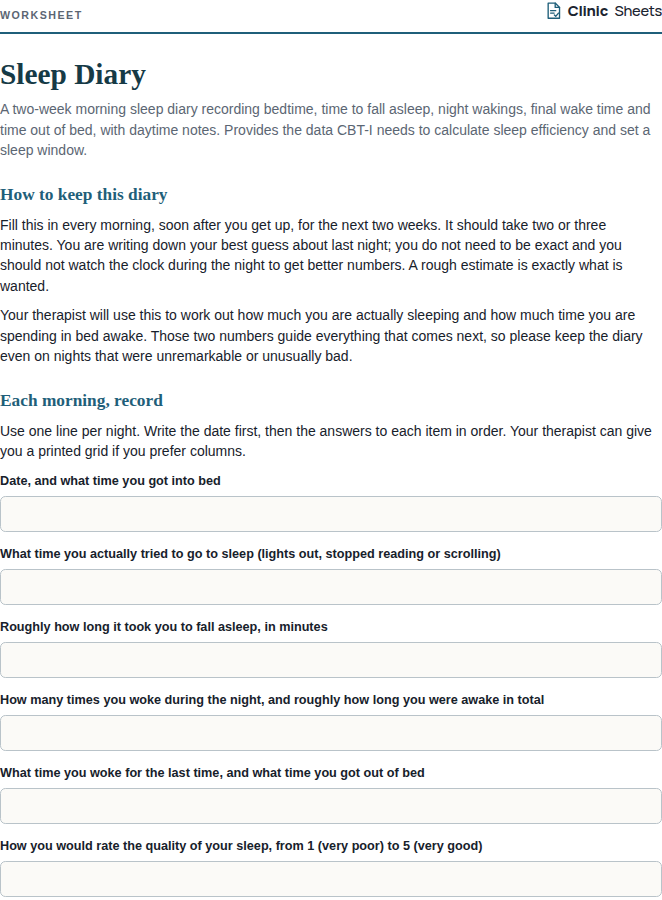
This worksheet takes the client through the calculation in order: totalling sleep from a one- to two-week diary, setting the window (never below five hours), choosing a fixed rise time and working backward to a bedtime, computing sleep efficiency each week, and applying the adjustment rule. Writing the numbers down removes ambiguity and gives the client ownership of the method.
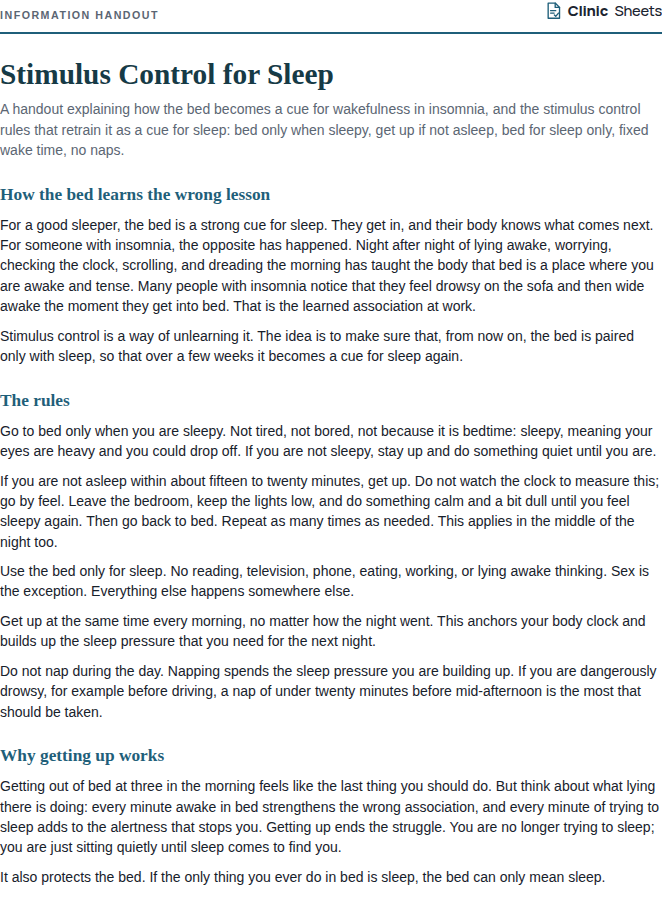
The professional version reminds the clinician that sleep restriction is contraindicated or requires modification in bipolar disorder, seizure disorders, untreated sleep apnoea, parasomnias and where daytime sleepiness would be dangerous (for example commercial driving), and that the first one to two weeks are usually the hardest. Combining it with stimulus control instructions is standard; the worksheet assumes the client also has those.
How to use it
- Screen for contraindications before prescribing sleep restriction: bipolar disorder, seizure disorder, untreated sleep apnoea, parasomnias, and occupations where sleepiness is dangerous. Adjust or choose a gentler approach (such as sleep compression) where needed.
- Ensure the client has at least one week, ideally two, of sleep diary data. Use the diary's estimates; exact minutes do not matter.
- Do the first calculation together in session. Set the window at average total sleep time, with a floor of five hours, and anchor it to a rise time the client can keep seven days a week.
- Explain that the first week or two will feel worse before they feel better, and that this is expected. Pair the window with stimulus control rules.
- Recalculate sleep efficiency each week from the diary and apply the adjustment rule shown on the worksheet. Extend by fifteen minutes when efficiency is 85 percent or higher; hold when it is between 80 and 85; reduce by fifteen minutes when it is below 80, without going below the five-hour floor.
References
- Spielman, A. J., Saskin, P., & Thorpy, M. J. (1987). Treatment of chronic insomnia by restriction of time in bed. Sleep, 10(1), 45-56.
- Morin, C. M., & Espie, C. A. (2003). Insomnia: A Clinical Guide to Assessment and Treatment. Kluwer Academic/Plenum.
- Edinger, J. D., & Carney, C. E. (2015). Overcoming Insomnia: A Cognitive-Behavioral Therapy Approach, Therapist Guide (2nd ed.). Oxford University Press.
- Perlis, M. L., Jungquist, C., Smith, M. T., & Posner, D. (2005). Cognitive Behavioral Treatment of Insomnia: A Session-by-Session Guide. Springer.