Session-by-Session Protocol: CBT-I for Insomnia
A session-by-session clinician protocol for cognitive behavioural therapy for insomnia (CBT-I), following Morin's approach: sleep diary assessment, sleep restriction and stimulus control, weekly titration of the sleep window, sleep hygiene, cognitive therapy for sleep-related beliefs and sleep effort, and relapse prevention.
About this resource
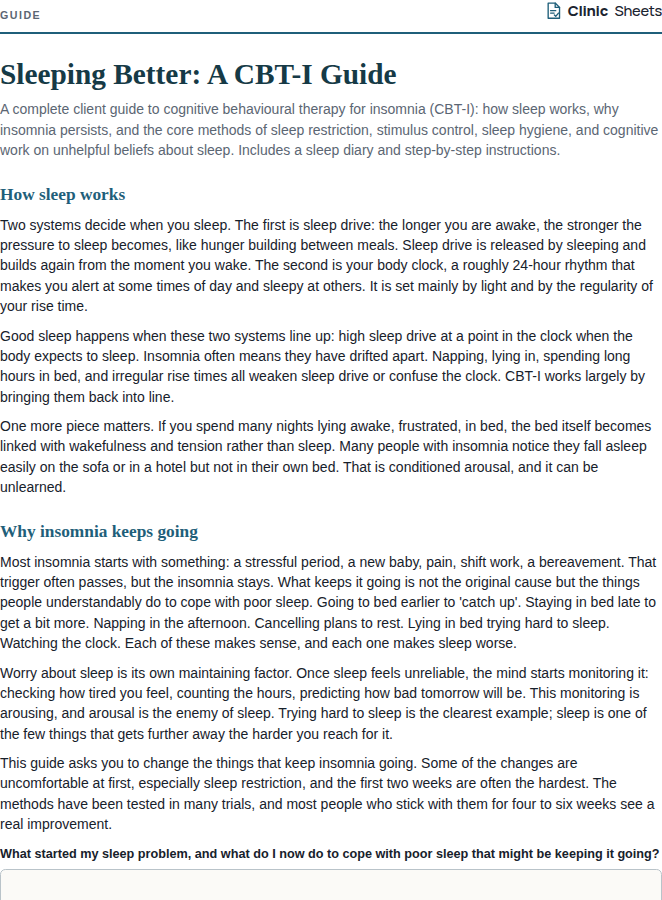
CBT-I is the recommended first-line treatment for chronic insomnia. It rests on Spielman's three-factor model, in which predisposing and precipitating factors start the insomnia but perpetuating factors, mainly extended time in bed, irregular schedules, conditioned arousal in the bedroom and anxious effort to sleep, keep it going long after the original trigger has passed. The two behavioural components, sleep restriction (Spielman, Saskin and Thorpy) and stimulus control (Bootzin), produce most of the effect. Cognitive work addresses the beliefs and the sleep effort that sustain arousal, and sleep hygiene removes the smaller obstacles.
This protocol lays out a six to eight session course of the kind described by Morin and by Perlis and colleagues, delivered weekly or fortnightly. It is driven by the sleep diary: the sleep window is prescribed from two weeks of diary data and titrated at every session according to sleep efficiency. The cognitive components are introduced once the behavioural programme is running, because most sleep-related beliefs are best challenged with the client's own diary evidence.
The professional version explains how to calculate and titrate the sleep window, the minimum window and the safety considerations, how to present sleep restriction so that clients actually adhere to it, how to handle the first two weeks of increased daytime sleepiness, and when to adapt the protocol for shift workers, older adults, comorbid depression or pain, and clients taking hypnotics.
How to use it
- Screen for conditions that require a different approach or medical review before sleep restriction: untreated sleep apnoea, restless legs, narcolepsy, parasomnias, bipolar disorder, seizure disorder, and jobs where daytime sleepiness is a safety risk. Assess current hypnotic use and involve the prescriber.
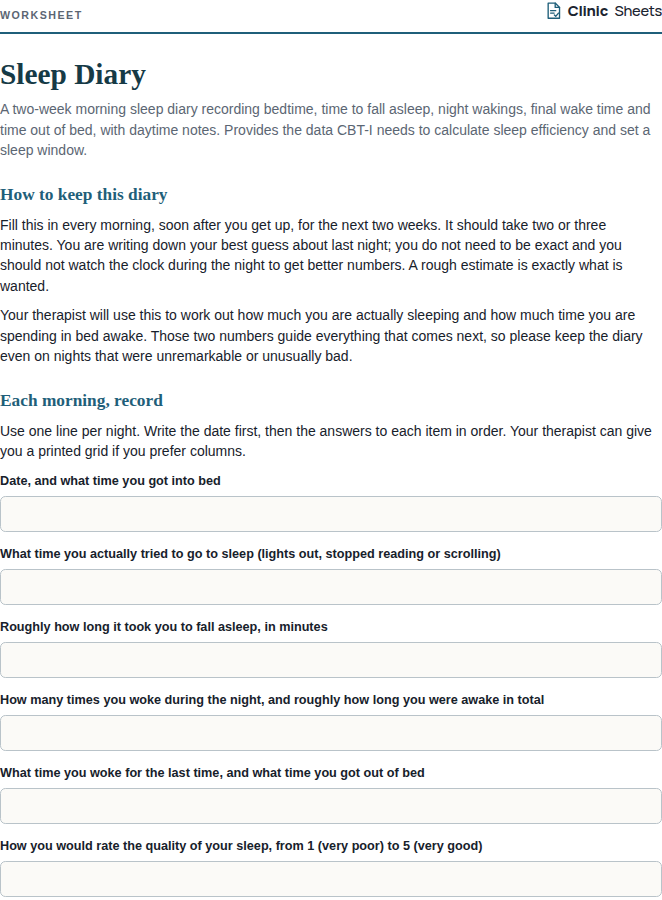
- Have the client complete a sleep diary for one to two weeks before the first treatment session. Do not prescribe a sleep window without diary data.
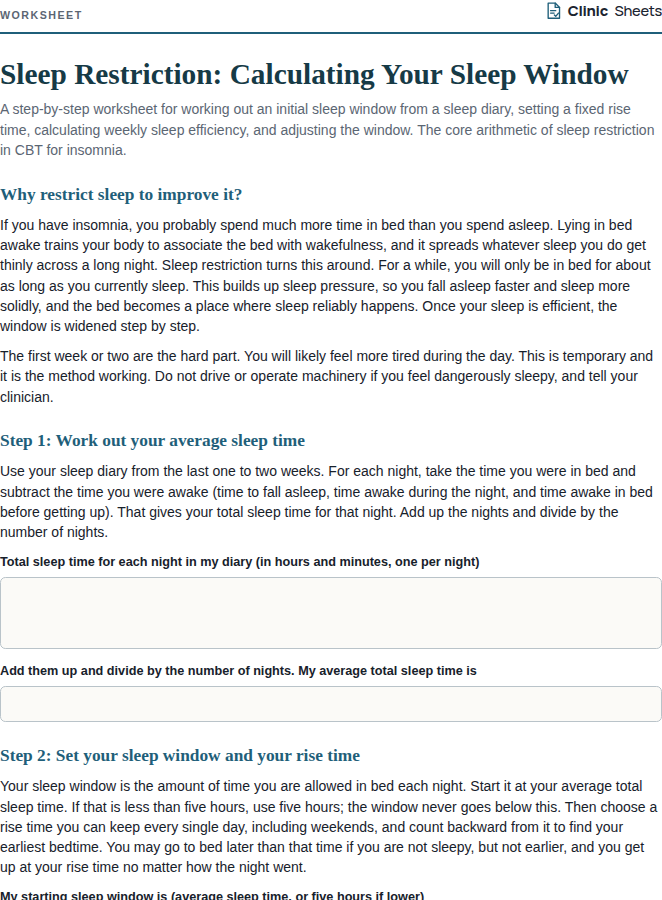
- Administer the Insomnia Severity Index at baseline, mid-treatment and end. Calculate sleep efficiency (time asleep divided by time in bed) from the diary every week and use it to titrate the window.
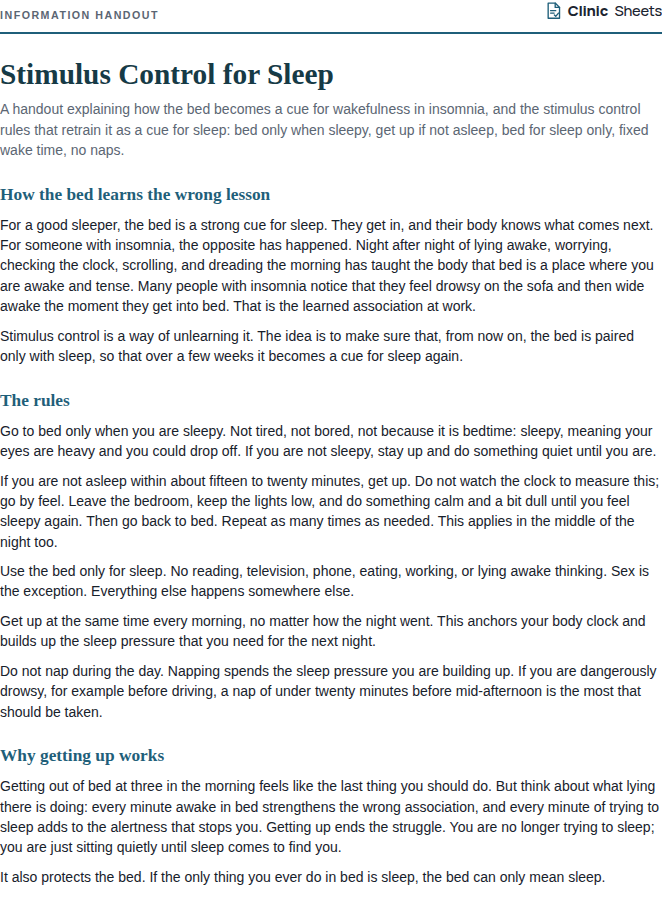
- Introduce sleep restriction and stimulus control together in the first treatment session and hold them in place throughout. Introduce cognitive work from the third or fourth session using the diary as evidence.
- Reserve the final session for relapse prevention: a written plan for reinstating the rules when sleep deteriorates.
References
- Morin, C. M. (1993). Insomnia: Psychological Assessment and Management. Guilford Press.
- Perlis, M. L., Jungquist, C., Smith, M. T., & Posner, D. (2005). Cognitive Behavioral Treatment of Insomnia: A Session-by-Session Guide. Springer.
- Spielman, A. J., Saskin, P., & Thorpy, M. J. (1987). Treatment of chronic insomnia by restriction of time in bed. Sleep, 10(1), 45-56.
- Edinger, J. D., & Carney, C. E. (2015). Overcoming Insomnia: A Cognitive-Behavioral Therapy Approach, Therapist Guide (2nd ed.). Oxford University Press.