Stimulus Control for Sleep
A handout explaining how the bed becomes a cue for wakefulness in insomnia, and the stimulus control rules that retrain it as a cue for sleep: bed only when sleepy, get up if not asleep, bed for sleep only, fixed wake time, no naps.
About this resource
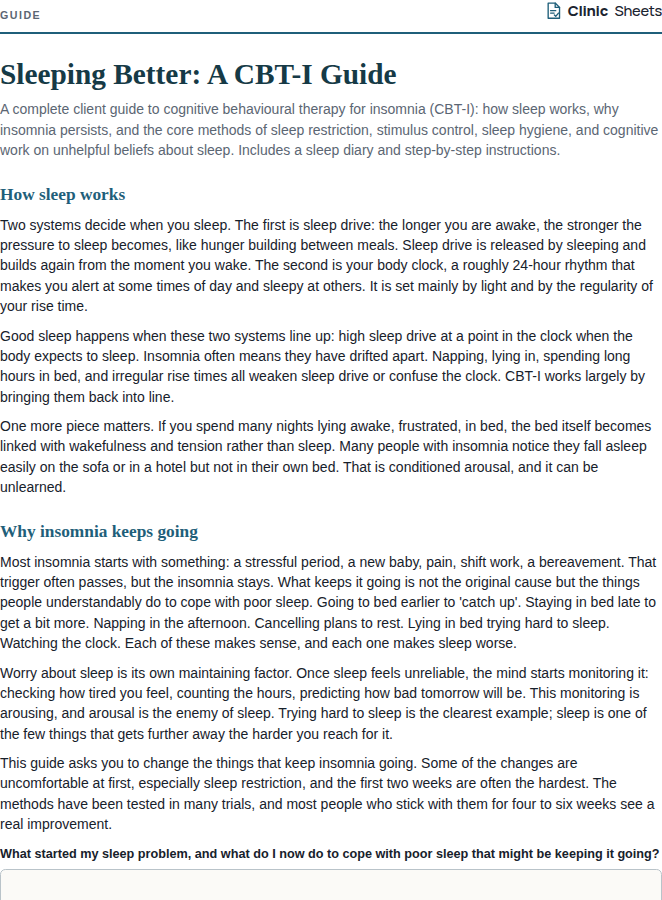
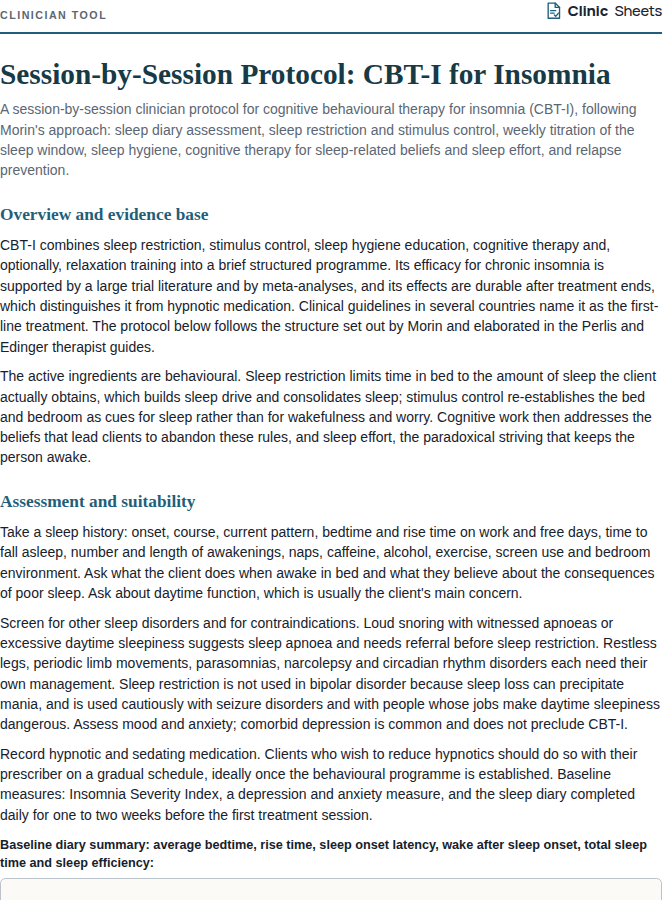
Stimulus control, developed by Richard Bootzin in the 1970s, is one of the two behavioural components of CBT-I with the strongest evidence and is recommended as a standalone treatment in its own right. Its premise is that in chronic insomnia the bed and bedroom have become conditioned cues for arousal rather than sleep, through repeated pairing with lying awake, worrying, watching the clock, and doing wakeful activities in bed. The treatment breaks that association by limiting the bed to sleep and by removing the client from the bed whenever they are awake for more than a short period.
The rules are simple and clients frequently resist them, because getting out of a warm bed at 3 a.m. feels like the wrong thing to do and because the first week or two typically involve less sleep, not more. This handout explains the conditioning rationale in plain language, sets out each rule with its reasoning, and prepares the client for the early dip and the temptation to abandon the method. It also frames getting up as a way of ending sleep effort: the bed stops being a place where one struggles to sleep.
Suitable for adults. The professional version includes guidance on combining stimulus control with sleep restriction, adapting the 'get up' rule for clients with mobility limitations or safety concerns, and handling the client who reports that they are 'just resting' in bed.
How to use it
- Introduce stimulus control once the client understands the insomnia model and has a week or two of sleep diary data. Present it as retraining, not as a test of willpower.
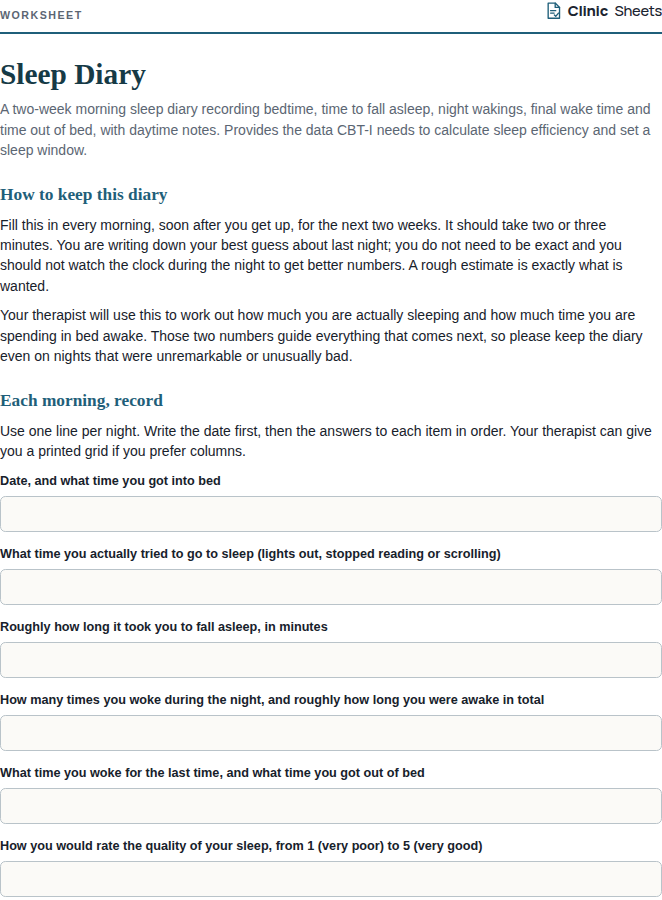
- Go through each rule and its rationale. Ask the client what they currently do in bed apart from sleep and how long they typically lie awake before giving up. This makes the conditioning argument concrete.
- Plan the 'get up' rule in detail: where the client will go, what they will do (dim light, boring or pleasant, not stimulating), how they will stay warm, and how they will decide when to return.
- Warn the client that the first one to two weeks usually feel worse before they feel better. Ask them to commit to at least two weeks before judging the method.
- Review adherence at each session using the sleep diary. The most common lapses are staying in bed 'resting' and going to bed early because the evening is boring.
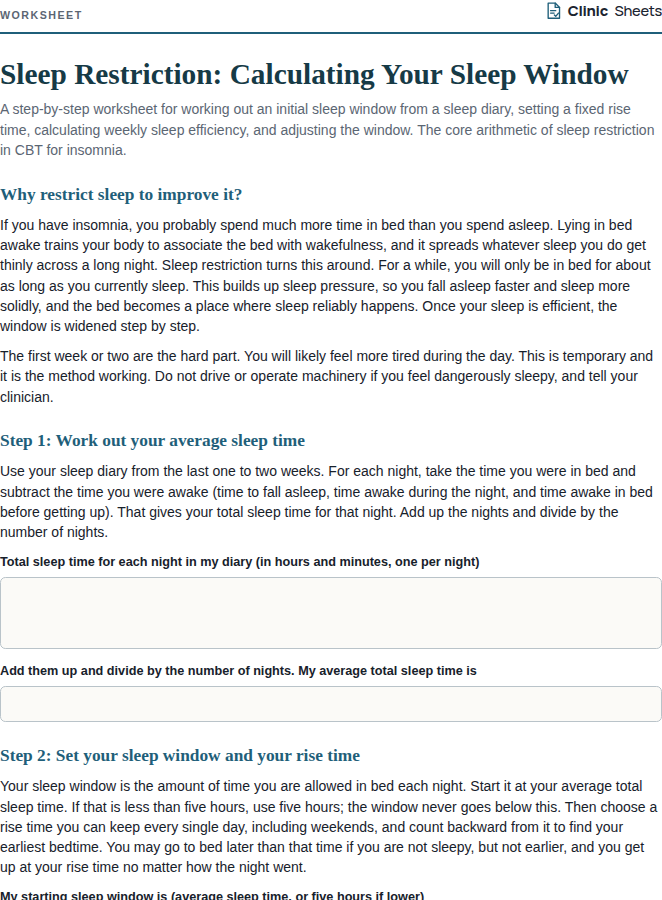
- Combine with sleep restriction for most clients, since the two methods reinforce each other.
References
- Bootzin, R. R. (1972). Stimulus control treatment for insomnia. Proceedings of the American Psychological Association, 7, 395-396.
- Bootzin, R. R., & Epstein, D. R. (2011). Understanding and treating insomnia. Annual Review of Clinical Psychology, 7, 435-458.
- Edinger, J. D., Arnedt, J. T., Bertisch, S. M., et al. (2021). Behavioral and psychological treatments for chronic insomnia disorder in adults: An American Academy of Sleep Medicine clinical practice guideline. Journal of Clinical Sleep Medicine, 17(2), 255-262.
- Morin, C. M., & Espie, C. A. (2003). Insomnia: A Clinical Guide to Assessment and Treatment. Kluwer Academic/Plenum.