Sleeping Better: A CBT-I Guide
A complete client guide to cognitive behavioural therapy for insomnia (CBT-I): how sleep works, why insomnia persists, and the core methods of sleep restriction, stimulus control, sleep hygiene, and cognitive work on unhelpful beliefs about sleep. Includes a sleep diary and step-by-step instructions.
About this resource
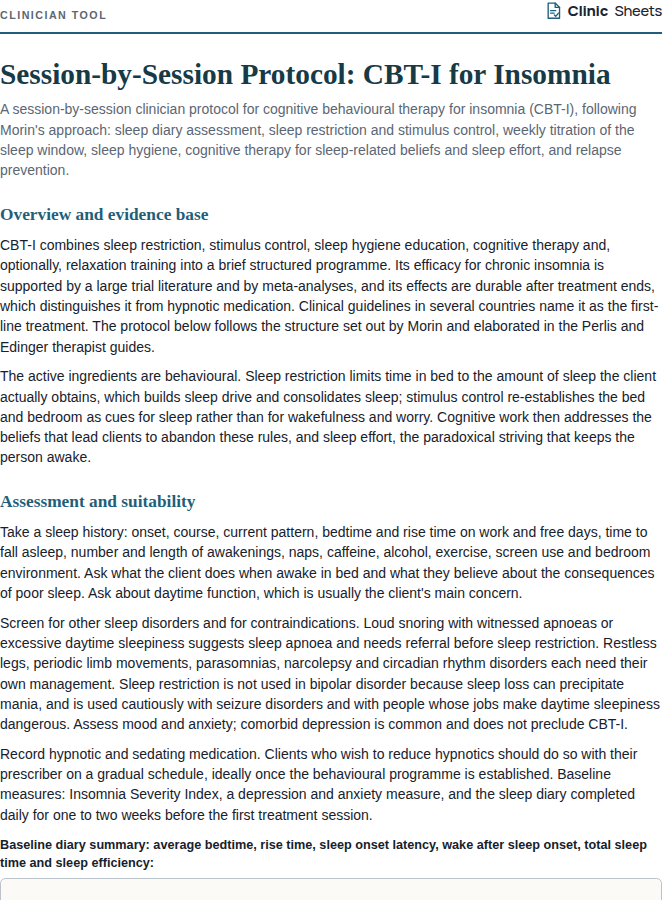
CBT-I is the recommended first-line treatment for chronic insomnia in adults, with effects that are comparable to hypnotic medication in the short term and more durable over follow-up. It rests on Spielman's three-factor model, in which predisposing vulnerabilities and a precipitating event start the insomnia, but perpetuating factors, chiefly extended time in bed, irregular schedules, daytime napping, and conditioned arousal in the bedroom, keep it going long after the trigger has passed. Harvey's cognitive model adds the role of worry about sleep, selective attention to sleep-related threat, and counterproductive safety behaviours such as sleep effort.
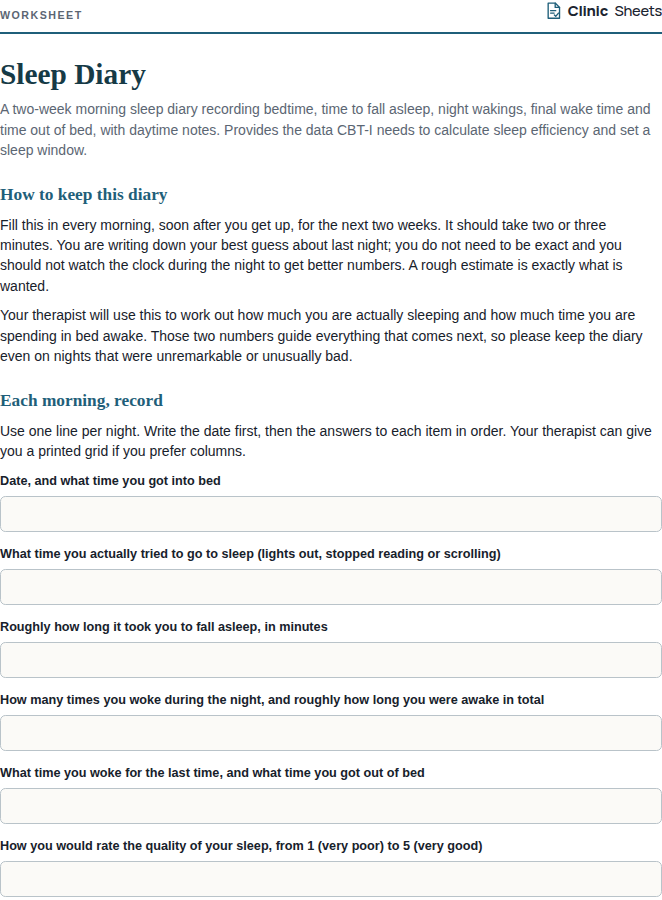
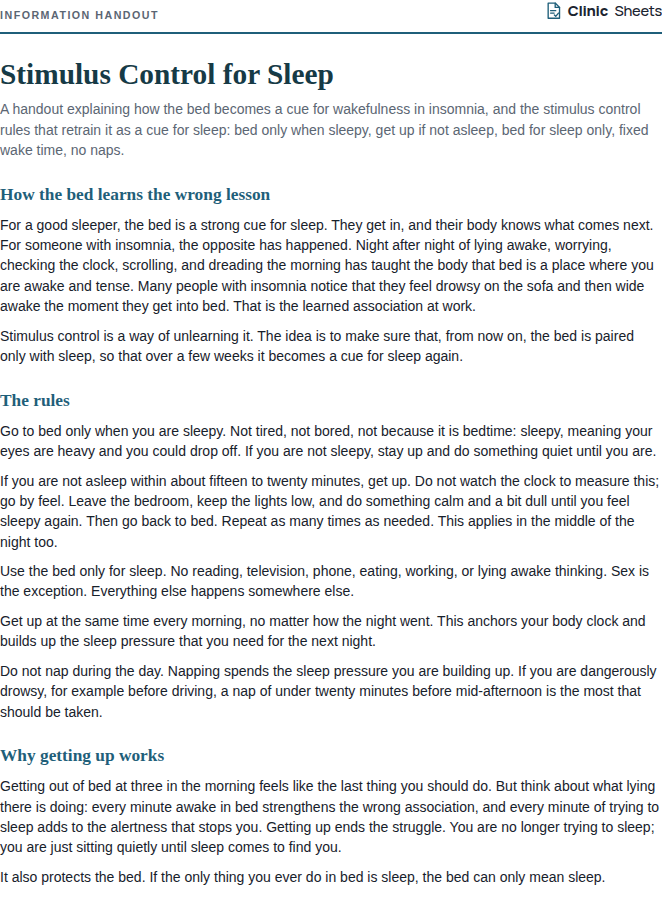
This guide takes the client through the full CBT-I package in the order it is usually delivered: a week of sleep diary keeping, psychoeducation about sleep drive and the body clock, stimulus control (Bootzin's rules for re-associating the bed with sleep), sleep restriction (Spielman's method of matching time in bed to actual sleep and extending it as efficiency improves), sleep hygiene as a supporting rather than central component, and cognitive work on beliefs about sleep and the consequences of a bad night. Each section includes a practice field. The guide is written for adults with chronic insomnia and is not a substitute for assessment of other sleep disorders.
The professional version includes the contraindications and cautions for sleep restriction (bipolar disorder, seizure disorders, untreated sleep apnoea, parasomnias, safety-critical occupations, pregnancy), the sleep efficiency formula and titration rules, and guidance on managing the first two weeks when daytime sleepiness peaks and adherence is hardest.
How to use it
- Screen for other sleep disorders (obstructive sleep apnoea, restless legs, circadian rhythm disorders) and for conditions where sleep restriction is contraindicated before starting. Refer for a sleep study where indicated.
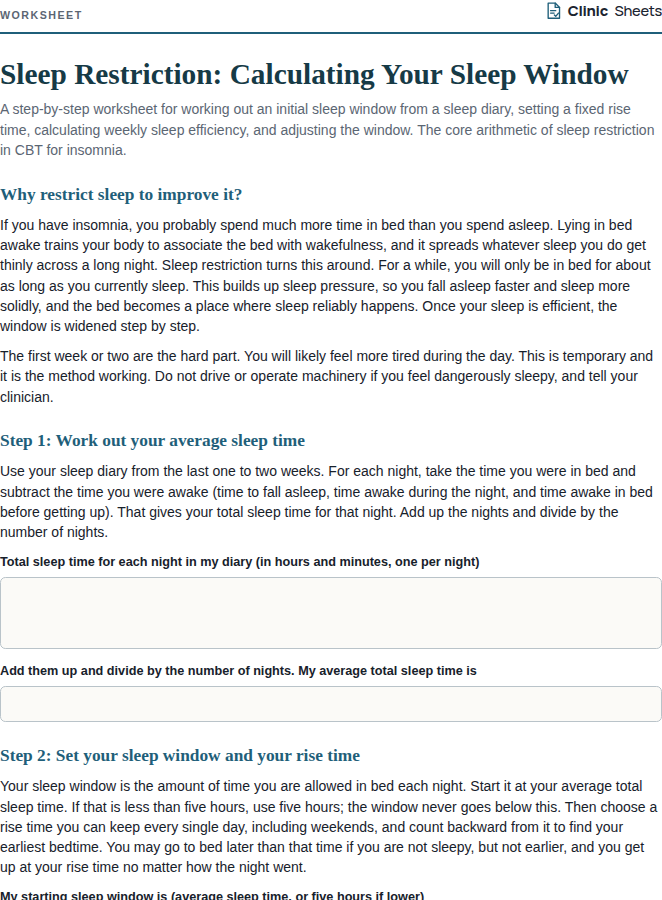
- Have the client keep the sleep diary for at least one week, ideally two, before setting a sleep window. Calculate average total sleep time and sleep efficiency from the diary.
- Introduce stimulus control and sleep restriction together in the same session, agree a fixed rise time, and set the initial time-in-bed window to average total sleep time, never below five hours.
- Review the diary weekly. Extend the window by 15 minutes when sleep efficiency is 85 percent or above; hold it if between 80 and 85; reduce it by 15 minutes if below 80 for a full week.
- Introduce the cognitive section once the behavioural changes are underway, typically in week three or four, targeting the specific beliefs the client's diary and worry reveal.
- Expect increased daytime sleepiness in the first one to two weeks. Warn the client in advance, discuss driving safety, and frame it as evidence that sleep drive is building.
References
- Morin, C. M., & Espie, C. A. (2003). Insomnia: A Clinical Guide to Assessment and Treatment. Kluwer Academic/Plenum.
- Spielman, A. J., Saskin, P., & Thorpy, M. J. (1987). Treatment of chronic insomnia by restriction of time in bed. Sleep, 10(1), 45-56.
- Harvey, A. G. (2002). A cognitive model of insomnia. Behaviour Research and Therapy, 40(8), 869-893.
- Edinger, J. D., & Carney, C. E. (2015). Overcoming Insomnia: A Cognitive-Behavioral Therapy Approach, Therapist Guide (2nd ed.). Oxford University Press.