Screen Time Agreement
A worksheet for a parent and young person to negotiate a written screen time agreement together: what is allowed, when, where, what happens at bedtime, and what follows if the agreement is broken.
About this resource
Conflict over screens is one of the most frequent sources of daily friction between parents and adolescents, and unrestricted evening screen use is consistently associated with shorter and poorer sleep in young people. Paediatric guidance from bodies including the Canadian Paediatric Society and the American Academy of Pediatrics recommends that families make a deliberate plan for media use rather than manage it reactively, with attention to screen-free times (meals, the hour before bed), screen-free places (bedrooms overnight), and the content and purpose of use, rather than simply counting hours.
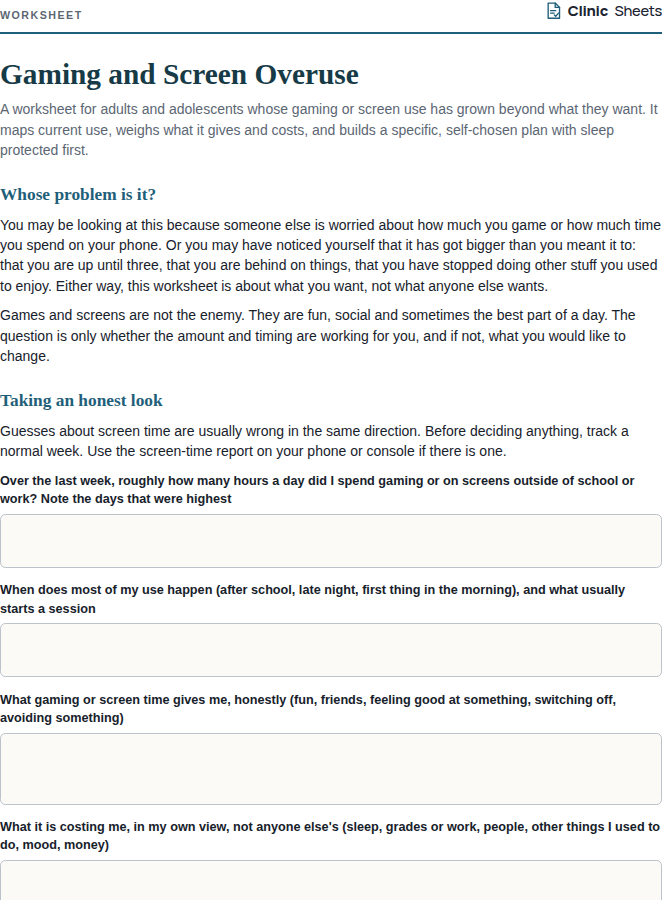
This worksheet turns that recommendation into a negotiated agreement. It is designed to be completed by the parent and young person together, with each side stating what they want and why, before the specifics are settled. Adolescents are far more likely to keep an agreement they helped write, and the process of negotiating it is itself a useful exercise in communication and problem solving. The agreement covers weekday and weekend limits, where devices are charged overnight, homework and mealtime rules, content and privacy expectations, and what happens when the agreement is broken, agreed in advance so that consequences do not have to be invented mid-argument.
The professional version adds guidance on running the negotiation in session, on distinguishing between types of screen use (social, creative, homework, passive scrolling, gaming) rather than treating all screen time alike, on the sleep evidence that makes bedroom charging the single most useful rule, and on parents modelling their own screen habits.
How to use it
- Use with the parent and adolescent together, ideally in session. Frame it as a negotiation with limits: the parent has final say on safety and sleep, but everything else is open for discussion.
- Ask each of them to complete the 'what I want and why' fields first, separately, then share. This surfaces the actual concerns (a parent worried about sleep and a teenager worried about being cut off from friends) rather than a fight about minutes.
- Work through the specifics, encouraging the young person to propose the first draft of each rule. Prioritise the rules with the strongest evidence: no devices in the bedroom overnight and a screen-free period before sleep.
- Agree the consequences for a broken agreement in advance, keep them proportionate and short, and write them down. Agree a review date.
- Ask the parent to consider which of the rules they will also follow. Adolescents notice inconsistency immediately, and parental modelling improves adherence.
References
- Canadian Paediatric Society, Digital Health Task Force. (2019). Digital media: Promoting healthy screen use in school-aged children and adolescents. Paediatrics & Child Health, 24(6), 402-408.
- Council on Communications and Media. (2016). Media use in school-aged children and adolescents. Pediatrics, 138(5), e20162592.
- Carter, B., Rees, P., Hale, L., Bhattacharjee, D., & Paradkar, M. S. (2016). Association between portable screen-based media device access or use and sleep outcomes: A systematic review and meta-analysis. JAMA Pediatrics, 170(12), 1202-1208.