Family Rules and Routines Planner
A planner for parents to set a small number of clear household rules, the consequences that follow, and the daily routines (mornings, homework, screens, bedtime) that prevent most conflict before it starts.
About this resource
A large share of day-to-day parent-child conflict comes not from defiance but from unclear expectations: rules that exist in the parent's head but have never been stated, consequences that vary with the parent's mood, and transitions (getting out the door, coming off screens, going to bed) that are negotiated afresh every day. Behavioural parenting programmes such as Triple P and parent management training consistently identify a few clear, positively stated rules, predictable consequences applied calmly, and structured routines as the foundation on which everything else (praise, rewards, planned ignoring, time-out) is built.
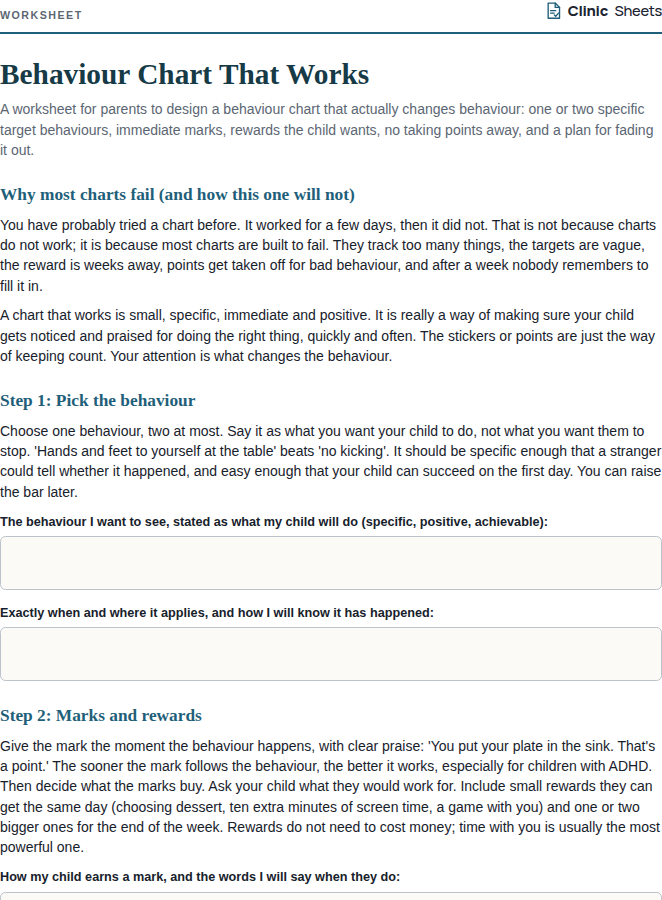
This planner walks parents through choosing three to five rules that matter most, stating each as what to do rather than what not to do, deciding in advance what happens when a rule is followed and when it is broken, and then mapping the two or three daily routines that cause the most friction step by step. It also asks parents to plan how they will introduce the rules to the children, since rules announced during a conflict rarely stick, and to set a date to review. The planner is written for the parents; a family meeting is a good place to present the result.
The professional version adds guidance on keeping the rule list short, on consequences that are proportionate and immediate rather than large and delayed, on the parent who wants a rule for everything, and on adapting routines for children with attention or developmental differences who need more visual structure and more warning before transitions.
How to use it
- Ask the parents to describe a typical bad day from waking to bedtime. Identify the two or three points where conflict reliably starts. These are the routines to plan.
- Help them choose no more than five rules. Push back on long lists. Ask which behaviours, if they changed, would make the biggest difference to the household.
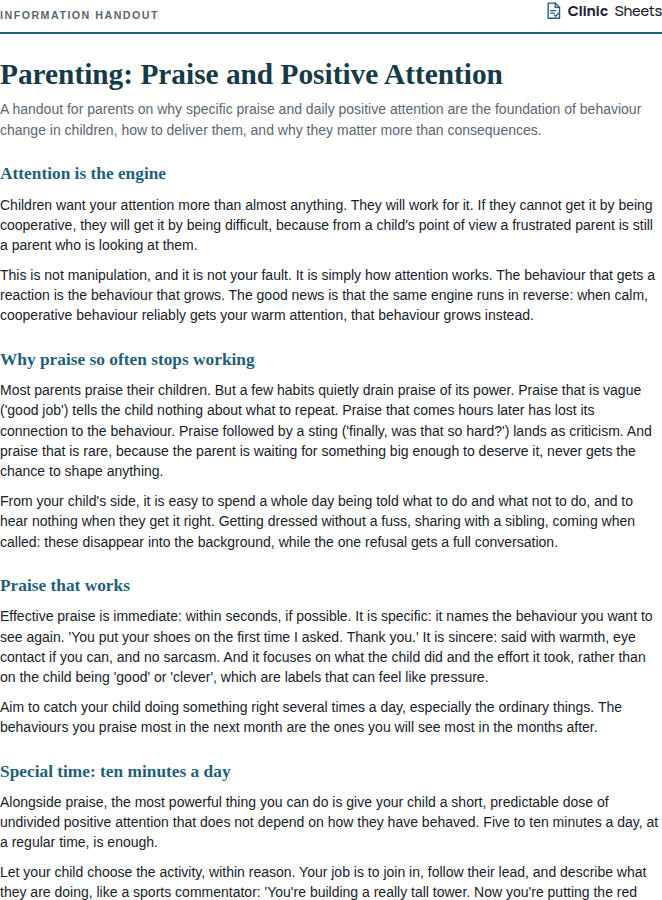
- Restate each rule as a positive: 'hands and feet to yourself' rather than 'no hitting', 'shoes by the door' rather than 'don't leave your shoes everywhere'. This tells the child what to do, and it gives the parent something specific to praise.
- Agree consequences that are small, immediate, and that the parent can actually deliver every time. A consequence that cannot be enforced consistently is worse than none. Balance with the positive: what happens when the rule is kept.
- Plan the introduction to the children at a calm moment, and set a review date in two to three weeks. Review the planner in session and adjust rules that turned out to be too vague or consequences that were not delivered.
References
- Sanders, M. R. (1999). Triple P-Positive Parenting Program: Towards an empirically validated multilevel parenting and family support strategy for the prevention of behavior and emotional problems in children. Clinical Child and Family Psychology Review, 2(2), 71-90.
- Kazdin, A. E. (2005). Parent Management Training: Treatment for Oppositional, Aggressive, and Antisocial Behavior in Children and Adolescents. Oxford University Press.
- Barkley, R. A. (2013). Defiant Children: A Clinician's Manual for Assessment and Parent Training (3rd ed.). Guilford Press.