Body Image: Mirror Exposure and Neutral Description
A structured mirror exposure exercise in which the client looks at their whole body in a full-length mirror and describes it in neutral, non-judgemental language, from head to toe, without checking, avoiding or lingering. Reduces body-image distress and body checking in eating disorders and body dissatisfaction.
About this resource
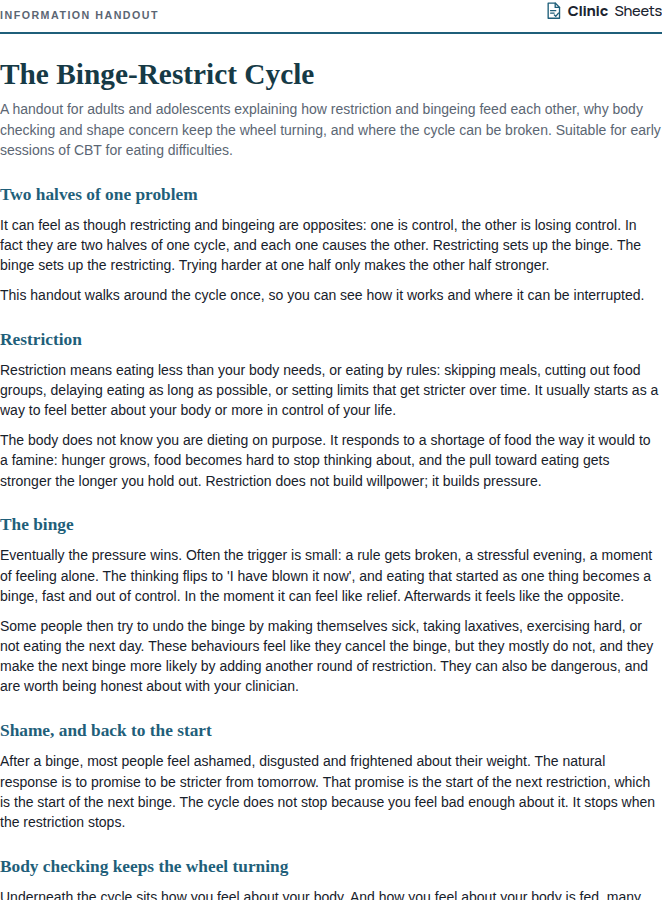
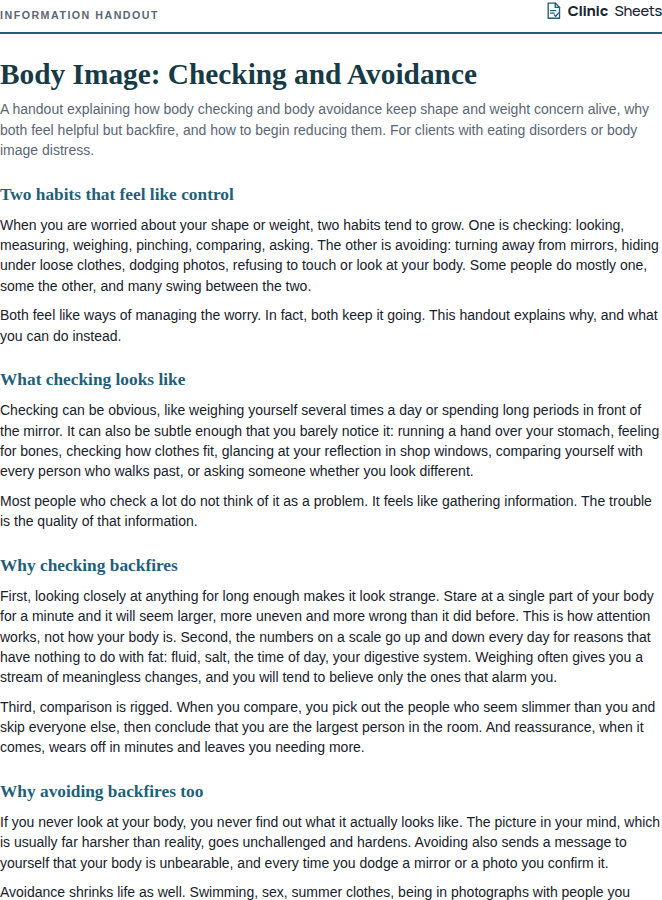
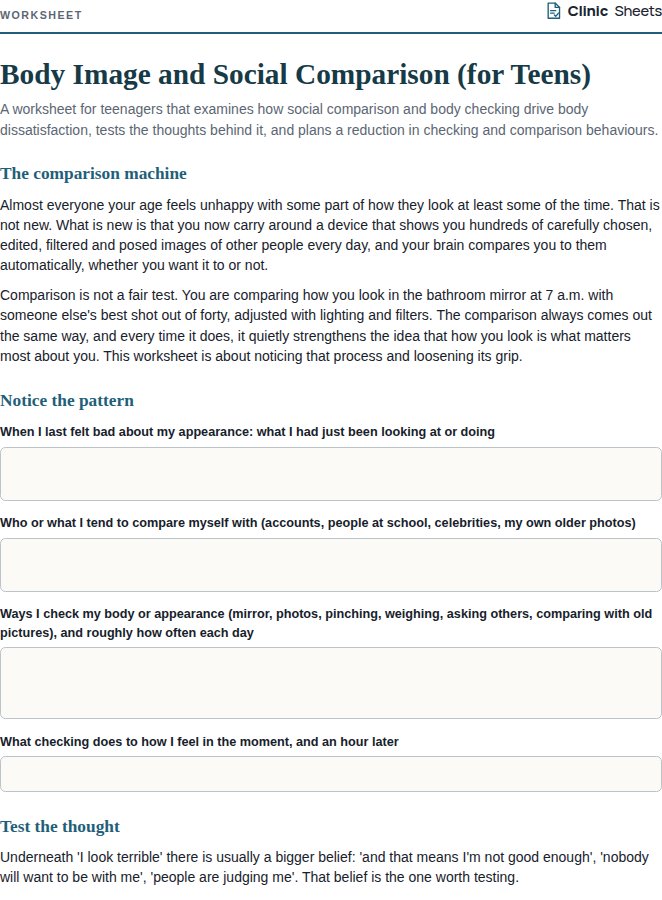
Mirror exposure is a behavioural intervention for body image disturbance used in CBT for eating disorders and body dissatisfaction. People with body image concerns tend to relate to their reflection in one of two ways, and often both: they check, scrutinising disliked areas at close range and comparing them with an ideal, or they avoid, keeping mirrors covered, undressing in the dark, and looking only at the face. Both patterns keep distress high. Checking narrows attention to flaws and produces a distorted, magnified impression; avoidance prevents any habituation and lets the imagined body become worse than the real one.
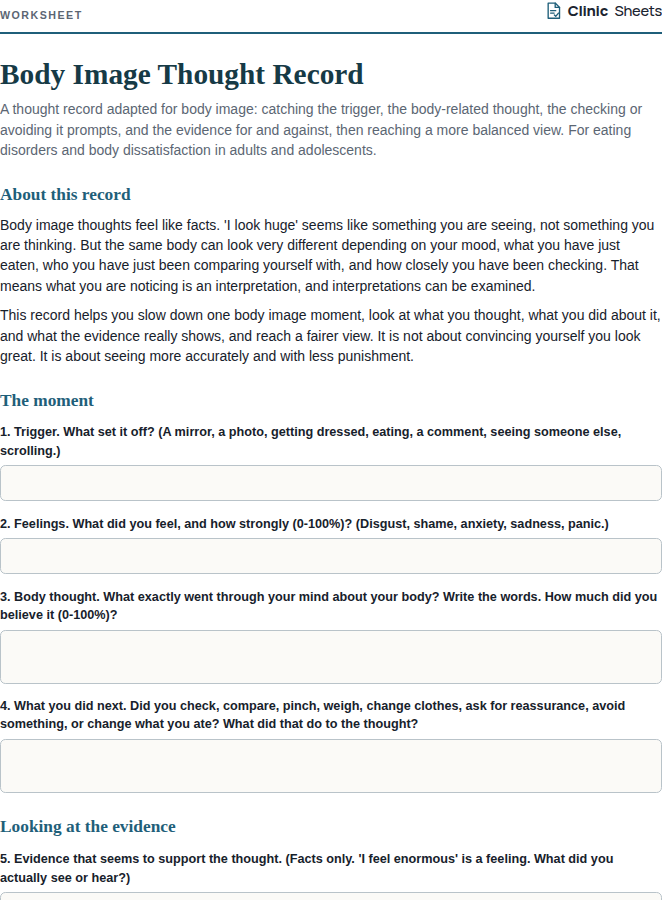
Structured mirror exposure addresses both. The client stands in front of a full-length mirror for a sustained period, looks at every part of the body in turn without skipping or lingering, and describes each part aloud in neutral, descriptive language, as though describing it to someone who cannot see it. Evaluative words (fat, ugly, disgusting, but also thin, good, fine) are avoided in favour of shape, colour, texture and position. Distress is rated before, during and after. Over repeated sessions distress typically falls, checking and avoidance reduce, and the client's global evaluation of their body becomes less negative. The approach was described by Delinsky and Wilson and by Cash, and is a standard component of Fairburn's enhanced CBT (CBT-E) module on body image.
The professional version adds guidance on preparation (a rationale that covers both checking and avoidance, an agreed dress level that begins where the client can tolerate it), on running the first exposure in session with the clinician modelling neutral description, on managing high distress without abandoning the exposure, on contraindications (active suicidality, severe dissociation, and clients at a medically unstable weight, for whom the timing should be reviewed with the treating team), and on the mindfulness-based variant that emphasises non-judgemental attention rather than habituation.
How to use it
- Assess the client's mirror habits first: how often they check, which areas, at what distance, and what they avoid. Present the exercise as a way of addressing both checking and avoidance, since most clients do both.
- Agree the starting dress level collaboratively (for example fitted clothing, then underwear or swimwear in later sessions). The exposure should be challenging but tolerable. Confirm that the client will not use the exercise as an opportunity to check.
- Run the first exposure in session if a suitable mirror is available, or model the neutral description using your own arm or hand. Coach the client away from evaluative words, from skipping, and from lingering on disliked areas. Aim for equal time on each region.
- Ask the client to practise two or three times a week at home, in good lighting, for twenty to thirty minutes, rating distress 0-100 before, at the peak and after. Review the log each session.
- Watch for the exercise turning into checking (close range, particular areas, comparing) or reassurance seeking. If distress is not falling across sessions, check for these and for covert avoidance such as unfocused gaze.
- Review timing with the treating team for clients who are medically compromised or acutely distressed; the exercise is usually introduced in the later body image phase of treatment rather than at the start.
References
- Delinsky, S. S., & Wilson, G. T. (2006). Mirror exposure for the treatment of body image disturbance. International Journal of Eating Disorders, 39(2), 108-116.
- Fairburn, C. G. (2008). Cognitive Behavior Therapy and Eating Disorders. Guilford Press.
- Cash, T. F. (2008). The Body Image Workbook: An Eight-Step Program for Learning to Like Your Looks (2nd ed.). New Harbinger.
- Griffen, T. C., Naumann, E., & Hildebrandt, T. (2018). Mirror exposure therapy for body image disturbances and eating disorders: A review. Clinical Psychology Review, 65, 163-174.