Body Scan
A guided body scan meditation from the mindfulness tradition: moving attention slowly through the body, noticing sensations without trying to change them. For stress, chronic pain and illness, and as a foundation practice for mindfulness-based work.
About this resource
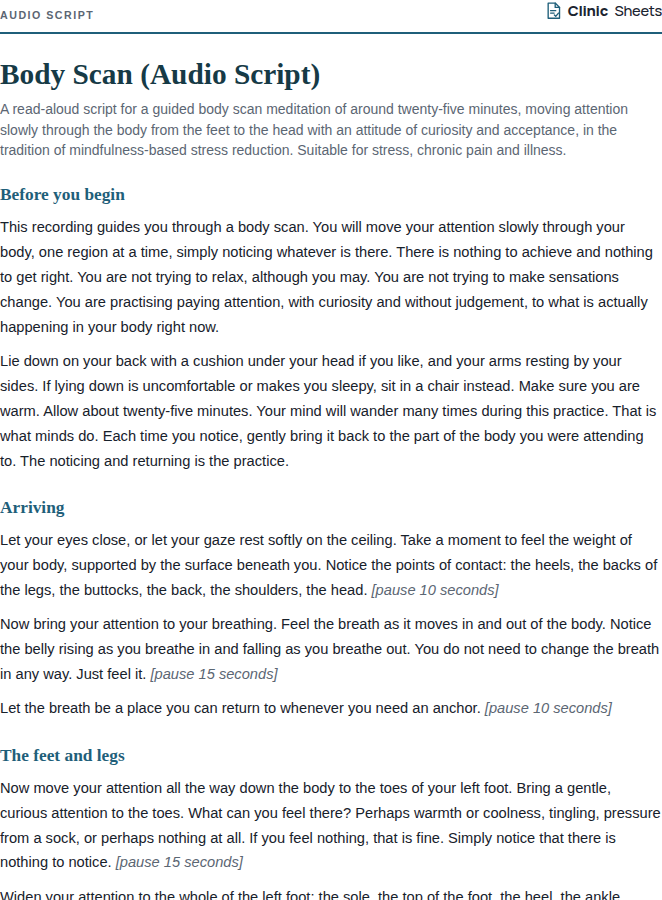
The body scan is one of the core formal practices of mindfulness-based stress reduction (MBSR), developed by Jon Kabat-Zinn, and of mindfulness-based cognitive therapy (MBCT). The practitioner moves attention systematically through the body, region by region, observing whatever sensations are present, including pain, tension, warmth, tingling, or nothing at all, with an attitude of curiosity and without trying to relax or alter anything. Unlike progressive muscle relaxation, which aims directly at reducing tension, the body scan aims at changing the relationship to bodily experience: noticing sensation as sensation, rather than as a problem to be fixed or a threat to be feared.
This makes it particularly useful in chronic pain and illness, where much of the suffering comes from the layer of resistance, fear and rumination that surrounds the raw sensation. Research on MBSR for chronic pain suggests that pain intensity may change little while pain interference, distress and quality of life improve considerably. In stress and burnout, the body scan reconnects clients with bodily signals they have been overriding, and it is often the first practice in which people notice how rarely their attention is in the body at all.
The professional version includes a full script suitable for recording or reading aloud, guidance on the common experiences of falling asleep, restlessness and intensified pain awareness, notes on trauma-sensitive adaptations (eyes open, shorter duration, choice about which regions to include), and suggestions for sequencing the body scan with other mindfulness practices.
How to use it
- Introduce the practice with its purpose clearly stated: to notice, not to relax. Clients who expect relaxation often feel they have failed when their mind wanders or pain remains.
- Lead a shortened version (10 to 15 minutes) in session the first time, then provide a recording for home practice. A 20 to 30 minute practice is standard in MBSR; shorter is fine to begin with.
- Discuss the client's experience afterwards using open questions: what did you notice, what was it like to attend to that region, what happened when the mind wandered?
- For clients with trauma histories, offer choices: eyes open, sitting rather than lying, skipping regions that feel unsafe, and permission to stop at any time.
- For chronic pain, prepare the client that pain may feel more noticeable at first. Encourage attending to the edges and qualities of the sensation rather than the whole, and to the regions that are not in pain.
- Ask the client to practise most days for two weeks and to keep the log. Review it with attention to attitude (curiosity versus striving) rather than outcome.
References
- Kabat-Zinn, J. (2013). Full Catastrophe Living: Using the Wisdom of Your Body and Mind to Face Stress, Pain, and Illness (rev. ed.). Bantam.
- Segal, Z. V., Williams, J. M. G., & Teasdale, J. D. (2013). Mindfulness-Based Cognitive Therapy for Depression (2nd ed.). Guilford Press.
- Hilton, L., Hempel, S., Ewing, B. A., et al. (2017). Mindfulness meditation for chronic pain: Systematic review and meta-analysis. Annals of Behavioral Medicine, 51(2), 199-213.
- Treleaven, D. A. (2018). Trauma-Sensitive Mindfulness: Practices for Safe and Transformative Healing. W. W. Norton.