Soothing Rhythm Breathing
A short, guided breathing practice for slowing the body and activating the soothing system. The foundational exercise in compassion-focused therapy and a useful standalone skill for anxiety and stress.
About this resource
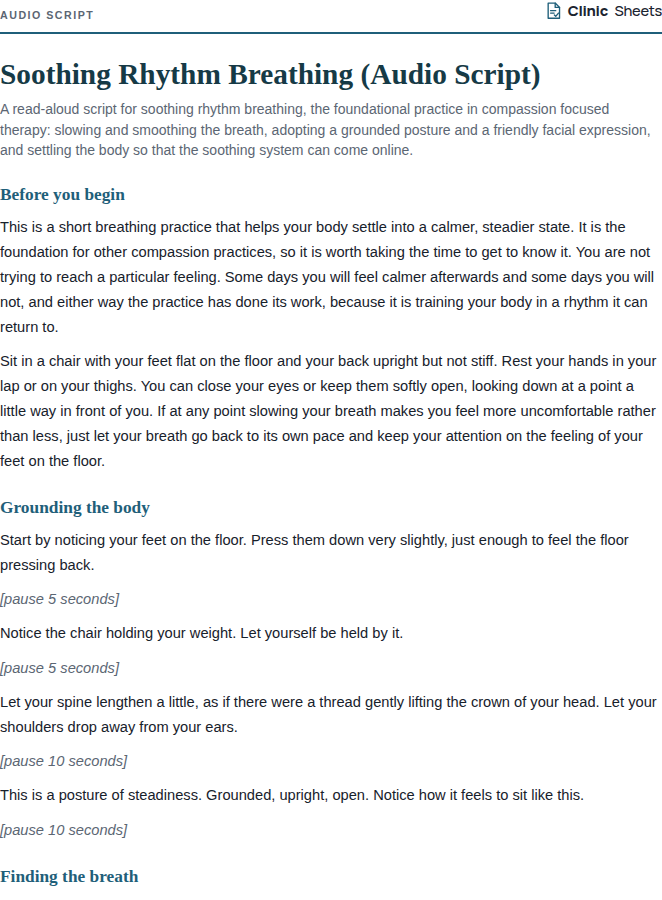
Soothing rhythm breathing is the first practice most clients learn in compassion-focused therapy. It involves slowing the breath to roughly four to six breaths per minute, with a smooth rhythm and a slight lengthening of the out-breath, while adopting an upright, open posture and a warm facial expression. The physiological rationale is well established: slow, rhythmic breathing increases vagal tone and heart rate variability, shifts the autonomic balance toward parasympathetic activity, and reduces the bodily arousal that feeds anxiety and threat-focused thinking.
In CFT the exercise has a second purpose beyond relaxation. It creates the bodily state in which compassionate imagery, compassionate letter writing and the compassionate self can be accessed. Gilbert emphasises that the mind's ability to be compassionate depends on the body being in a state of safeness, so this practice is the ground on which the rest of the work is built. It is deliberately simple so that it can be used anywhere, including in the middle of a difficult moment.
The professional version adds notes on clients who find slowed breathing itself anxiety-provoking (common in panic and trauma), on the option of starting with posture and facial expression alone, and on a brief script for guiding the practice in session.
How to use it
- Introduce the exercise in session and guide it live for three to five minutes before assigning it. Model the pace with your own breathing and voice.
- Explain the rationale briefly: the body has a calming system, and slow rhythmic breathing is one of the most direct ways to switch it on.
- Ask the client to find a comfortable pace rather than counting rigidly. A slight lengthening of the out-breath is enough. Forcing very slow breaths can create tension or dizziness.
- For clients who become more anxious with attention on breathing, begin with posture, grounding through the feet, and a soft facial expression, and add the breath later.
- Assign short, frequent practices (two to three minutes, several times a day) rather than one long practice. Use the log to track what changes.
- Once the practice is familiar, use it as the starting point for compassionate imagery and letter writing.
References
- Gilbert, P. (2009). The Compassionate Mind. Constable.
- Gilbert, P. (2010). Compassion Focused Therapy: Distinctive Features. Routledge.
- Lehrer, P. M., & Gevirtz, R. (2014). Heart rate variability biofeedback: How and why does it work? Frontiers in Psychology, 5, 756.
- Zaccaro, A., et al. (2018). How breath-control can change your life: A systematic review on psycho-physiological correlates of slow breathing. Frontiers in Human Neuroscience, 12, 353.