Body Scan (Audio Script)
A read-aloud script for a guided body scan meditation of around twenty-five minutes, moving attention slowly through the body from the feet to the head with an attitude of curiosity and acceptance, in the tradition of mindfulness-based stress reduction. Suitable for stress, chronic pain and illness.
About this resource
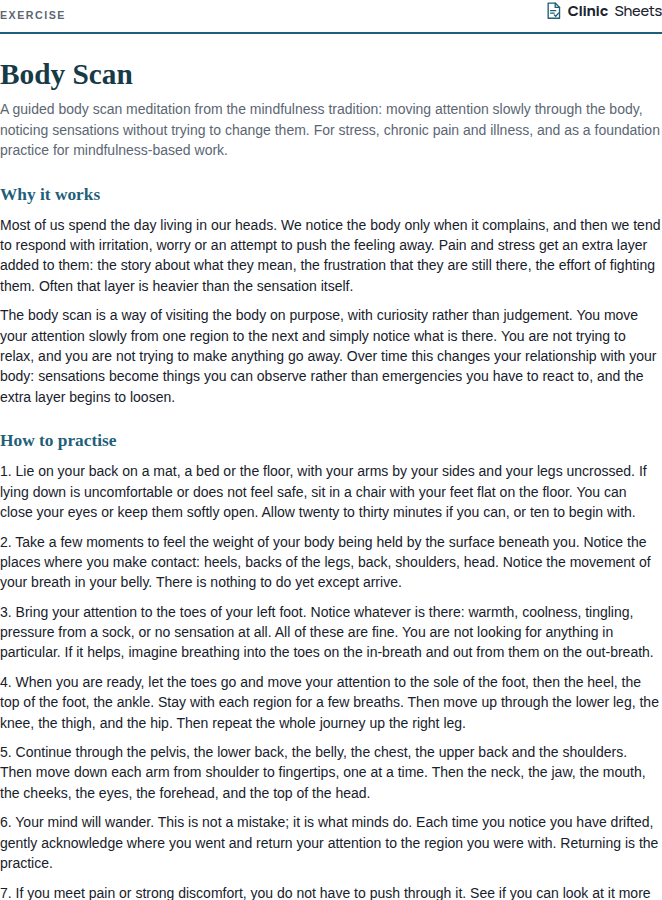
The body scan is one of the foundational practices of mindfulness-based stress reduction (MBSR), developed by Jon Kabat-Zinn, and of mindfulness-based cognitive therapy (MBCT). It involves moving attention systematically through the regions of the body, noticing whatever sensations are present without trying to change them, and returning attention to the body each time the mind wanders. Unlike progressive muscle relaxation, the body scan does not aim at relaxation directly, although relaxation often follows; its aim is to train sustained, non-judgemental attention and to change the person's relationship to bodily experience, including discomfort and pain, from one of avoidance or struggle to one of allowing.
This makes the body scan particularly useful for stress and for chronic pain and illness, where the habitual response to bodily sensation is tension, resistance and catastrophic thinking. Kabat-Zinn's original programme was developed with chronic pain patients, and the practice is now widely used in pain management. It is also the first formal practice taught in MBCT for recurrent depression, where it develops the capacity to notice and step back from experience that the later practices build on.
This script is written for recording or live reading in the present tense and second person, with pauses marked in square brackets. It follows the conventional sequence from the feet to the head, with instructions for working with mind-wandering, discomfort, and sleepiness. The professional version adds guidance on introducing the practice to clients with trauma histories, for whom sustained attention to the body can be activating and who may need shorter practices, eyes open, and explicit permission to move or stop.
How to use it
- Introduce the practice in session with a short version of five to ten minutes before assigning the full recording, and discuss the client's experience, including boredom, restlessness and mind-wandering, as normal parts of the practice rather than failures.
- Screen for trauma history and dissociation. Where present, begin with brief practices, eyes open, and agree in advance that the client may move, open their eyes, or stop at any point.
- Ask the client to practise daily for at least two weeks, ideally at a time when they are unlikely to fall asleep, and to note briefly what they observed after each practice.
- For chronic pain, frame the practice as changing the relationship to pain rather than reducing it, and explore in session what the client noticed when they brought attention to painful regions rather than away from them.
- Review the practice log in session and address common difficulties: sleepiness (practise sitting or at a different time), restlessness (allow movement, shorten), and self-criticism about wandering attention (each return is the practice).
References
- Kabat-Zinn, J. (2013). Full Catastrophe Living: Using the Wisdom of Your Body and Mind to Face Stress, Pain, and Illness (Revised ed.). Bantam Books.
- Segal, Z. V., Williams, J. M. G., & Teasdale, J. D. (2013). Mindfulness-Based Cognitive Therapy for Depression (2nd ed.). Guilford Press.
- Williams, M., & Penman, D. (2011). Mindfulness: A Practical Guide to Finding Peace in a Frantic World. Piatkus.