Parenting: Praise and Positive Attention
A handout for parents on why specific praise and daily positive attention are the foundation of behaviour change in children, how to deliver them, and why they matter more than consequences.
About this resource
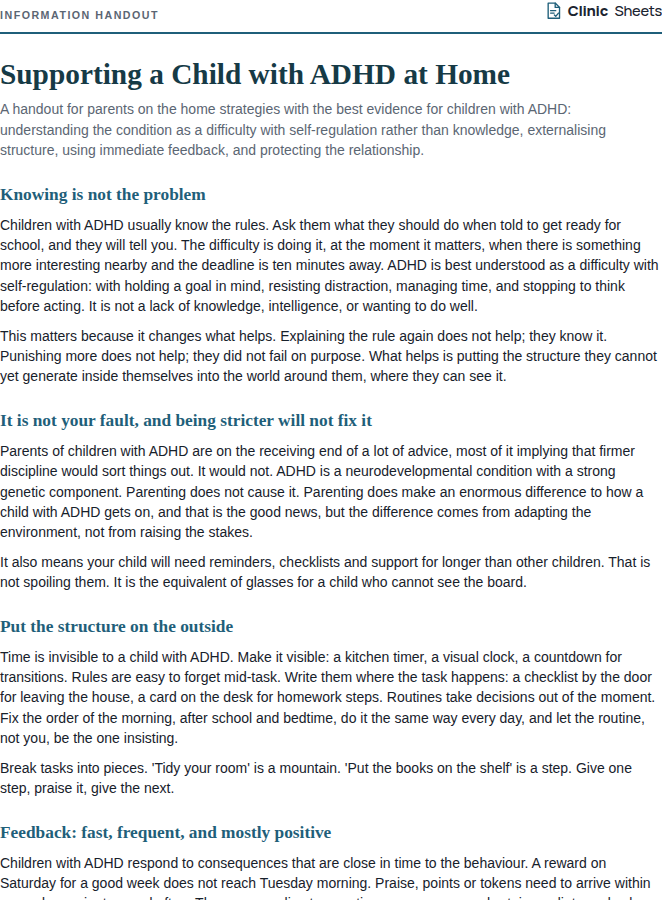
Behavioural parent training programs consistently place praise and positive attention before any discipline strategy, for a reason that is easy to state and hard to practise: children repeat the behaviour that gets attention, and adult attention, positive or negative, is one of the strongest reinforcers in a child's world. When a child's difficult behaviour reliably produces a reaction and their cooperative behaviour produces nothing, the balance tips toward difficulty. Parents caught in this cycle often report that they 'never get a break' from correcting, and that praise feels false or unearned.
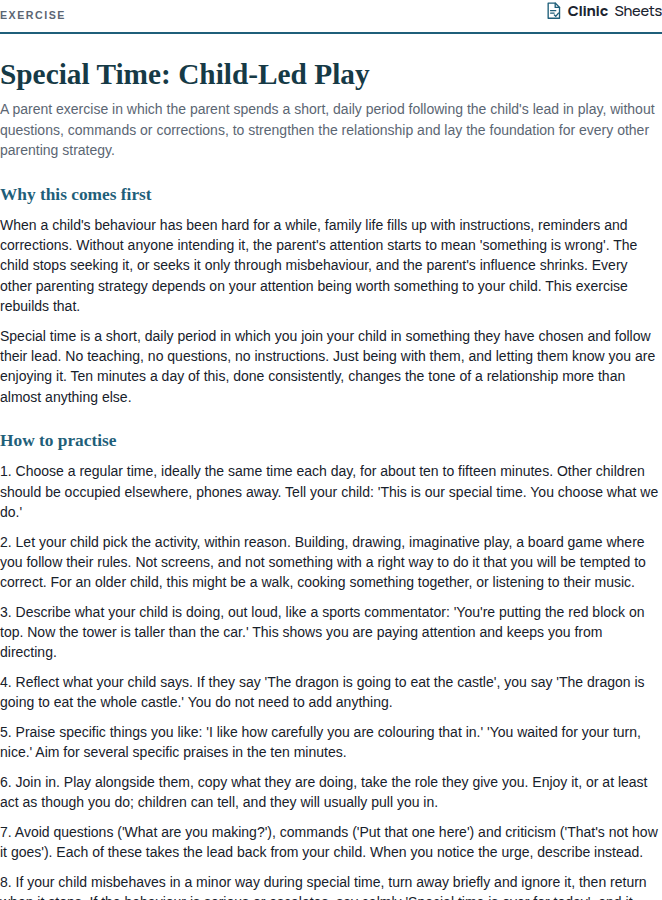
This handout explains the attention principle in plain terms, describes the features of effective praise (immediate, specific, sincere, and focused on effort and behaviour rather than character), introduces brief daily child-led play as a way of rebuilding the relationship, and addresses the common objections: that praise will make the child dependent or entitled, that the child does not deserve it, or that it feels unnatural. It is intended as the first parenting session in a course of work, before any strategy for reducing unwanted behaviour is introduced.
The professional version adds guidance on the ratio of positive to corrective interactions, on coaching parents to catch behaviour they usually overlook, on adapting praise for children who find it aversive, and on the parent's own history with praise, which often shapes their reluctance. It also includes a short script for introducing special time.
How to use it
- Ask the parent to describe a typical afternoon at home and count, with them, how many of their interactions with the child were corrections, instructions or warnings, and how many were positive. Most parents are surprised by the ratio.
- Introduce the attention principle using the parent's own example. Avoid framing it as blame; the cycle is natural and nearly universal.
- Practise specific praise in session with role play. Have the parent turn 'good job' into a sentence that names the behaviour. Watch for praise followed by a qualifier ('nice work, why can't you always do that?').
- Set up daily special time: five to ten minutes of child-led play with no questions, commands or corrections from the parent. Rehearse describing and praising what the child is doing.
- Give the handout to read at home and ask the parent to track praise and special time for a week using the reflection section. Review at the next session before moving on to limit setting.
References
- Kazdin, A. E. (2008). The Kazdin Method for Parenting the Defiant Child. Houghton Mifflin.
- Webster-Stratton, C. (2005). The Incredible Years: A Trouble-Shooting Guide for Parents of Children Aged 2-8 Years (Rev. ed.). Incredible Years.
- Eyberg, S. M., Nelson, M. M., & Boggs, S. R. (2008). Evidence-based psychosocial treatments for children and adolescents with disruptive behavior. Journal of Clinical Child and Adolescent Psychology, 37(1), 215-237.