Parenting: Managing Big Emotions
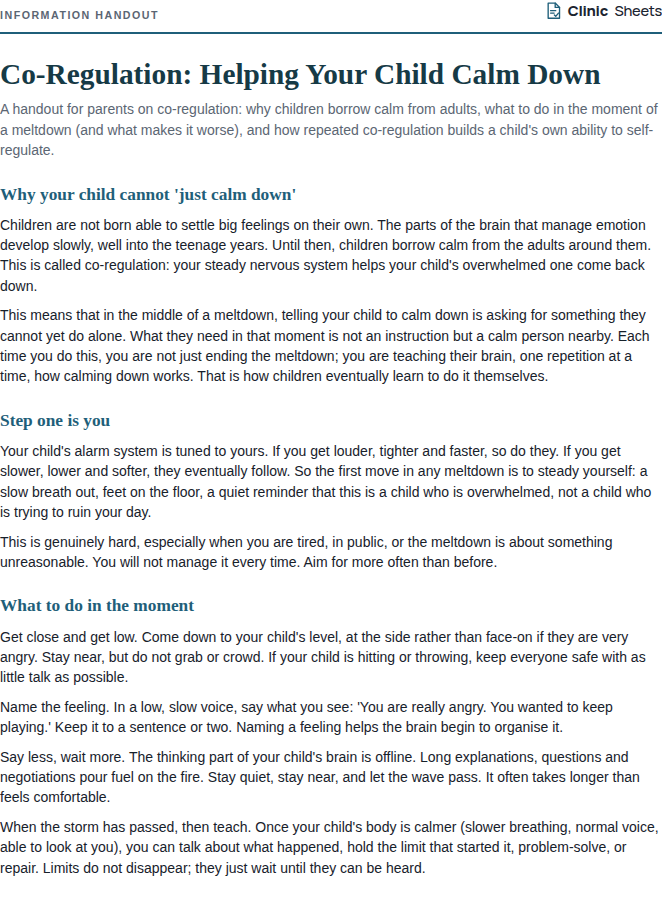
A handout for parents on responding to a child's meltdowns, rages and tears: what is happening in the child, why validation comes before problem solving, and how to coach through a big emotion without giving in or shutting it down.
About this resource
Parents of children with intense emotions frequently swing between two responses that both make things worse: dismissing the emotion ('you're fine, stop crying') or being swept into it (matching the child's volume, or giving in to end the scene). Both are understandable. Both, repeated over time, teach the child either that their feelings are unacceptable or that the only way to be heard is to escalate. Invalidation is a central mechanism in Linehan's biosocial model of emotion dysregulation, and it is also a common finding in the developmental literature on emotion coaching: children whose emotions are named and accepted, while their behaviour is still guided, develop better self-regulation.
This handout explains what is happening in a child's body and brain during a big emotion, why reasoning does not work at the peak, and introduces a simple sequence: stay calm, name and accept the feeling, hold the limit, and problem-solve afterwards. It addresses the distinction between validating a feeling and approving a behaviour, which is where most parents get stuck. It is written for parents of children aged roughly four to twelve and complements the Calm-Down Toolkit and Feelings Thermometer resources.
The professional version adds guidance on the parent's own arousal and how to coach parents whose own emotions are triggered by their child's, on distinguishing meltdowns from tantrums that are goal-directed, on when a pattern of intense emotion warrants further assessment, and on adapting the approach for neurodivergent children who may need longer recovery times and fewer words.
How to use it
- Ask the parent to describe a recent big emotion in detail: what led up to it, what the child did, what the parent did, and how it ended. Map the sequence together without judgement.
- Introduce the idea that the child's thinking brain is offline at the peak of an emotion, and that the parent's job in that moment is to be a calm anchor, not a teacher.
- Teach the validate-then-limit sequence with the parent's own example. Practise naming the feeling out loud ('you're really angry that the game ended') and separating it from the behaviour ('and it's not okay to throw the controller').
- Explore what the parent feels in those moments. Many parents feel shame, helplessness or anger, and their own regulation is the first thing to work on.
- Give the handout to read and ask the parent to try the sequence during the week, logging one or two attempts in the reflection section. Review at the next session and fine-tune.
References
- Gottman, J. M., Katz, L. F., & Hooven, C. (1996). Parental meta-emotion philosophy and the emotional life of families: Theoretical models and preliminary data. Journal of Family Psychology, 10(3), 243-268.
- Linehan, M. M. (1993). Cognitive-Behavioral Treatment of Borderline Personality Disorder. Guilford Press.
- Havighurst, S. S., Wilson, K. R., Harley, A. E., Prior, M. R., & Kehoe, C. (2010). Tuning in to Kids: Improving emotion socialization practices in parents of preschool children. Journal of Child Psychology and Psychiatry, 51(12), 1342-1350.