Understanding Your Child's Big Emotions
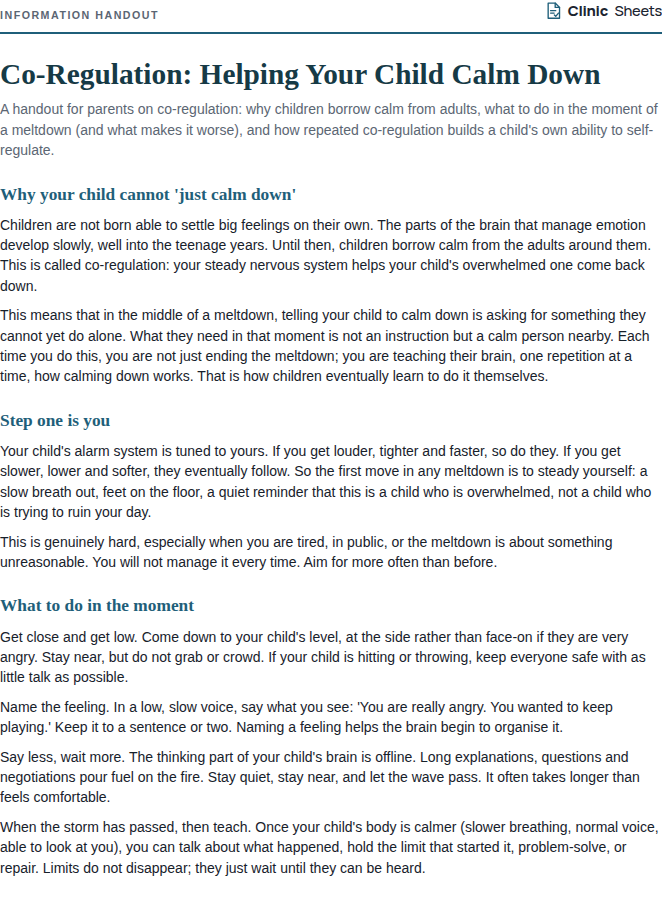
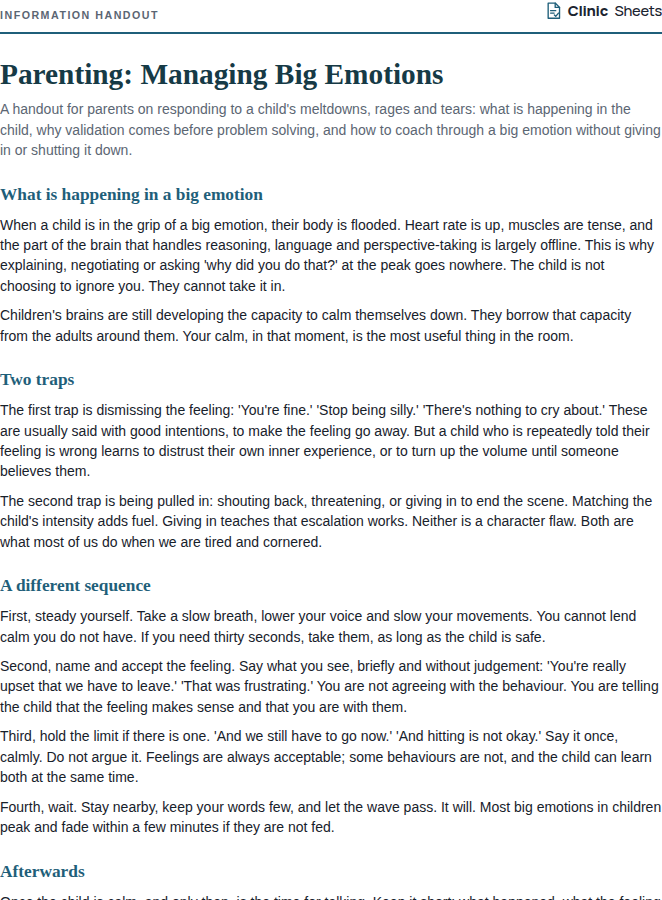
A handout for parents of an emotionally intense child, explaining why some children feel things more strongly and for longer, how well-meaning responses can accidentally invalidate, and how to validate a feeling while still holding a limit on behaviour.
About this resource
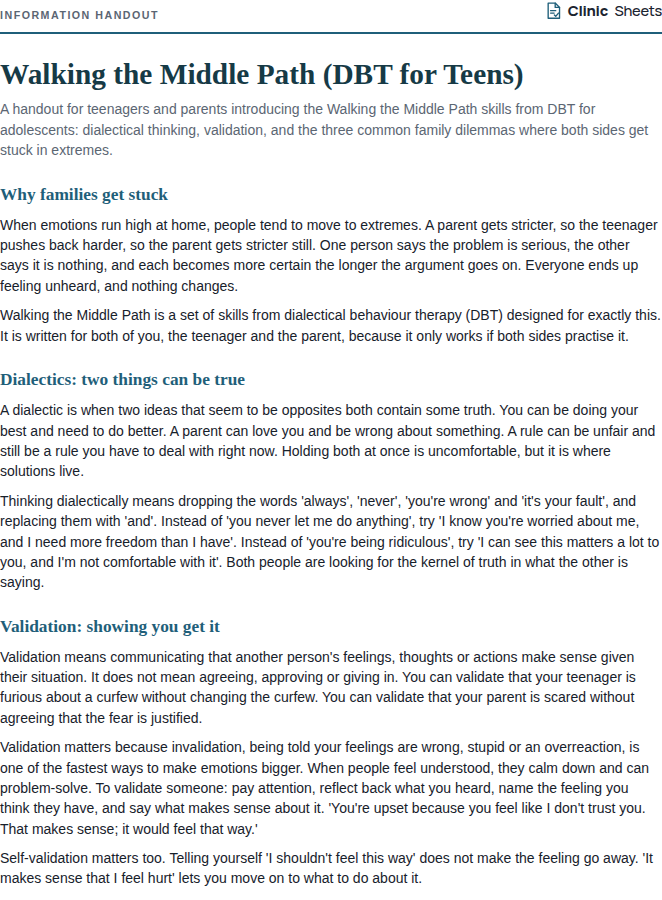
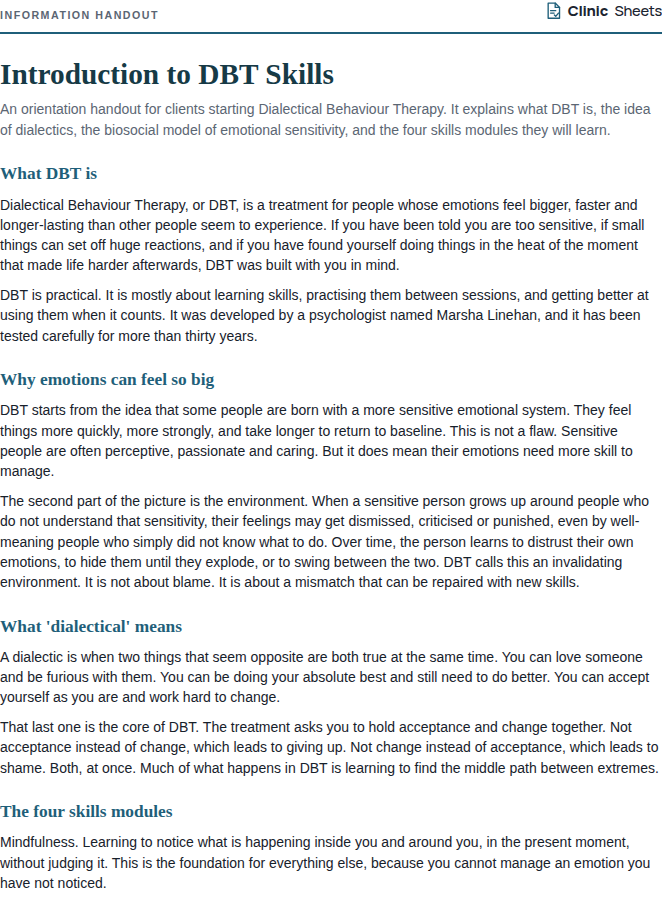
Linehan's biosocial theory proposes that emotion dysregulation develops from the interaction between a biologically based emotional vulnerability (higher sensitivity, greater intensity, slower return to baseline) and an invalidating environment: one that dismisses, punishes, minimises or over-simplifies the child's emotional experience. Invalidation is rarely deliberate. It comes from loving parents who are trying to calm the child down ('It's nothing to cry about'), fix the problem, or teach resilience, and who are themselves overwhelmed by the intensity. The child learns that their feelings are wrong or too much, does not learn to label and regulate them, and oscillates between suppressing emotion and escalating until someone responds.
This handout explains the theory to parents without blame. It describes what an emotionally sensitive child experiences, lists the ordinary parental responses that function as invalidation, and teaches validation in the DBT sense: acknowledging that the feeling is real and makes sense, without necessarily agreeing with the behaviour or the interpretation. It then separates validation from limit setting, because parents frequently believe that validating a feeling means giving in to a demand, and shows how the two go together. Gottman's emotion coaching work is drawn on for the practical steps.
The professional version adds notes on the parent's own emotional reactions and history of invalidation, on distinguishing validation from reassurance, on adolescents (for whom DBT-A multifamily skills training exists), and on the risk that a parent takes the theory as a verdict on their parenting. It is a starting point for parent work in DBT-informed and emotion-focused family treatment.
How to use it
- Introduce the two-part model (a sensitive child plus an environment that does not fit) carefully, emphasising that invalidation is ordinary and unintentional and that the parent is here precisely because they want to do this well.
- Ask the parent to recall a recent big-emotion episode and to walk through what they said. Identify any invalidating responses together, without judgement, and note what the parent was trying to achieve with them.
- Teach validation with examples from that episode. Rehearse validating statements in session; parents often find them unnatural at first.
- Practise pairing validation with a limit: 'You are furious that the game is off. That makes sense. And the game stays off.' Emphasise that validation is not agreement and not giving in.
- Ask the parent to notice their own emotional state during their child's episodes, since a dysregulated parent cannot co-regulate a child. Consider whether the parent needs their own regulation skills.
References
- Linehan, M. M. (1993). Cognitive-Behavioral Treatment of Borderline Personality Disorder. Guilford Press.
- Rathus, J. H., & Miller, A. L. (2015). DBT Skills Manual for Adolescents. Guilford Press.
- Gottman, J. M., & DeClaire, J. (1997). Raising an Emotionally Intelligent Child: The Heart of Parenting. Simon & Schuster.
- Havighurst, S. S., Wilson, K. R., Harley, A. E., Prior, M. R., & Kehoe, C. (2010). Tuning in to Kids: Improving emotion socialization practices in parents of preschool children. Journal of Child Psychology and Psychiatry, 51(12), 1342-1350.