Committed Action Plan (ACT)
A worksheet for turning a value into a concrete, scheduled action, anticipating the internal barriers that will show up, and planning how to make room for them. The ACT counterpart to behavioural goal setting.
About this resource
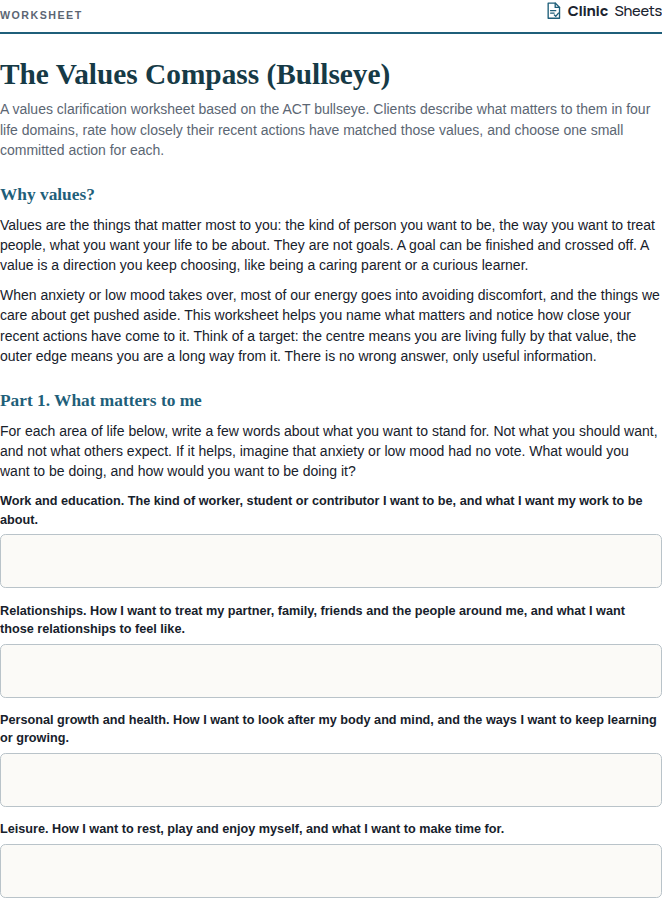
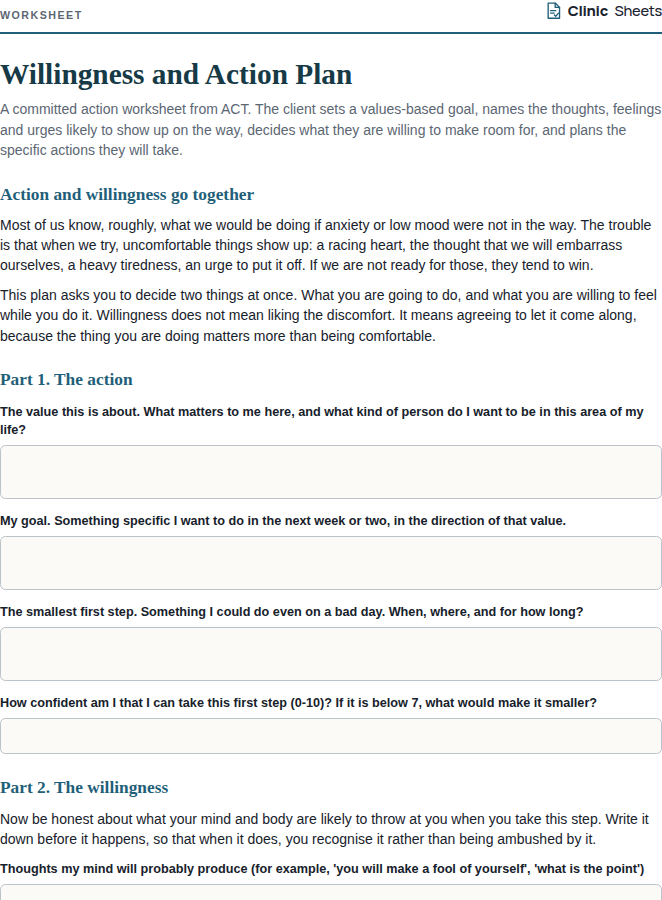
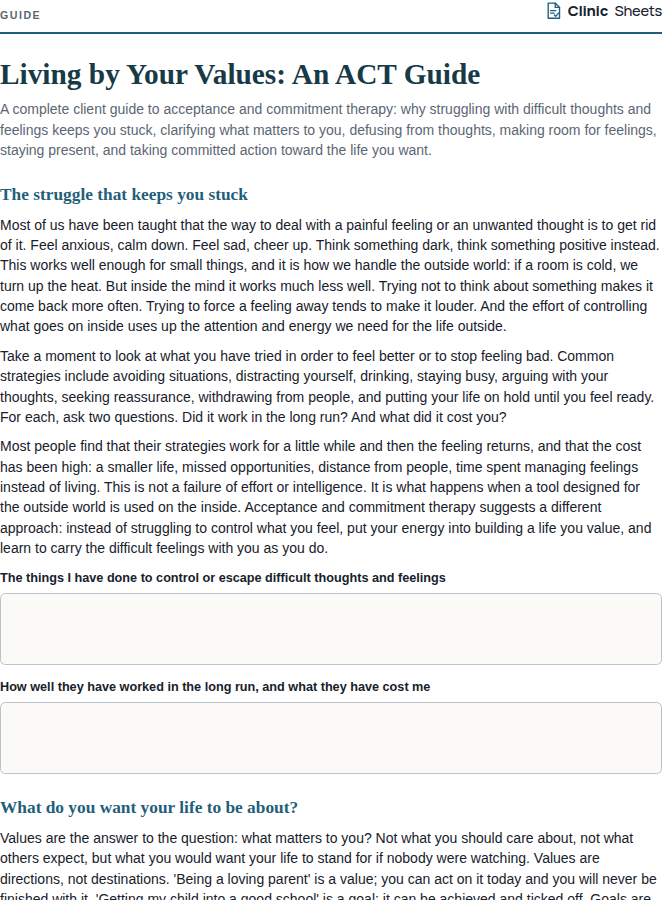
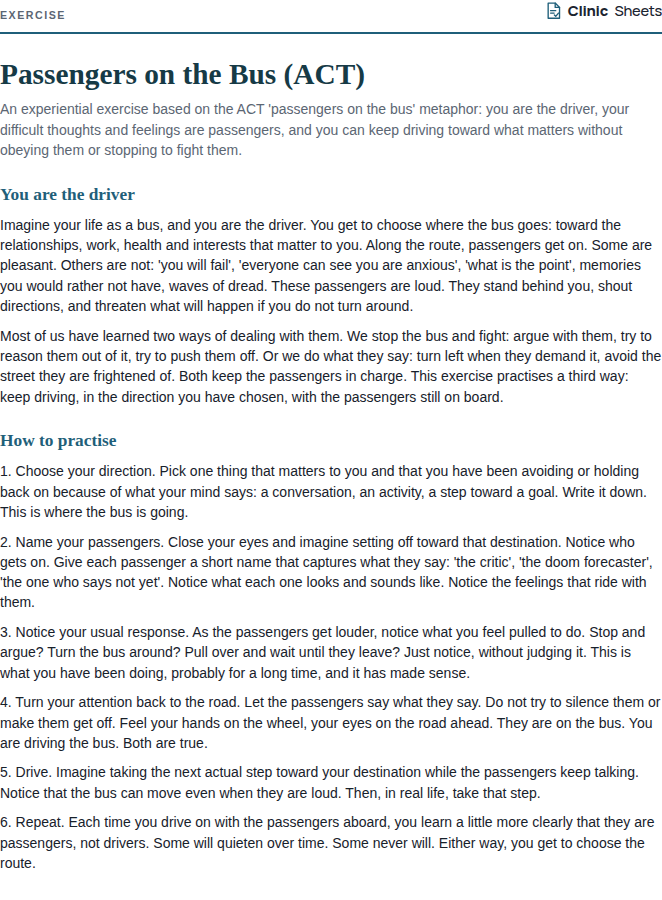
Committed action is the process in acceptance and commitment therapy by which values are translated into patterns of behaviour. It draws on traditional behavioural methods (goal setting, activity scheduling, graded tasks, skills training) but differs in two ways. First, action is chosen in the service of a stated value rather than to reduce a symptom. Second, the plan explicitly anticipates the thoughts, feelings and urges that will arise when the person acts, and treats these as expected passengers rather than reasons to stop. In depression and anxiety, most abandoned plans fail at exactly this point: the person waits to feel ready, or to feel less anxious, before acting.
This worksheet walks the client from a value to a small, specific action, checks that the action is genuinely in their control, forecasts the barriers, and pairs each internal barrier with an unhooking skill. It closes with a commitment statement and a review section. It can be used weekly as the standing between-session task once values have been clarified.
The professional version adds notes on right-sizing the action (small enough to be almost certain, large enough to matter), on distinguishing internal barriers from practical ones, and on responding to a missed commitment without either scolding or letting it pass unexamined.
How to use it
- Complete values clarification first. The worksheet needs a value the client has chosen, not a goal imposed by circumstances or by you.
- Help the client choose an action that is specific (what, when, where, with whom), within their control, and small. The first committed action should be one the client is confident they can complete even on a bad day.
- Spend most of the session time on the barriers section. Ask the client to imagine the moment of doing the action and describe what their mind will say and what their body will feel. Match each barrier to a skill already practised in therapy.
- Ask the client to state the commitment out loud, in the form 'I am going to [action] because I value [value]'. Saying it aloud strengthens it.
- Review at the next session. If the action was completed, ask what showed up and how they handled it. If not, treat this as data about the barriers rather than as failure, revise the action size or the skill, and recommit.
- Over several weeks, build a pattern: once an action is reliable, extend it or add a second value.
References
- Hayes, S. C., Strosahl, K. D., & Wilson, K. G. (2012). Acceptance and Commitment Therapy: The Process and Practice of Mindful Change (2nd ed.). Guilford Press.
- Harris, R. (2019). ACT Made Simple: An Easy-to-Read Primer on Acceptance and Commitment Therapy (2nd ed.). New Harbinger.
- Luoma, J. B., Hayes, S. C., & Walser, R. D. (2017). Learning ACT: An Acceptance and Commitment Therapy Skills Training Manual for Therapists (2nd ed.). New Harbinger.