Session-by-Session Protocol: CBT for Low Self-Esteem
A session-by-session clinician protocol for cognitive behavioural therapy for low self-esteem, following Fennell's model: deriving the individual formulation of the bottom line and rules for living, working with anxious predictions and self-critical thinking, building self-acceptance through positive data logs, changing the rules, and revising the bottom line.
About this resource
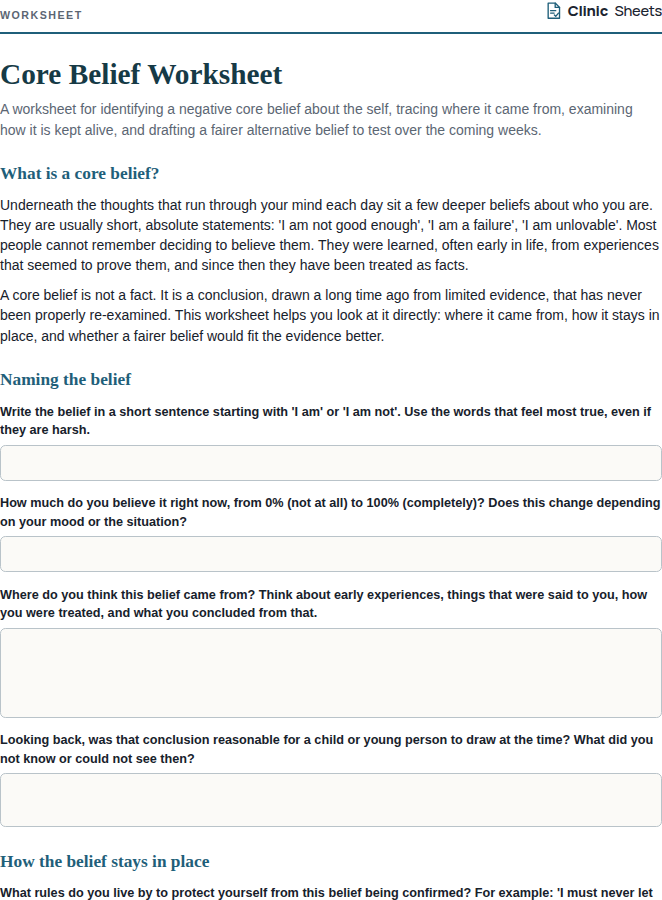
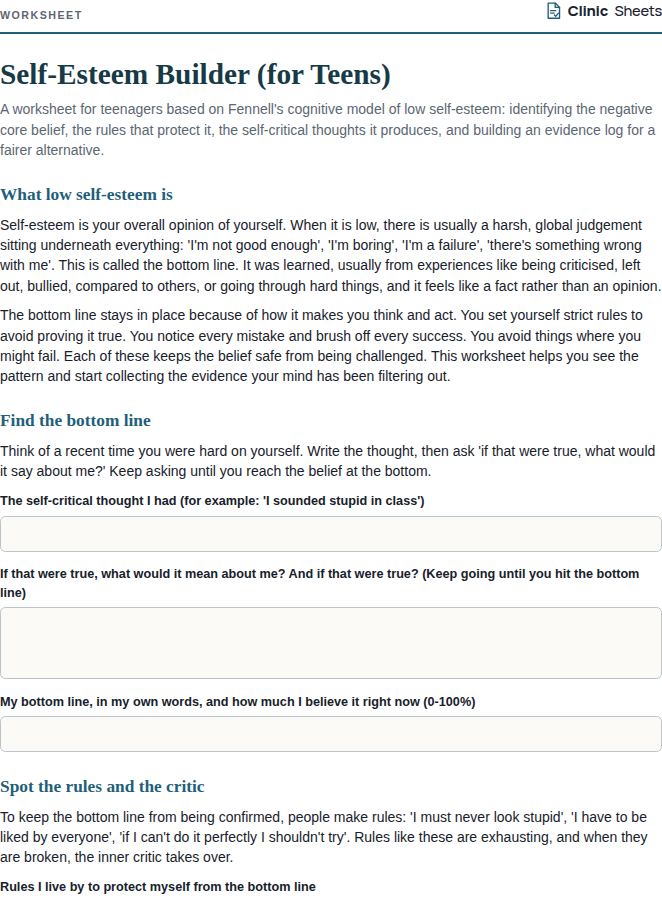
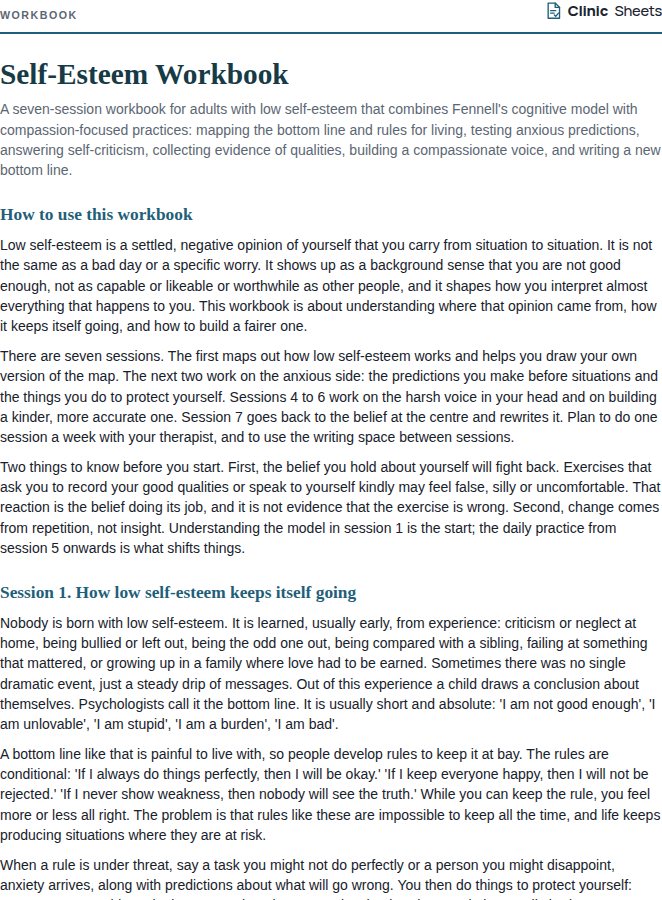
Fennell's cognitive model treats low self-esteem as a problem in its own right rather than only as a symptom of depression. At its centre is the bottom line, a global negative belief about the self ('I am worthless', 'I am not good enough') formed from early experience. The person develops rules for living ('If I always put others first, I will be accepted') that keep the bottom line dormant while they are obeyed. When a rule is threatened or broken, anxious predictions and safety behaviours follow; when the rule is judged to have been broken, the bottom line is activated, self-criticism and low mood follow, and the belief is confirmed. The model integrates the maintenance cycles of anxiety and depression around the self-belief.
This protocol follows the ten-session course evaluated by Waite, McManus and Shafran (2012) and the sequence set out in Fennell's work. The treatment moves from the anxiety-side cycle (predictions, safety behaviours and experiments) to the depression-side cycle (self-criticism and self-acceptance), then to the rules for living, and finally to the bottom line itself, with a written new bottom line and blueprint at the end. This order matters: experiments on predictions provide the early evidence that later work on beliefs draws on.
The professional version explains how to elicit the bottom line without it becoming a point of argument, how to run positive data logs so that they actually change belief rather than being dismissed, how to distinguish low self-esteem from a depressive episode that will lift with standard treatment, and how to adapt the protocol when the bottom line is linked to specific early memories or to a comorbid anxiety disorder.
How to use it
- Assess whether low self-esteem is the primary problem or is secondary to a current depressive or anxiety disorder that should be treated first. Administer the Rosenberg Self-Esteem Scale or Robson Self-Concept Questionnaire at baseline and end, and the PHQ-9 and GAD-7 weekly.
- Build the individual formulation in the first two sessions: early experience, bottom line, rules for living, the anxiety cycle and the depression cycle. Draw it and give the client a copy.
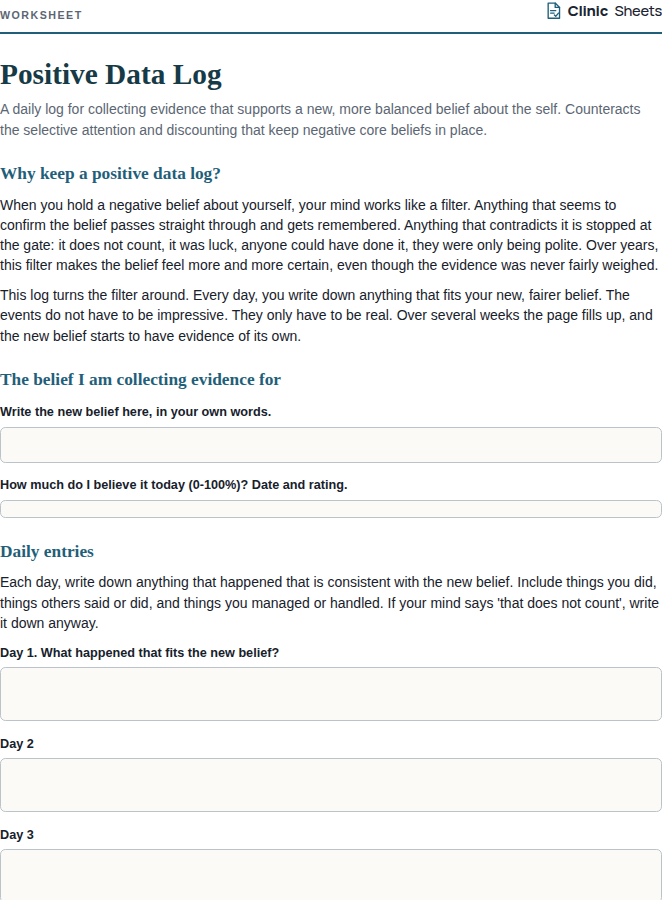
- Work the anxiety side first: identify anxious predictions, drop safety behaviours and run behavioural experiments. Then work the depression side: catch self-critical thoughts and begin a positive data log.
- Address the rules for living in the middle sessions and the bottom line in the later sessions, using the evidence accumulated from experiments and the log.
- End with a written new bottom line, new rules, and a blueprint for maintaining change.
References
- Fennell, M. J. V. (1997). Low self-esteem: A cognitive perspective. Behavioural and Cognitive Psychotherapy, 25(1), 1-25.
- Fennell, M. (2016). Overcoming Low Self-Esteem: A Self-Help Guide Using Cognitive Behavioural Techniques (2nd ed.). Robinson.
- Waite, P., McManus, F., & Shafran, R. (2012). Cognitive behaviour therapy for low self-esteem: A preliminary randomized controlled trial in a primary care setting. Journal of Behavior Therapy and Experimental Psychiatry, 43(4), 1049-1057.
- Padesky, C. A. (1994). Schema change processes in cognitive therapy. Clinical Psychology and Psychotherapy, 1(5), 267-278.