Self-Esteem Builder (for Teens)
A worksheet for teenagers based on Fennell's cognitive model of low self-esteem: identifying the negative core belief, the rules that protect it, the self-critical thoughts it produces, and building an evidence log for a fairer alternative.
About this resource
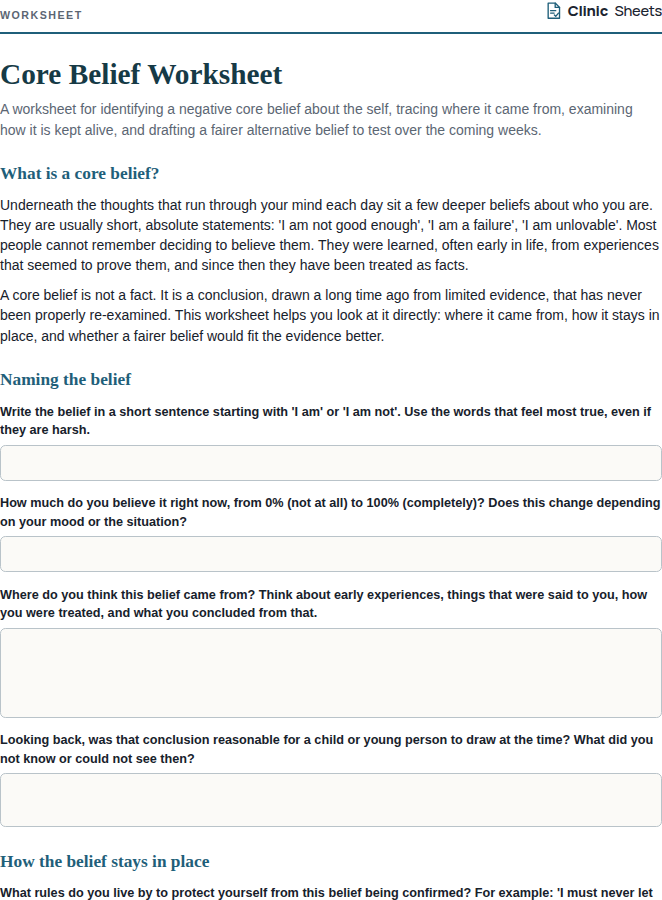
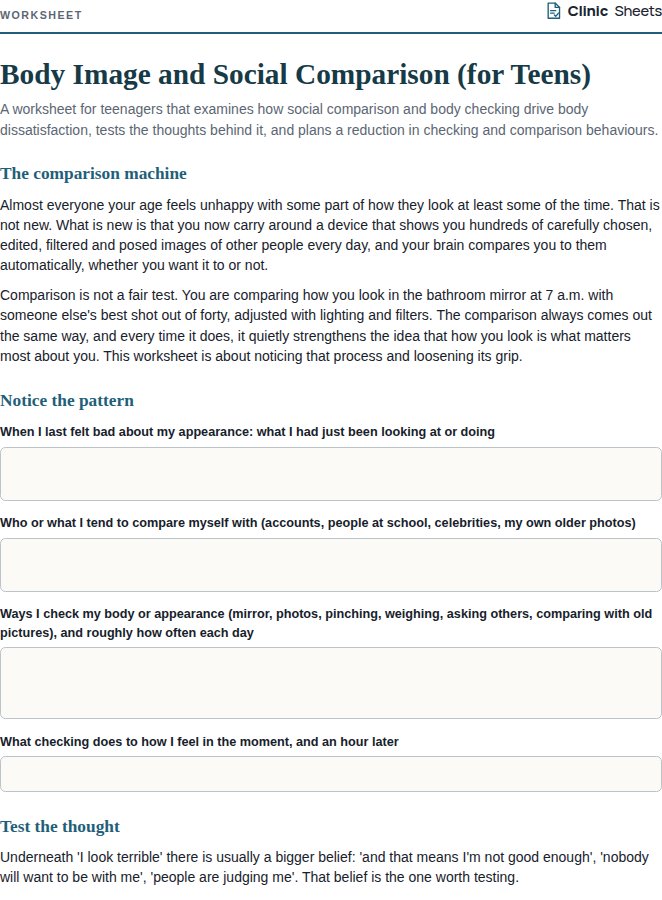
Fennell's cognitive model describes low self-esteem as a global negative belief about the self, formed through experience, and maintained by two mechanisms: rules for living that require constant effort to avoid confirming the belief, and a bias in attention and memory that registers failures and discounts successes. In adolescence the belief is often being actively formed, and the maintaining cycle is visible in perfectionism, social withdrawal, harsh self-criticism after minor setbacks, and difficulty accepting praise.
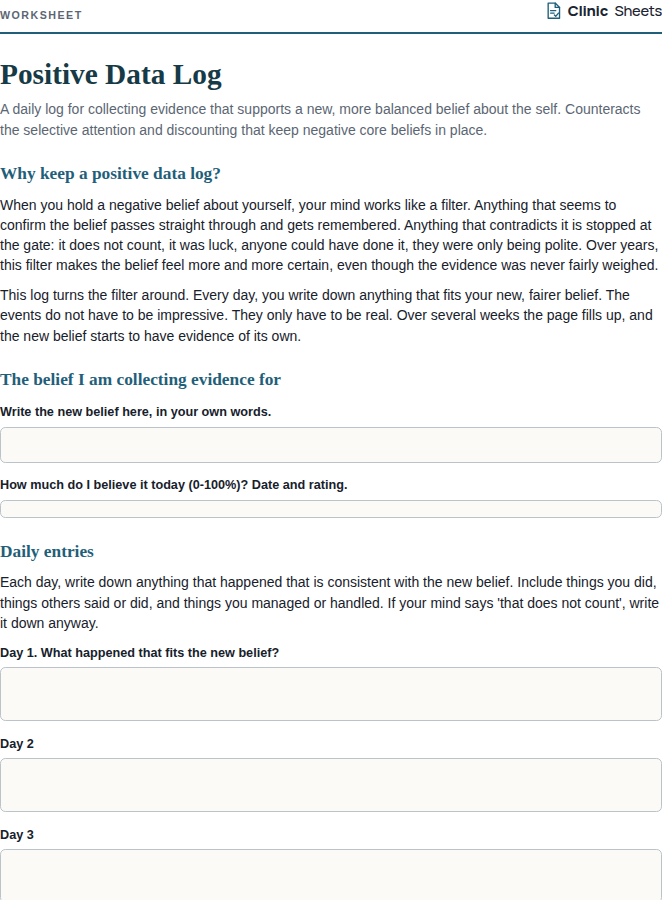
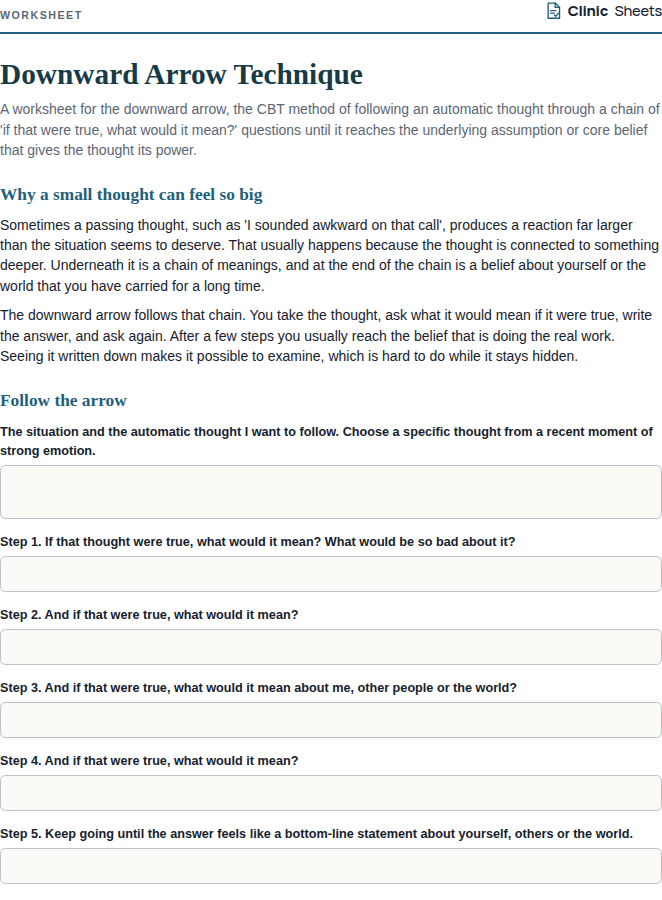
This worksheet takes the young person through the model in a simplified form: naming the bottom line, spotting the rules and the self-critical voice, examining the evidence with attention to what is being filtered out, and starting an ongoing log of evidence for a more balanced self-view. It is written to be revisited across several sessions rather than completed once. The language avoids the term 'core belief' in favour of 'bottom line', following Fennell's client materials.
The professional version adds guidance on eliciting the bottom line without the young person feeling exposed, on working with the discounting of positive evidence that makes the log difficult at first, and on where to focus when the belief has been shaped by bullying, criticism or trauma.
How to use it
- Introduce the model with the young person's own recent example of self-criticism, tracing it back to the belief underneath.
- Elicit the bottom line gently, using the downward arrow. Accept the young person's own wording and do not argue with it.
- Identify one or two rules for living and the self-critical thoughts that follow when a rule is broken. Note the cost of each rule.
- Start the evidence log in session with two or three entries, modelling how small and ordinary the evidence can be. Set it as an ongoing task.
- Return to the log each session. Over time, introduce a balanced alternative belief and rate it alongside the original.
References
- Fennell, M. J. V. (1997). Low self-esteem: A cognitive perspective. Behavioural and Cognitive Psychotherapy, 25(1), 1-25.
- Fennell, M. (2016). Overcoming Low Self-Esteem: A Self-Help Guide Using Cognitive Behavioural Techniques (2nd ed.). Robinson.
- Stallard, P. (2019). Think Good, Feel Good: A Cognitive Behavioural Therapy Workbook for Children and Young People (2nd ed.). Wiley.