Positive Data Log
A daily log for collecting evidence that supports a new, more balanced belief about the self. Counteracts the selective attention and discounting that keep negative core beliefs in place.
About this resource
Negative core beliefs survive because of how information is processed rather than because the evidence supports them. Experiences that fit the belief are noticed, remembered and taken as proof; experiences that do not fit are overlooked, minimised or attributed to luck. Padesky's positive data log, developed within Beck's cognitive model and central to Fennell's treatment of low self-esteem, reverses this bias deliberately. The client is asked to record, every day, any event however small that is consistent with a new belief, so that the new belief begins to accumulate the evidence it has never been allowed to collect.
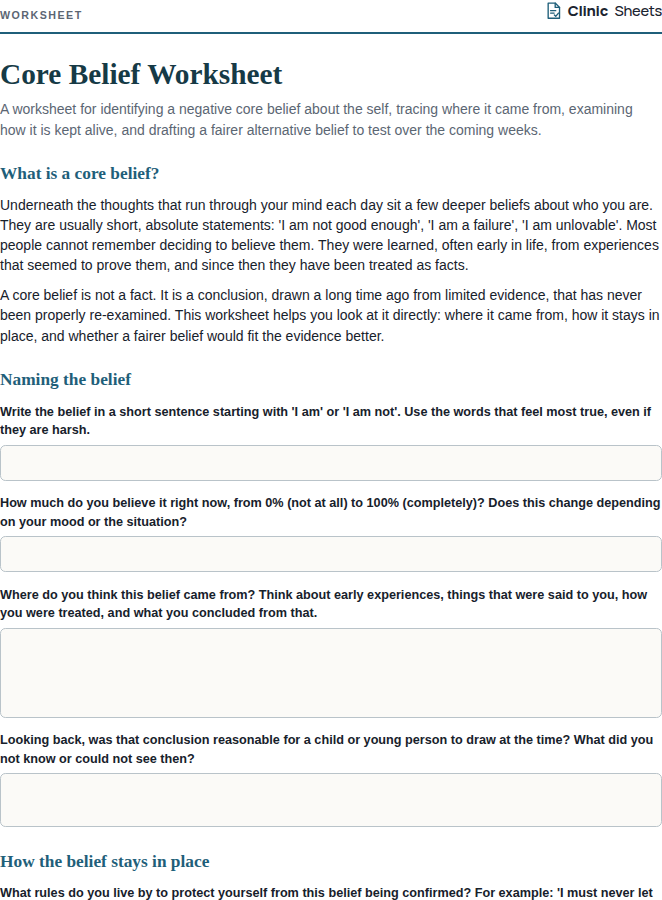
The log works best once a specific alternative belief has been drafted (see Core Belief Worksheet). It is a long-term tool rather than a one-week exercise: most clients need several weeks of daily entries before the new belief starts to feel like a real possibility, and the effect strengthens over time as entries accumulate.
The professional version includes guidance on the very common early difficulty of clients returning with an empty log, on the difference between logging an event and logging a feeling, and on using the log entries in session to re-rate belief in the old and new statements.
How to use it
- Agree the new belief to be tested. Write it at the top of the log in the client's words. It should be specific enough that evidence for it can be recognised.
- In session, generate the first five or six entries together from the past week so the client leaves with a model of what counts. Small, ordinary events are the point: a colleague said thanks, a task was finished, a friend texted first.
- Set the expectation that the belief itself will not feel different for a while. The task is to record evidence, not to feel convinced.
- If the client returns with few entries, walk through their week hour by hour and pull out events they discounted. Name the discounting when it happens ('that does not count because anyone could do it').
- Review the log at the start of each session. Re-rate belief in the old and new statements every two to three weeks and record the numbers on the log.
- Continue for at least six to eight weeks. When the log is full, start a new page; do not throw the old one away.
References
- Padesky, C. A. (1994). Schema change processes in cognitive therapy. Clinical Psychology and Psychotherapy, 1(5), 267-278.
- Fennell, M. (2016). Overcoming Low Self-Esteem (2nd ed.). Robinson.
- Greenberger, D., & Padesky, C. A. (2015). Mind Over Mood (2nd ed.). Guilford Press.