Sleep Hygiene
A handout covering the daytime and evening habits that support good sleep: light, caffeine, alcohol, exercise, the bedroom environment, and the wind-down period. Honest about what sleep hygiene can and cannot do on its own.
About this resource
Sleep hygiene refers to the behavioural and environmental practices that support the body's natural sleep regulation. It is usually delivered as a list of do's and don'ts, and clients with chronic insomnia have frequently tried it already without success. That is not because the advice is wrong but because sleep hygiene addresses the conditions for sleep rather than the conditioned arousal and sleep effort that maintain insomnia. Used alone it is not an effective treatment for chronic insomnia; used as one component of CBT-I it removes obstacles that would otherwise limit the effect of stimulus control and sleep restriction.
This handout sets expectations accordingly. It explains the reasoning behind each recommendation in terms of the two-process model, so that clients can judge which items apply to them rather than following a list mechanically. The emphasis is on the few things that matter most: regular wake time, morning light, limiting caffeine and alcohol, keeping the bedroom for sleep, and a genuine wind-down that is not a sleep-forcing ritual.
Suitable for adults. Also useful as a general resource for clients with anxiety or depression whose sleep is disrupted but who do not meet criteria for insomnia disorder. The professional version adds notes on caffeine half-life, alcohol's effect on sleep architecture, and how to frame sleep hygiene for clients who have 'tried everything'.
How to use it
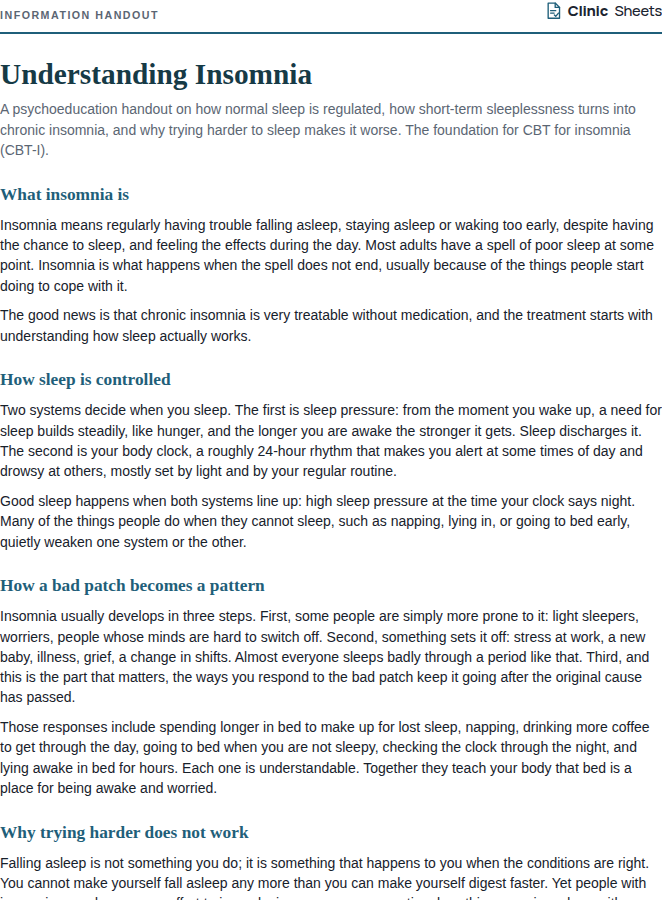
- Introduce sleep hygiene after the Understanding Insomnia handout, and be clear that it is a foundation, not the treatment. Clients who expect it to fix insomnia will be disappointed and may disengage.
- Go through the list and ask the client to identify which items are already in place and which are not. Focus on two or three changes, not all of them at once.
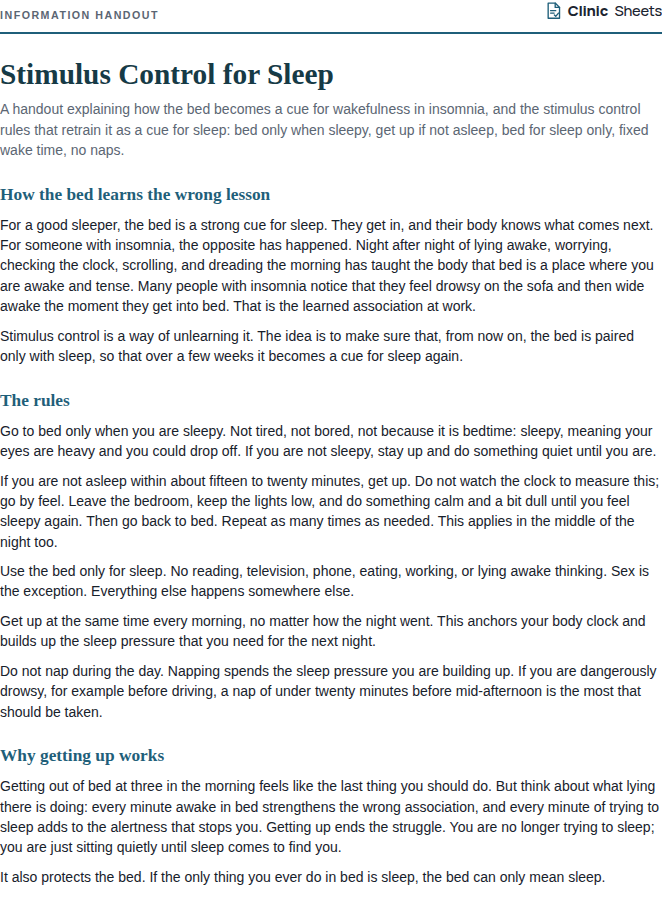
- Give particular weight to a fixed wake time and morning light, since these anchor the body clock and set up sleep restriction later.
- Watch for hygiene practices that have become sleep effort: elaborate rituals, strict rules about screens, or lying in the dark for an hour 'winding down'. These need to be relaxed rather than intensified.
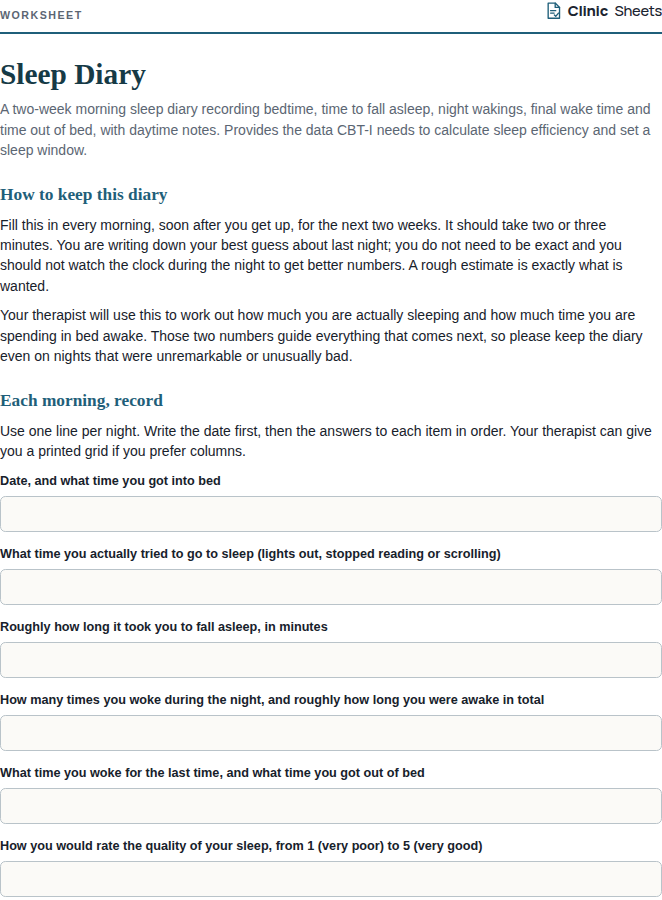
- Review at the next session using the sleep diary to check whether changes were made and what, if anything, shifted.
References
- Morin, C. M., & Espie, C. A. (2003). Insomnia: A Clinical Guide to Assessment and Treatment. Kluwer Academic/Plenum.
- Irish, L. A., Kline, C. E., Gunn, H. E., Buysse, D. J., & Hall, M. H. (2015). The role of sleep hygiene in promoting public health: A review of empirical evidence. Sleep Medicine Reviews, 22, 23-36.
- Edinger, J. D., Arnedt, J. T., Bertisch, S. M., et al. (2021). Behavioral and psychological treatments for chronic insomnia disorder in adults: An American Academy of Sleep Medicine clinical practice guideline. Journal of Clinical Sleep Medicine, 17(2), 255-262.