Understanding Insomnia
A psychoeducation handout on how normal sleep is regulated, how short-term sleeplessness turns into chronic insomnia, and why trying harder to sleep makes it worse. The foundation for CBT for insomnia (CBT-I).
About this resource
Cognitive behavioural therapy for insomnia is the recommended first-line treatment for chronic insomnia, and its effectiveness depends heavily on the client understanding the model. Most people with insomnia have developed a set of beliefs and habits, all of which make sense on the surface and all of which perpetuate the problem: going to bed earlier to catch up, lying in to compensate, napping, spending long periods awake in bed, and monitoring how much sleep they are getting.
This handout explains the two-process model of sleep regulation (homeostatic sleep drive and the circadian rhythm), Spielman's three-factor model of how insomnia develops (predisposing, precipitating and perpetuating factors), and the concept of sleep effort described by Espie and colleagues: the paradox that sleep is an involuntary process that cannot be forced, and that trying to force it produces the arousal that prevents it. It also addresses the common catastrophic beliefs about the consequences of poor sleep that drive anxiety at bedtime.
Suitable for adults beginning CBT-I. The professional version adds a brief screening note on when to consider sleep apnoea, restless legs, circadian disorders or medication effects before starting CBT-I, and a summary of the conditioned arousal concept that the Stimulus Control handout builds on.
How to use it
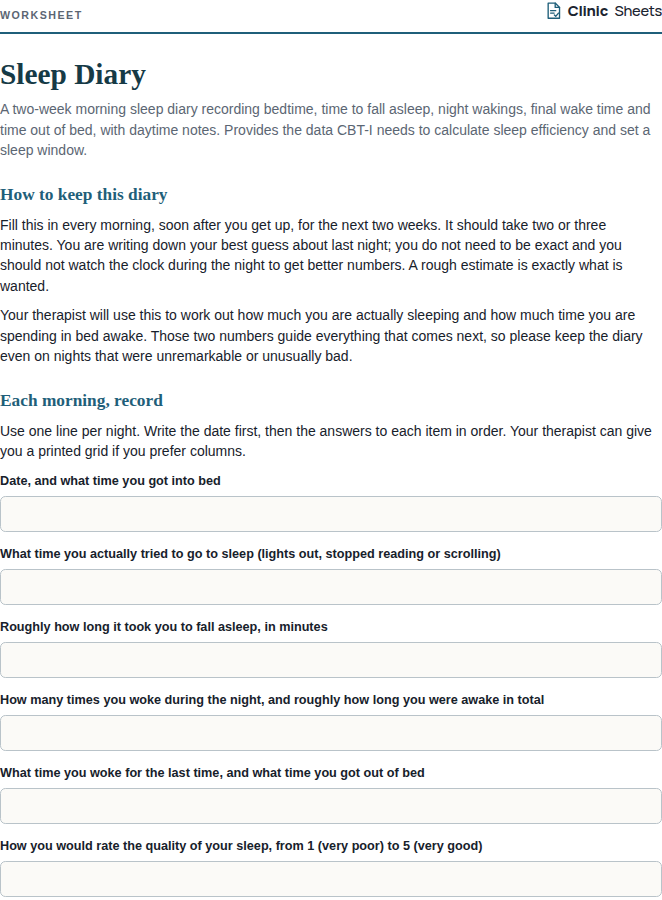
- Use in the first session of CBT-I, alongside starting the sleep diary. The diary provides the data; this handout provides the model.
- Ask the client to identify their own predisposing, precipitating and perpetuating factors as you go through the three-factor section. Most clients can name the event that started it and are surprised to see the perpetuating factors as a distinct category.
- Spend time on sleep effort. Ask what the client currently does to try to make sleep happen, and gently make the case that each strategy adds to arousal.
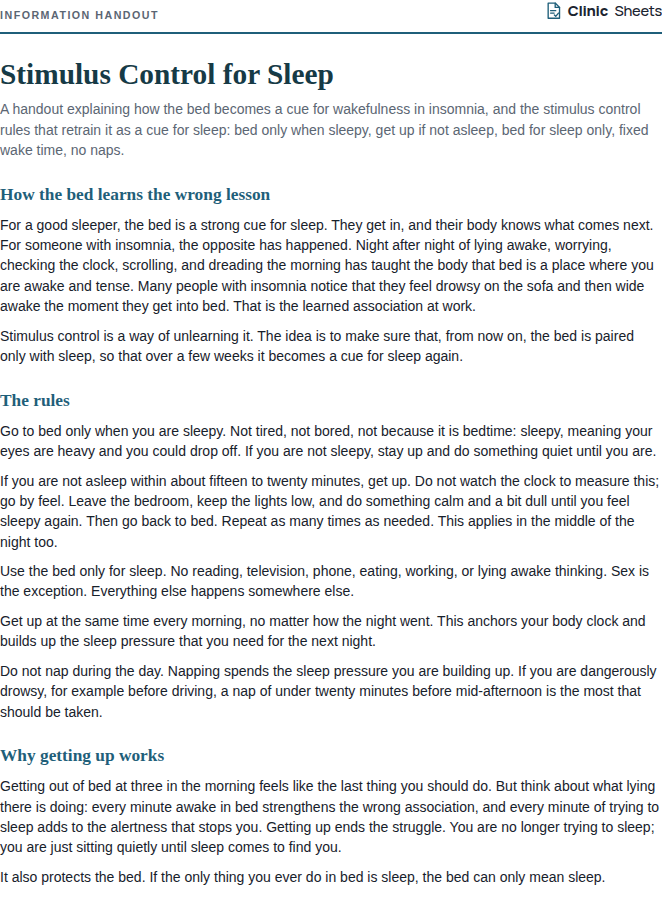
- Follow with Sleep Hygiene and Stimulus Control for Sleep, then sleep restriction once two weeks of diary data are available.
- Screen for other sleep disorders before starting sleep restriction: loud snoring, witnessed apnoeas, restless legs, or a strongly shifted sleep schedule warrant medical review.
References
- Spielman, A. J., Caruso, L. S., & Glovinsky, P. B. (1987). A behavioral perspective on insomnia treatment. Psychiatric Clinics of North America, 10(4), 541-553.
- Espie, C. A., Broomfield, N. M., MacMahon, K. M. A., Macphee, L. M., & Taylor, L. M. (2006). The attention-intention-effort pathway in the development of psychophysiologic insomnia: A theoretical review. Sleep Medicine Reviews, 10(4), 215-245.
- Harvey, A. G. (2002). A cognitive model of insomnia. Behaviour Research and Therapy, 40(8), 869-893.
- Morin, C. M., & Espie, C. A. (2003). Insomnia: A Clinical Guide to Assessment and Treatment. Kluwer Academic/Plenum.