Difficulties in Emotion Regulation Scale (DERS): Scoring and Interpretation Guide
A clinician's guide to scoring and interpreting the Difficulties in Emotion Regulation Scale (DERS), Gratz and Roemer's 36-item self-report measure of emotion dysregulation. Covers the six subscales, the reverse-scored items, the absence of published cut-offs, the short forms, and how to use the profile to plan and track DBT skills work.
About this resource
The DERS was developed by Kim Gratz and Lizabeth Roemer (2004) as a multidimensional measure of clinically relevant difficulties in emotion regulation. Rather than treating regulation as a single ability, it draws on a model in which adaptive regulation involves awareness and understanding of emotions, acceptance of emotions, the ability to control impulsive behaviour and act in line with goals while distressed, and access to strategies that are felt to be effective. Its 36 items produce a total score and six subscale scores that correspond to difficulties in each of these areas. It is widely used in DBT services, in research on borderline personality disorder, self-harm, substance use and eating disorders, and as a general measure of the transdiagnostic process that emotion regulation skills training targets.
This resource is a scoring and interpretation guide. The DERS is copyrighted by its authors, who make it freely available for clinical and research use, but in keeping with our policy on copyrighted instruments we do not reproduce the items. The guide describes the response format, the scoring including the reverse-scored items, the six subscales and what each one means clinically, the psychometric evidence you can rely on, the two widely used short forms, and how to read a DERS profile when planning a DBT skills programme. It is candid about the fact that the DERS has no validated clinical cut-offs, and explains how to interpret it without them.
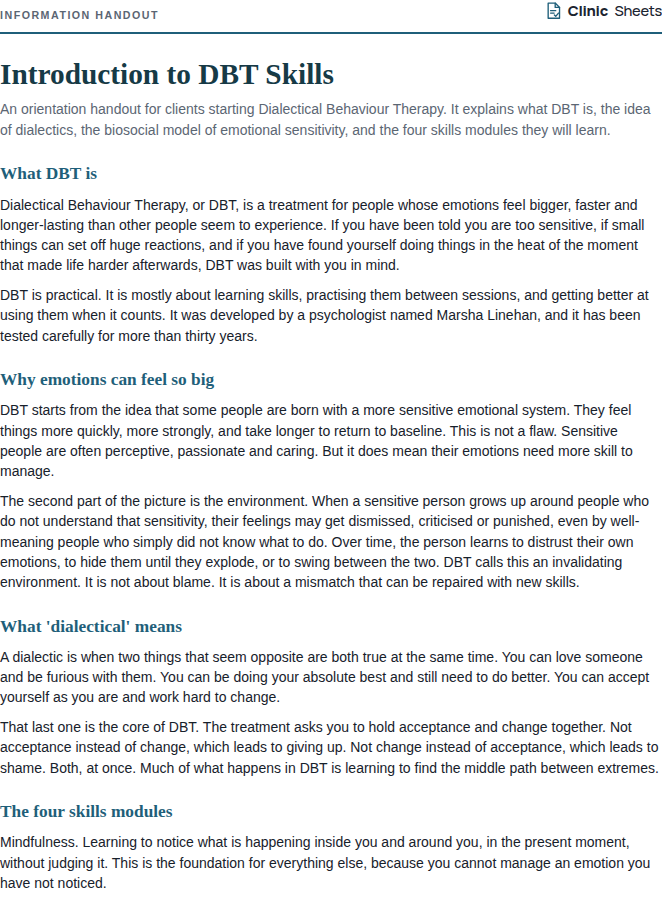
For clinicians delivering DBT or emotion regulation skills training, the value of the DERS is in the profile rather than the total. High scores on the strategies and impulse subscales point to distress tolerance and crisis survival skills; high scores on nonacceptance point to the mindfulness and self-validation components; high scores on awareness and clarity point to the emotion identification work at the start of the emotion regulation module.
How to use it
- Obtain the DERS from the authors' published paper or an official source. Administer at assessment and explain that the questions ask about how the person usually responds to their emotions, not about the past week.
- Score each item from 1 to 5 as marked, reversing the eleven reverse-worded items so that a high score always means more difficulty. Sum all 36 items for the total (range 36 to 180) and sum the items within each subscale for the six subscale scores.
- Because there are no published clinical cut-offs, interpret the total in relation to the person's own baseline and to published sample means, and interpret the subscales relative to each other. Identify the two or three highest subscales and map them onto the skills modules you plan to teach.
- Share the profile with the client as a description of where their regulation system is under strain, using their own examples from the diary card or chain analyses to bring the subscales to life.
- Repeat the DERS at the end of each skills module or every eight to twelve weeks and at the end of treatment. Look for movement in the subscales that were targeted; the total moves more slowly and is best used as a pre and post measure.
References
- Gratz, K. L., & Roemer, L. (2004). Multidimensional assessment of emotion regulation and dysregulation: Development, factor structure, and initial validation of the Difficulties in Emotion Regulation Scale. Journal of Psychopathology and Behavioral Assessment, 26(1), 41-54.
- Bjureberg, J., Ljótsson, B., Tull, M. T., Hedman, E., Sahlin, H., Lundh, L. G., Bjärehed, J., DiLillo, D., Messman-Moore, T., Gumpert, C. H., & Gratz, K. L. (2016). Development and validation of a brief version of the Difficulties in Emotion Regulation Scale: The DERS-16. Journal of Psychopathology and Behavioral Assessment, 38(2), 284-296.
- Linehan, M. M. (2015). DBT skills training manual (2nd ed.). Guilford Press.