Dropping Anchor (Audio Script)
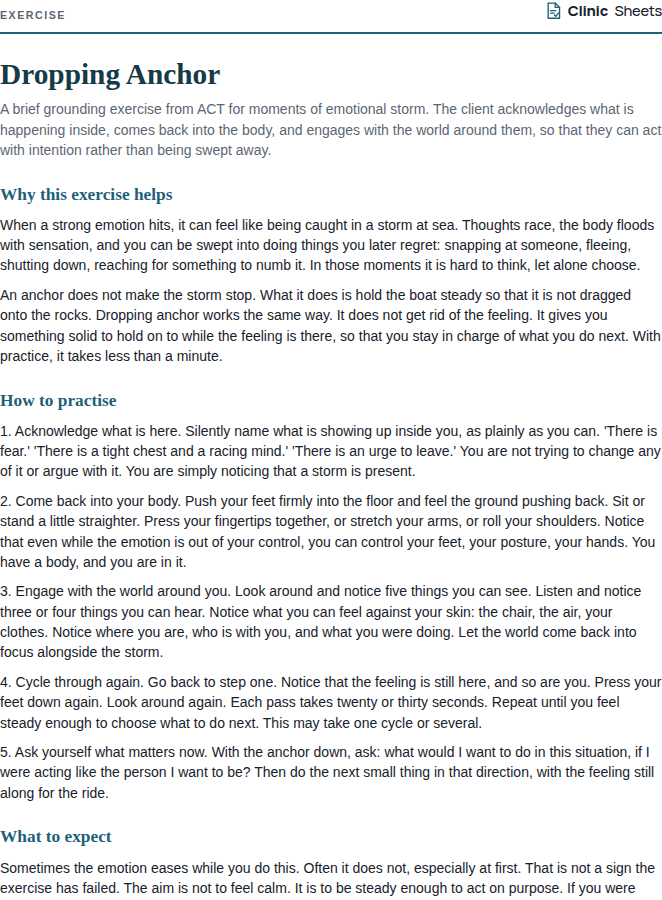
A read-aloud script for Russ Harris's Dropping Anchor grounding exercise, built around the ACE sequence: acknowledge your inner experience, come back into your body, engage with the world. For emotional storms, dissociation, overwhelm and urges.
About this resource
Dropping Anchor is a grounding exercise from Acceptance and Commitment Therapy, developed and popularised by Russ Harris. It is designed for moments when a client is caught in what Harris calls an emotional storm: flooded with painful feelings, memories or urges and unable to think or act clearly. The metaphor is that an anchor does not make the storm go away; it holds the boat steady until the storm passes. The exercise does not aim to reduce distress, though that often happens. It aims to give the client control over their attention and their actions while the distress is present.
The exercise follows the ACE sequence. Acknowledge: notice and name what is showing up inside, with curiosity rather than argument. Come back into your body: press the feet down, stretch, move, breathe, and take control of the parts of the body that can be controlled. Engage: notice the world around you through the senses and re-connect with what you are doing. The sequence is repeated two or three times, each cycle typically leaving the client more present. Because the first step is acknowledging the difficult experience rather than distracting from it, the exercise is consistent with acceptance and is not a control strategy.
This script is written to be recorded or read aloud at a steady pace, and runs around eight to ten minutes. Once learned, the exercise can be done in thirty seconds without a recording, and that is the goal. The professional version adds notes on using the exercise in session when a client dissociates or becomes flooded, on adapting the body step for clients with mobility limitations or trauma-related discomfort with body focus, and on checking afterwards that the client has not turned the exercise into a way of getting rid of feelings.
How to use it
- Introduce the anchor metaphor before the practice: an anchor does not stop the storm, it stops the boat from being swept away. Make clear that the exercise is not a way to make feelings disappear.
- First practise in session when the client is calm or only mildly distressed, so the sequence is familiar before it is needed in a storm. Do it with the client rather than to them, doing the movements yourself.
- Use it in session whenever a client becomes flooded, dissociated or stuck in rumination. Keep your voice steady and give simple instructions: press your feet down, look around the room, tell me five things you can see.
- Assign practice with the recording daily for a week, then ask the client to use a shortened version several times a day in ordinary moments, so that it becomes automatic.
- Check in afterwards: did you notice the feelings, were you able to take control of your body and attention, and were you able to engage with what you were doing. If the client reports using it only to escape feelings, revisit the acknowledge step.
References
- Harris, R. (2019). ACT Made Simple: An Easy-to-Read Primer on Acceptance and Commitment Therapy (2nd ed.). New Harbinger.
- Harris, R. (2021). Trauma-Focused ACT: A Practitioner's Guide to Working with Mind, Body, and Emotion Using Acceptance and Commitment Therapy. New Harbinger.
- Hayes, S. C., Strosahl, K. D., & Wilson, K. G. (2012). Acceptance and Commitment Therapy: The Process and Practice of Mindful Change (2nd ed.). Guilford Press.