First Responders and Occupational Trauma
A handout for police, firefighters, paramedics, correctional officers, dispatchers and other public safety personnel on how repeated exposure to critical incidents affects mind and body, why the usual coping strategies wear thin, and when and how to get help.
About this resource
Public safety personnel are exposed to potentially traumatic events as a routine part of their work, and the exposure is cumulative: not one event but hundreds over a career. Canadian survey research led by Carleton and colleagues found substantially elevated rates of PTSD, depression, anxiety and related difficulties among public safety personnel compared with the general population, and international reviews of rescue workers report the same pattern. Occupational trauma in this group has distinctive features: exposure is repeated and expected, the culture prizes composure and self-reliance, symptoms are often attributed to the job rather than recognised as treatable, and help-seeking is inhibited by stigma and by concerns about fitness-for-duty consequences.
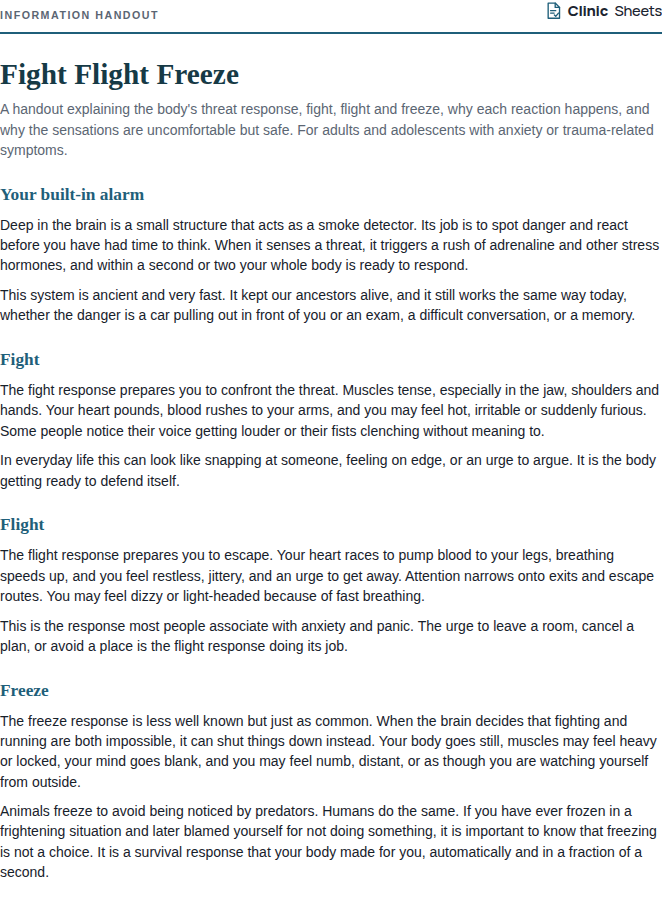
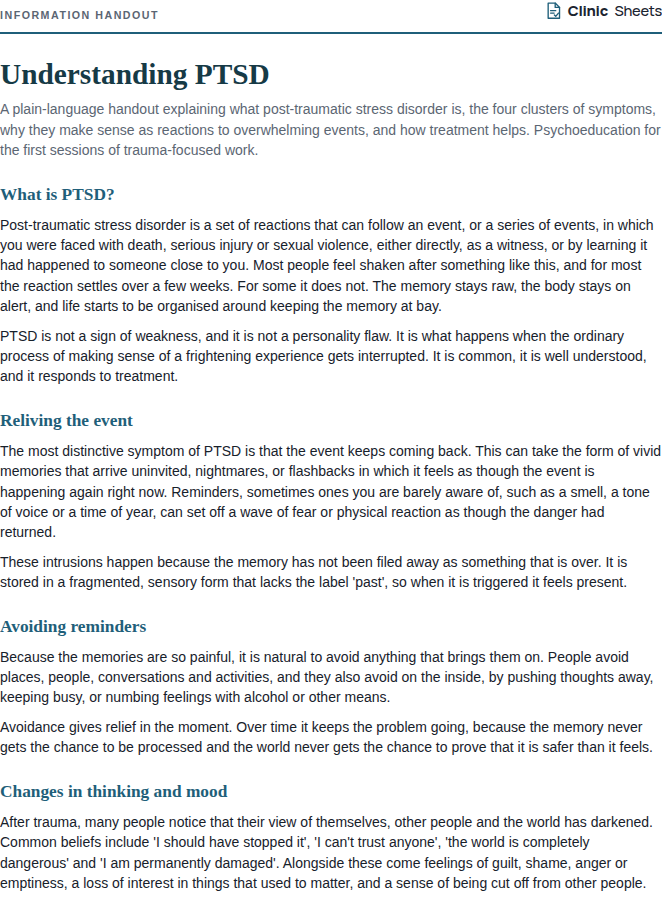
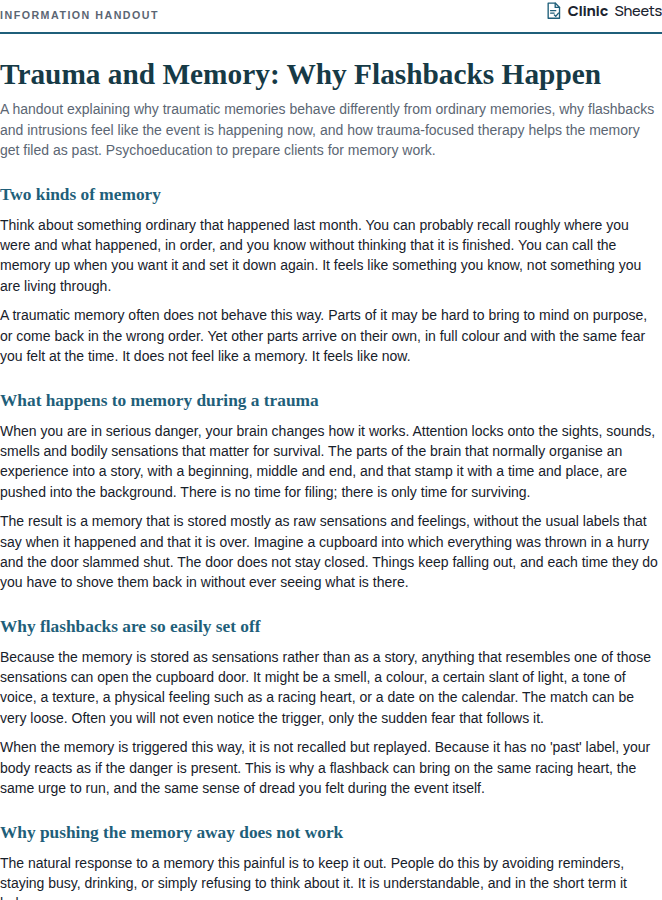
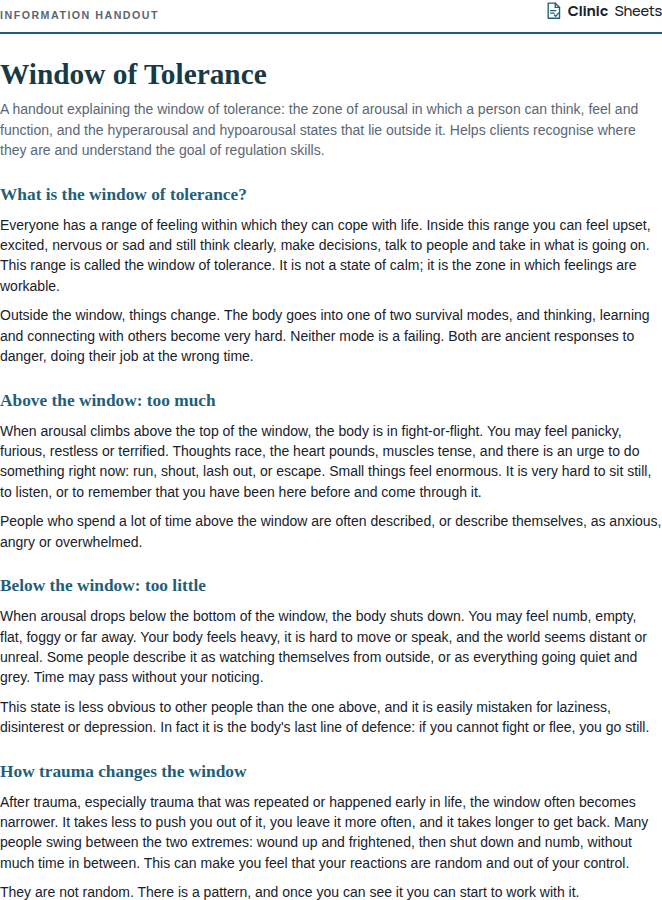
This handout is written for the first responder directly. It describes the cumulative nature of occupational exposure, the difference between normal reactions and a developing problem, the hypervigilance that is adaptive on shift and corrosive at home, and the coping strategies (detachment, dark humour, alcohol, overwork) that serve for a while and then stop working. It frames treatment as something that fits the culture, evidence-based, structured and time-limited, rather than as an admission of weakness, and notes that PTSD in this population is treatable with the same trauma-focused therapies used elsewhere.
The professional version notes the need to ask about cumulative and occupational exposure explicitly, the frequent presence of moral injury and organisational betrayal alongside PTSD, the importance of understanding the client's workplace context (shift patterns, peer support programmes, return-to-work requirements and presumptive coverage under provincial workers' compensation legislation), and the value of a matter-of-fact, non-pathologising stance from the first session.
How to use it
- Use at assessment or in the first session with any public safety client, or give it to peer support teams and occupational health services as a resource.
- Ask about cumulative exposure rather than a single index trauma. Many clients will not identify one event but will recognise a build-up, and some will identify one call that 'stuck' among many.
- Use the section on hypervigilance to discuss the shift-to-home transition and how vigilance is affecting family life, sleep and mood.
- Discuss coping strategies without judgement. Detachment and dark humour are functional at work; the question is what happens when they are the only tools available.
- Address confidentiality, fitness for duty and reporting obligations explicitly. Uncertainty about these is a major reason first responders delay treatment.
References
- Carleton, R. N., Afifi, T. O., Turner, S., Taillieu, T., Duranceau, S., LeBouthillier, D. M., ... Asmundson, G. J. G. (2018). Mental disorder symptoms among public safety personnel in Canada. Canadian Journal of Psychiatry, 63(1), 54-64.
- Berger, W., Coutinho, E. S. F., Figueira, I., Marques-Portella, C., Luz, M. P., Neylan, T. C., Marmar, C. R., & Mendlowicz, M. V. (2012). Rescuers at risk: A systematic review and meta-regression analysis of the worldwide current prevalence and correlates of PTSD in rescue workers. Social Psychiatry and Psychiatric Epidemiology, 47(6), 1001-1011.
- Ehlers, A., & Clark, D. M. (2000). A cognitive model of posttraumatic stress disorder. Behaviour Research and Therapy, 38(4), 319-345.