Grief and the Dual Process Model
A handout explaining Stroebe and Schut's dual process model of bereavement: how healthy grieving moves back and forth between facing the loss and rebuilding daily life, and what goes wrong when someone gets stuck at one end.
About this resource
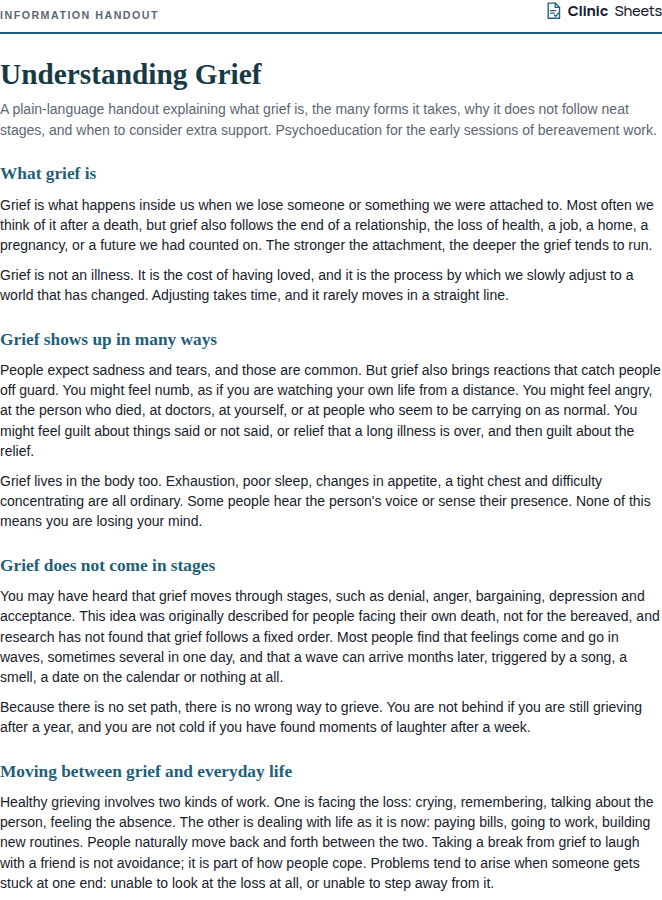
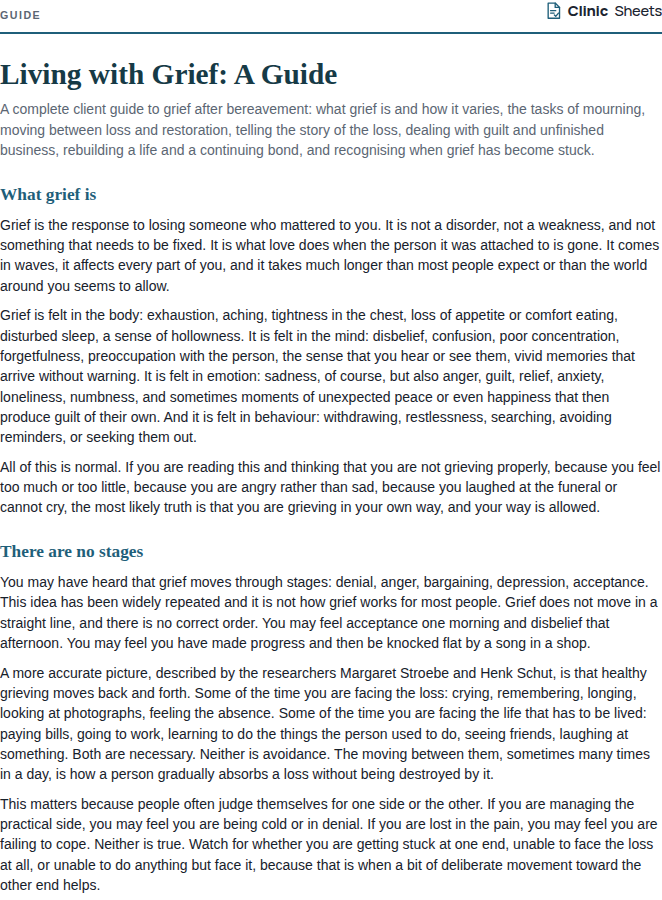
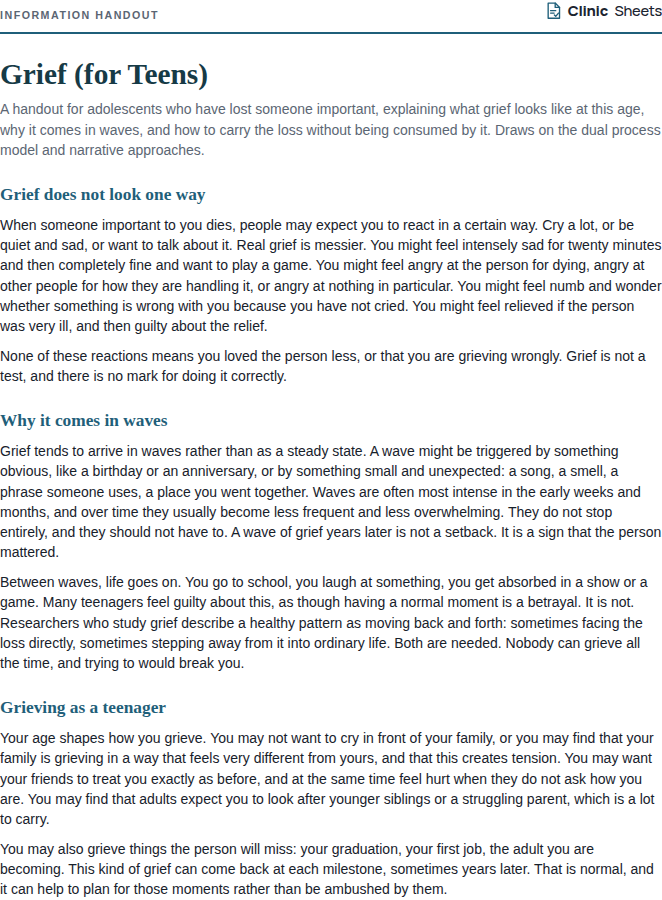
The dual process model, developed by Margaret Stroebe and Henk Schut, describes bereavement coping as an oscillation between two kinds of stressor. Loss-oriented coping involves confronting the loss itself: grief work, yearning, remembering, looking at photographs, crying. Restoration-oriented coping involves dealing with the secondary changes the loss brings: taking on new roles, managing finances, forming a new identity, and building new relationships and routines. The model's central claim is that healthy grieving requires both, and that people naturally move between them. Time off from grief is not denial but a necessary part of adapting.
The model is clinically useful because it helps explain two common patterns of difficulty. Some clients are chronically loss-oriented: they cannot step away from the grief, avoid anything new, and feel that engaging with life would be a betrayal. Others are chronically restoration-oriented: they keep busy, avoid reminders, and never allow the loss to be felt. Both are forms of avoidance, and the handout gently names this so that the client and clinician can identify which side is being neglected.
The professional version adds a brief guide to assessing which orientation dominates, suggested interventions for each pattern (graded engagement with reminders for the restoration-stuck client; behavioural activation and identity work for the loss-stuck client), and notes on the gender and cultural patterns that the model's authors have described.
How to use it
- Use after Understanding Grief, once the client has a sense that grief is not linear and that there is no single correct way to grieve.
- Draw the two sides on paper together and ask the client to place their recent days and weeks. Most people can quickly see which side they spend most time on.
- Ask what stops them from moving to the other side. Common answers include guilt ('if I enjoy myself, it means I did not care'), fear ('if I start crying I will never stop') and practical overload.
- Agree one small step toward the neglected side for the coming week, and record it in the reflection fields.
- Revisit the model when the client reports feeling stuck or guilty. It provides a shared language for noticing the oscillation over time.
References
- Stroebe, M., & Schut, H. (1999). The dual process model of coping with bereavement: Rationale and description. Death Studies, 23(3), 197-224.
- Stroebe, M., & Schut, H. (2010). The dual process model of coping with bereavement: A decade on. Omega: Journal of Death and Dying, 61(4), 273-289.
- Stroebe, M., Schut, H., & Boerner, K. (2017). Cautioning health-care professionals: Bereaved persons are misguided through the stages of grief. Omega: Journal of Death and Dying, 74(4), 455-473.