Group Session Plan: 8-Week Depression Group
A facilitator's plan for an eight-week CBT group for depression built on behavioural activation and Beck-style cognitive therapy: purpose, format, materials, session-by-session aims, content and homework, and common challenges.
About this resource
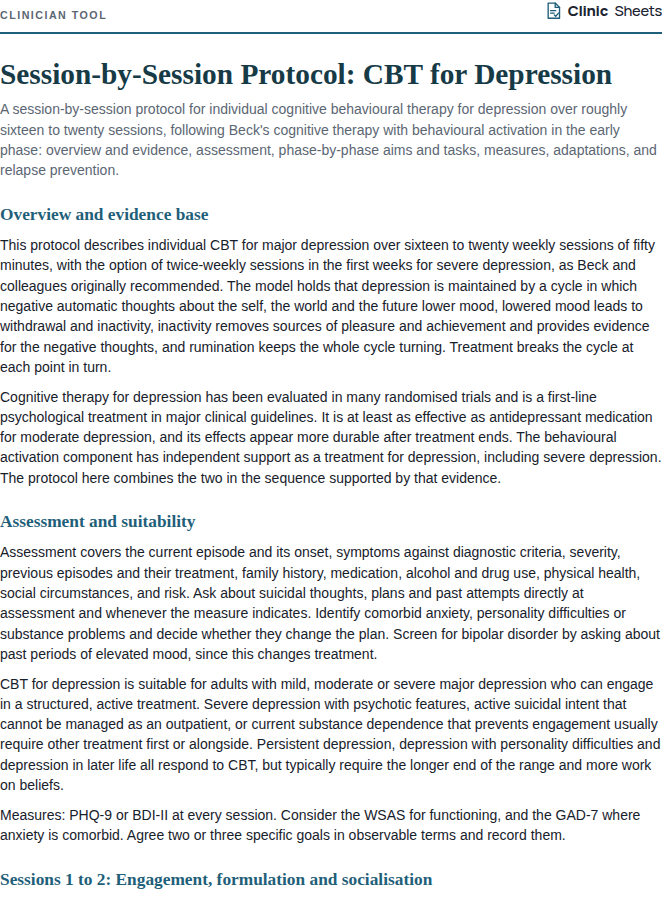
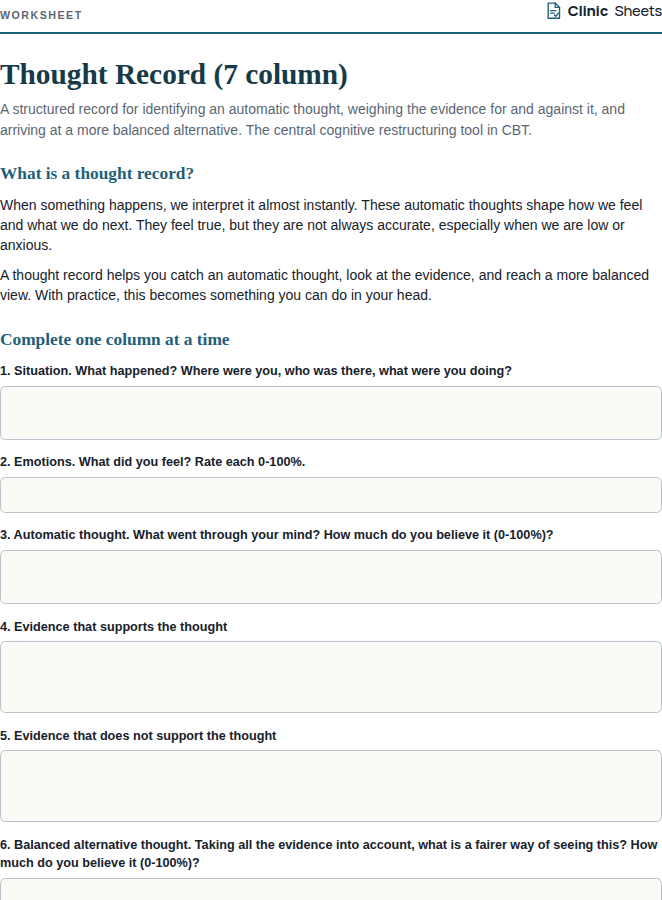
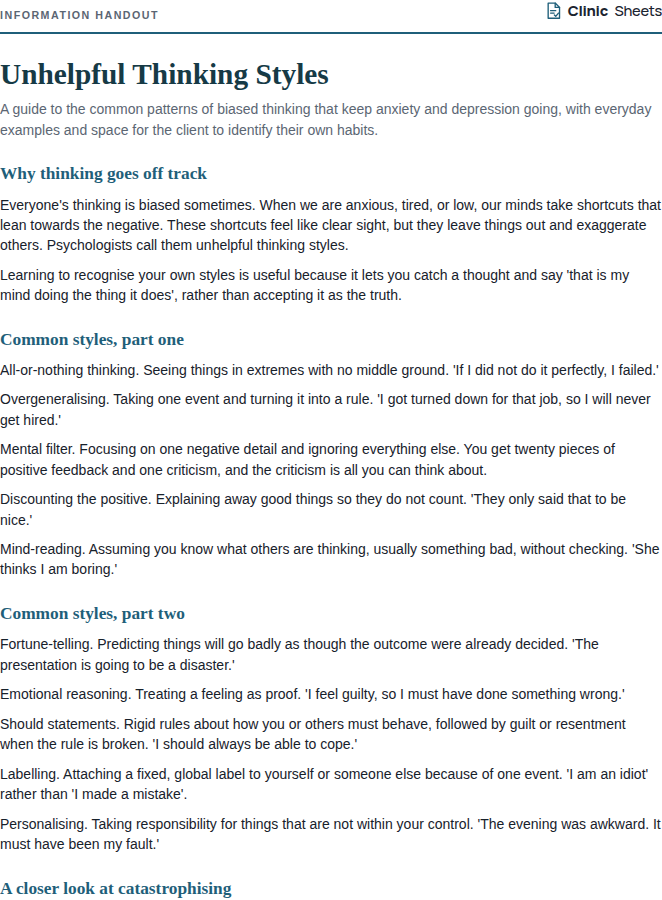
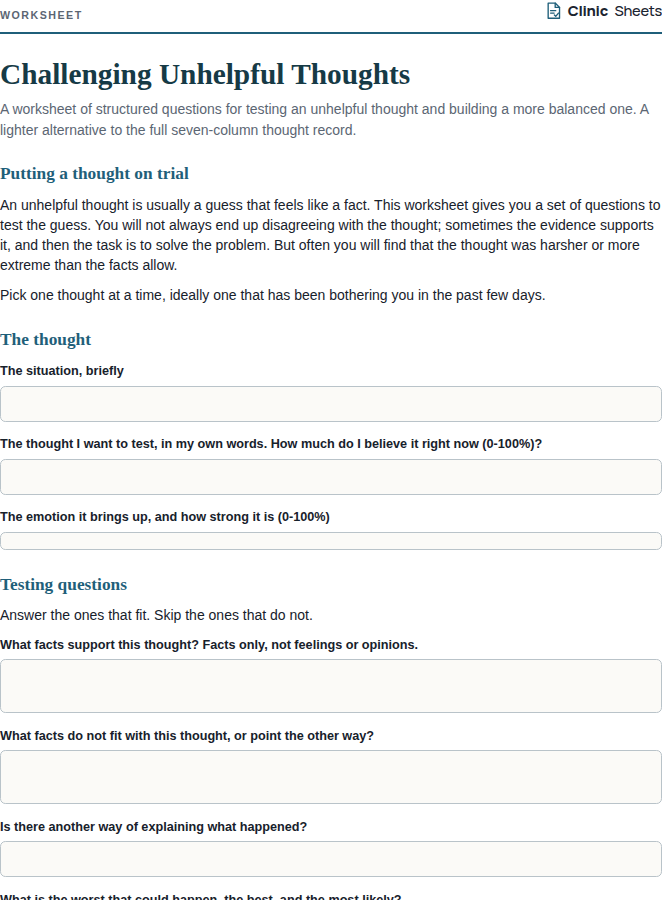
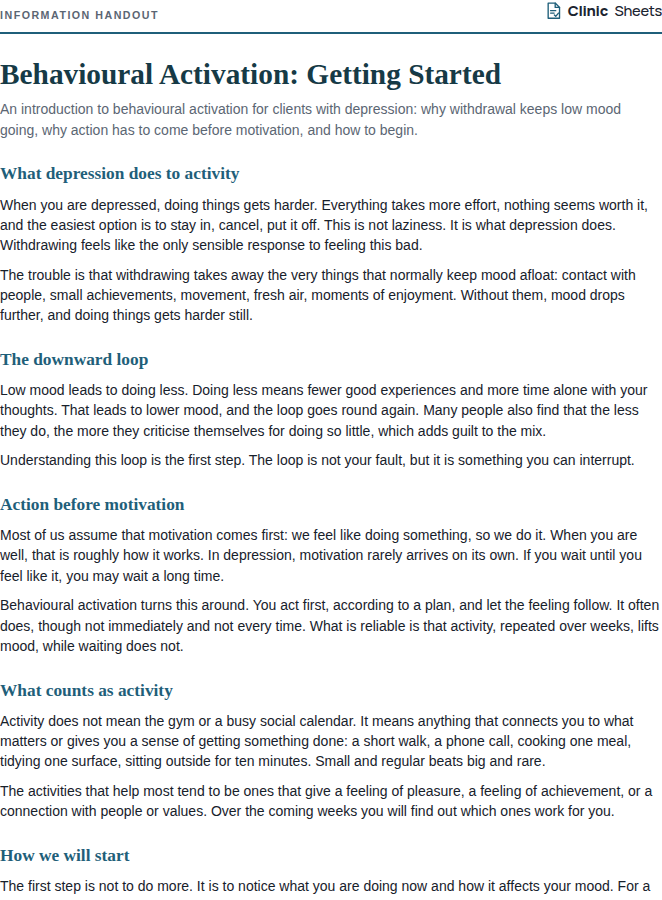
Group CBT for depression follows the same sequence as the individual treatment described by Beck and colleagues: socialising members to the cognitive model, activating behaviour early, identifying and testing negative automatic thoughts, working with underlying assumptions, and planning for relapse. Behavioural activation, developed as a standalone treatment by Jacobson, Martell and colleagues, provides the early sessions, because activity change produces mood change quickly and gives members evidence for the cognitive work that follows.
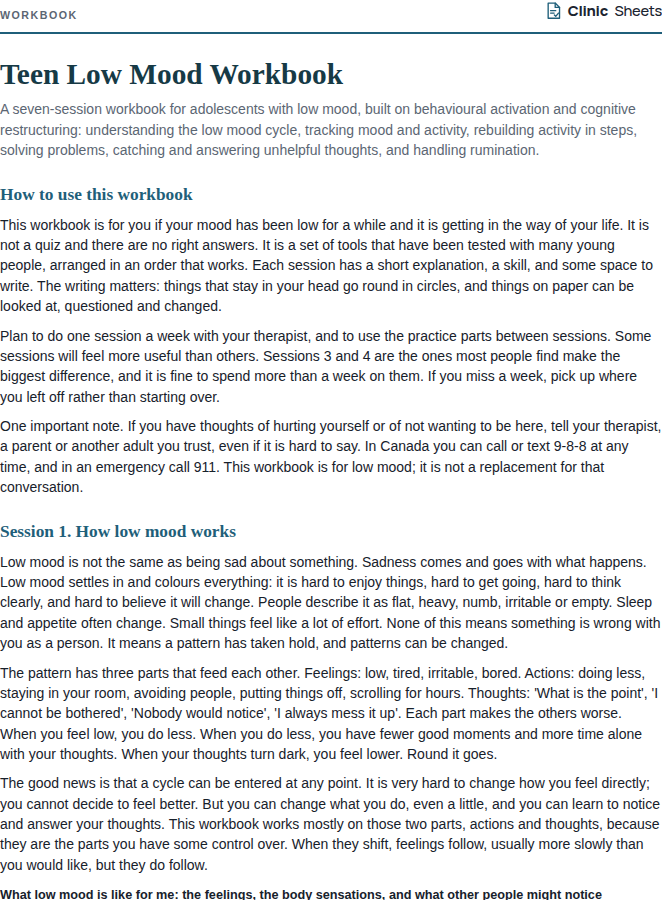
The group format has particular advantages in depression. Members who believe they are uniquely defective hear others describe the same thoughts. Members who have withdrawn from everyone rehearse being with people every week. And the planned, structured shape of the sessions counters the passivity and hopelessness that depression brings. The main risks are that low-energy members drift into silence while more articulate members fill the space, and that homework is quietly abandoned; the plan addresses both.
The professional version gives the facilitator a complete outline of all eight sessions with aims, content and between-session tasks, recommendations on screening and outcome measurement, and guidance on managing risk, low engagement and hopelessness in the room.
How to use it
- Hold an individual pre-group meeting with each prospective member to assess suitability, explain the model, complete the PHQ-9, and agree the expectation of weekly attendance and daily between-session practice.
- Assess suicide risk at screening and monitor it. Item 9 of the PHQ-9 should be reviewed at every administration, and any positive response followed up individually the same day. Give every member the crisis numbers 9-8-8 and 911 in writing.
- Administer the PHQ-9 at the pre-group meeting, at sessions 4 and 8, and if possible weekly. Plot scores on the member's check-in sheet so that change is visible.
- Run the group with two facilitators. Depression groups need one person free to attend to members who go quiet, arrive late or seem worse.
- Protect homework review. Spend the first part of every session on it, ask each member in turn, and treat non-completion as information about the depression to be worked with, not as a failure to be glossed over.
- Keep the pace active. Short teaching segments, worked examples on the board, pair work and in-session practice keep energy up in a room where energy is scarce.
References
- Beck, A. T., Rush, A. J., Shaw, B. F., & Emery, G. (1979). Cognitive Therapy of Depression. Guilford Press.
- Martell, C. R., Dimidjian, S., & Herman-Dunn, R. (2010). Behavioral Activation for Depression: A Clinician's Guide. Guilford Press.
- Bieling, P. J., McCabe, R. E., & Antony, M. M. (2006). Cognitive-Behavioral Therapy in Groups. Guilford Press.
- Beck, J. S. (2020). Cognitive Behavior Therapy: Basics and Beyond (3rd ed.). Guilford Press.