Behavioural Activation: Getting Started
An introduction to behavioural activation for clients with depression: why withdrawal keeps low mood going, why action has to come before motivation, and how to begin.
About this resource
Behavioural activation (BA) rests on a simple functional account of depression. When mood drops, people do less: they withdraw from friends, drop activities, and put off tasks. Each of these responses makes sense in the moment because it reduces effort and avoids discomfort. But it also removes the sources of reward, connection and accomplishment that keep mood stable, and it tends to increase rumination and guilt. The result is a downward loop in which low mood leads to less activity, and less activity leads to lower mood.
BA aims to reverse the loop by scheduling activity in a deliberate, graded way, guided by what matters to the person rather than by how they feel at the time. Component analyses of cognitive therapy for depression found the behavioural component alone to be as effective as the full package, and a large trial in 2016 found BA delivered by junior mental health workers to be non-inferior to CBT delivered by therapists. It is a first-line treatment in its own right.
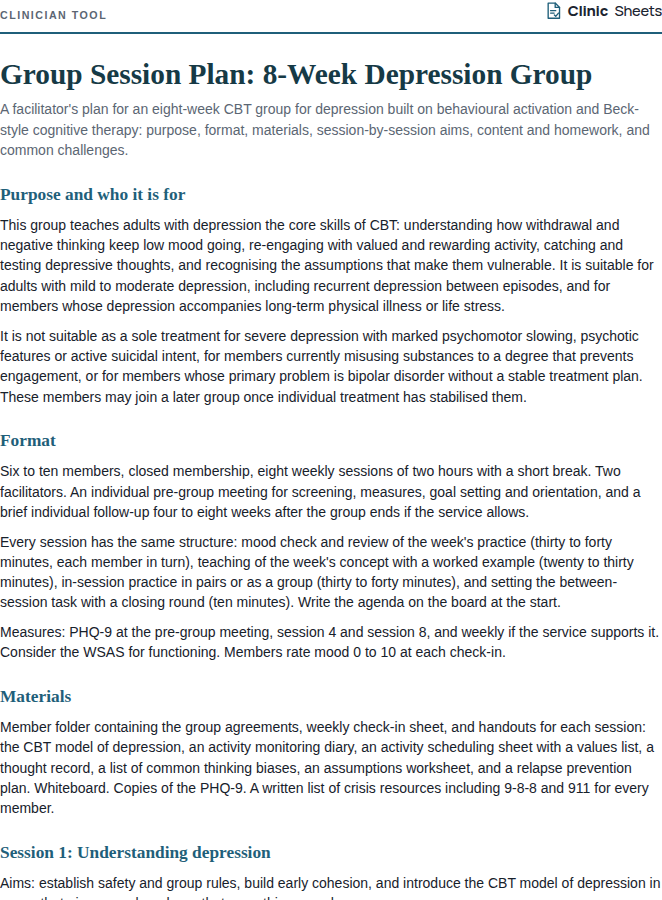
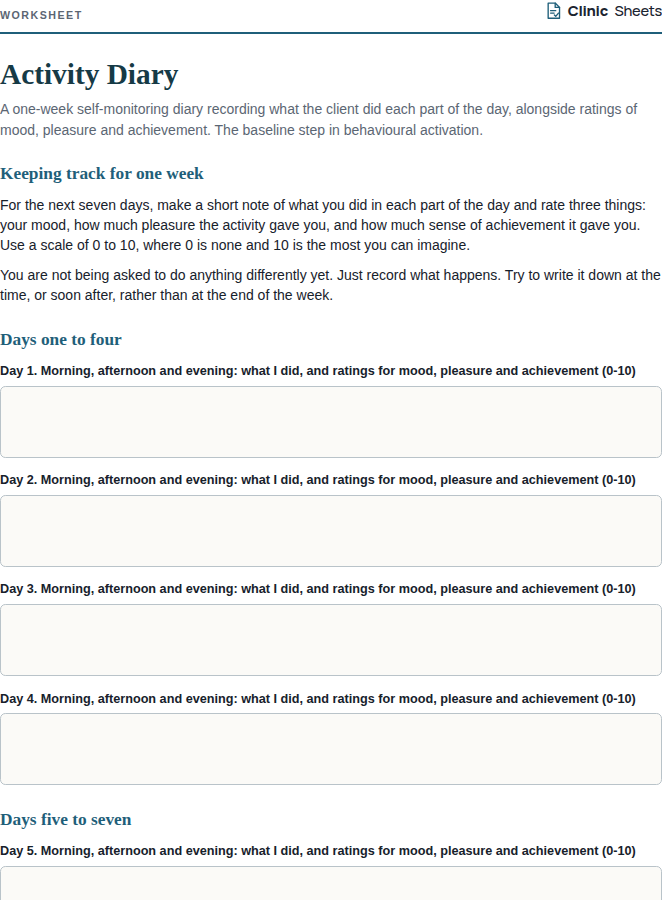
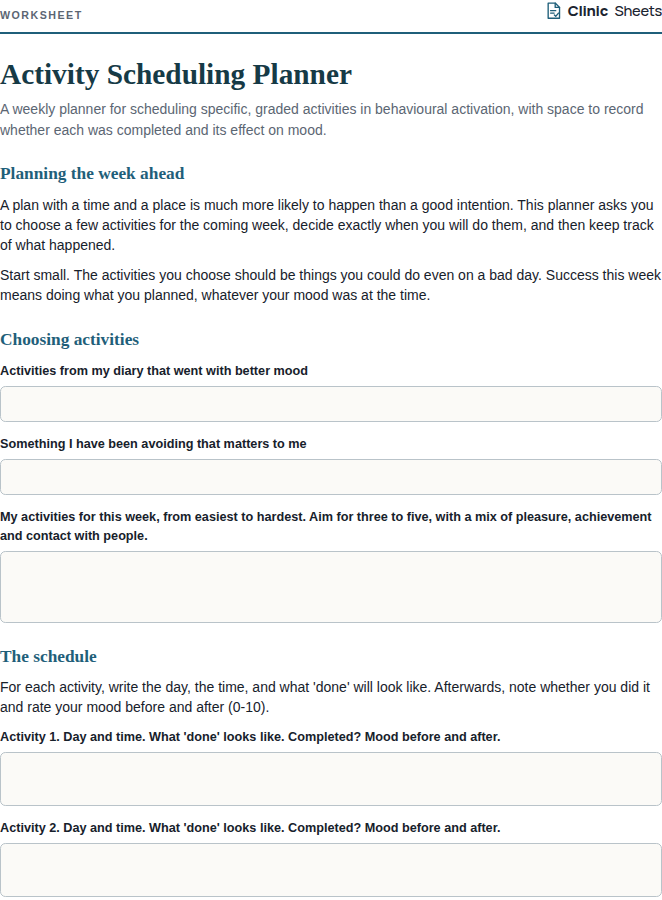
This handout is the orientation piece. It explains the loop, introduces the principle of acting according to a plan rather than a mood, and sets up the client to begin monitoring activity. It leads naturally into the Activity Diary and the Activity Scheduling Planner.
The professional version adds notes on presenting the rationale without it sounding like 'just do more', on distinguishing avoidance from genuine rest, and on the role of rumination as a covert form of avoidance.
How to use it
- Introduce in the first or second session once the client's pattern of withdrawal is clear from the assessment.
- Read the section on the downward loop together and ask the client to describe their own version: what they have stopped doing, and what happened to their mood as a result.
- Spend time on 'action before motivation'. This is the idea clients most often push back on, and it needs to be understood rather than accepted.
- Ask the client to complete the reflection section and to begin the Activity Diary before the next session.
- Return to this handout when scheduling begins, so that planned activities are tied to the rationale.
References
- Jacobson, N. S., Martell, C. R., & Dimidjian, S. (2001). Behavioral activation treatment for depression: Returning to contextual roots. Clinical Psychology: Science and Practice, 8(3), 255-270.
- Martell, C. R., Dimidjian, S., & Herman-Dunn, R. (2010). Behavioral Activation for Depression: A Clinician's Guide. Guilford Press.
- Richards, D. A., Ekers, D., McMillan, D., et al. (2016). Cost and outcome of behavioural activation versus cognitive behavioural therapy for depression (COBRA): A randomised, controlled, non-inferiority trial. The Lancet, 388(10047), 871-880.