Teen Low Mood Workbook
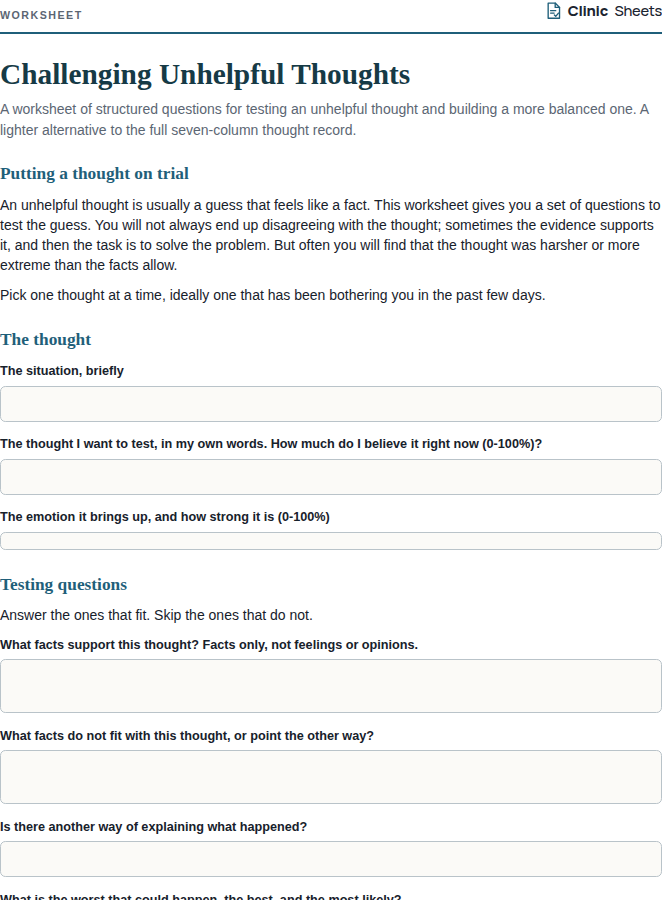
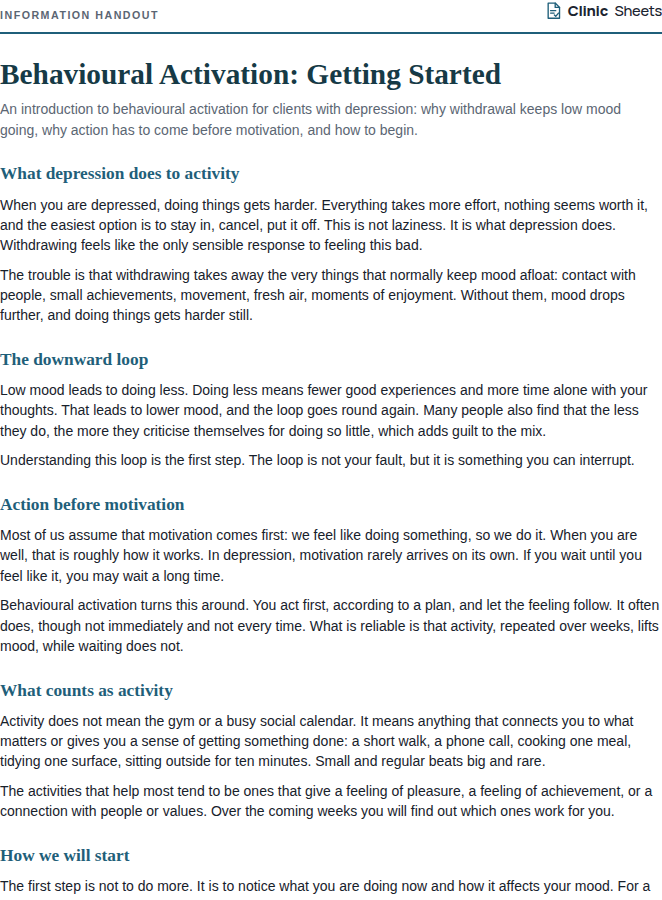
A seven-session workbook for adolescents with low mood, built on behavioural activation and cognitive restructuring: understanding the low mood cycle, tracking mood and activity, rebuilding activity in steps, solving problems, catching and answering unhelpful thoughts, and handling rumination.
About this resource
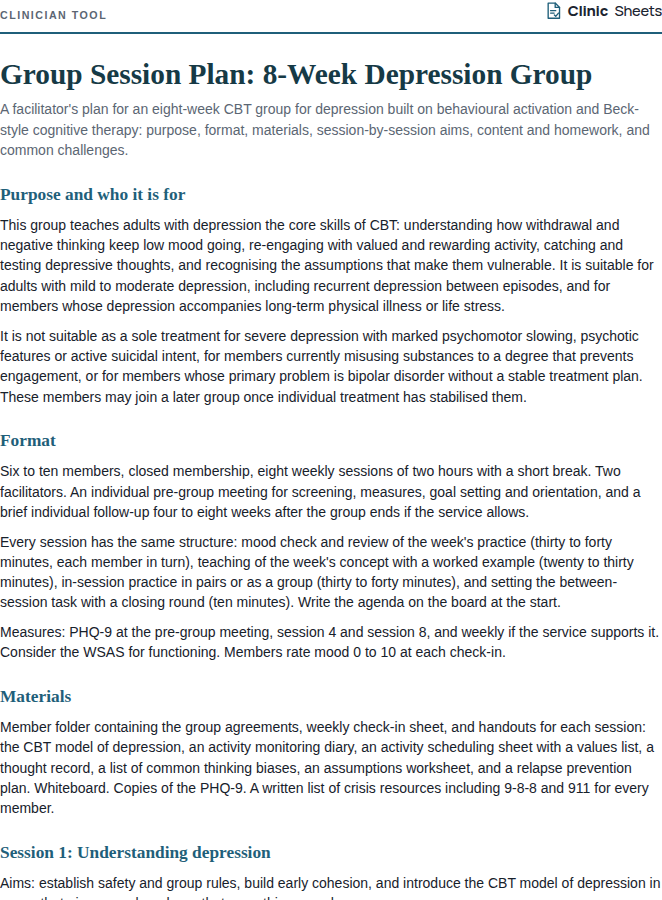
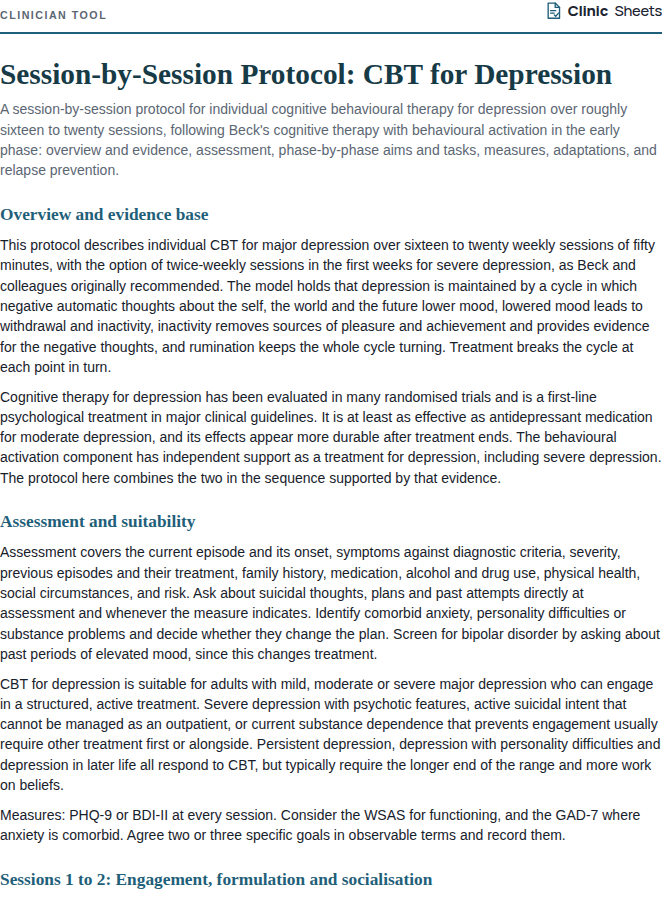
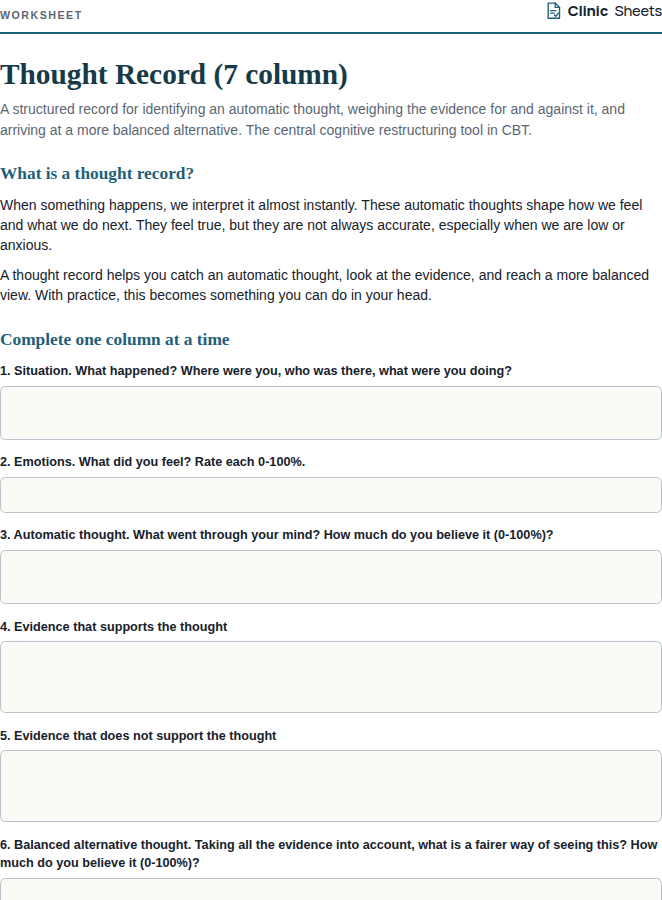
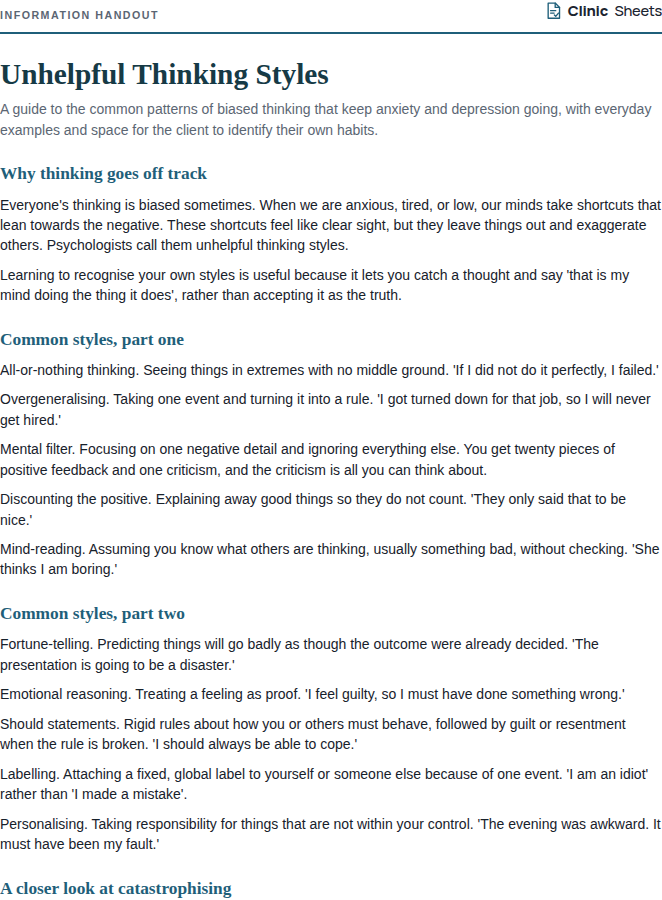
This workbook takes a young person through a structured course of CBT for depression, drawing on Beck's cognitive therapy and on behavioural activation as described by Martell, Dimidjian and Herman-Dunn. The order follows the usual sequence in adolescent CBT: psychoeducation about the low mood cycle, self-monitoring of mood and activity, behavioural activation with graded tasks and values-linked activities, problem solving, then cognitive work on automatic thoughts and rumination. Each session has two to four practice fields so that the workbook can be completed between sessions and reviewed together.
Behavioural activation is placed before cognitive work because withdrawal and inactivity are usually the most accessible maintaining factors in adolescent depression, and because early behavioural gains make the cognitive sessions easier to engage with. Rumination is treated as a behaviour to be noticed and interrupted, following Nolen-Hoeksema's work, rather than as content to be argued with. The tone is direct and respectful, avoids slang, and does not lecture.
The professional version adds guidance on pacing (one session per week is typical, but two weeks on activation is often worthwhile), on involving parents without taking the work away from the young person, and on safety. The workbook does not address suicidal thinking directly; assess risk at the outset and at each session, and use a separate safety plan where indicated.
How to use it
- Assess for depression, risk and comorbidity before starting, and complete a safety plan if there is any suicidal ideation. Repeat a brief measure such as the PHQ-A at each session.
- Work through one session per week in order. Read the session together, complete the first field in session, and set the remaining fields as between-session tasks.
- Spend as long as needed on sessions 3 and 4; behavioural activation is the engine of the workbook and often needs two or three weeks before mood begins to shift.
- Review the practice fields at the start of each session, and treat incomplete tasks as information about obstacles rather than as failure.
- Involve a parent or caregiver in the activity planning where the young person agrees, particularly for activities that need transport, money or permission, while keeping the young person as the owner of the plan.
- Use the final section to build a written relapse prevention plan and agree how the young person will recognise early warning signs.
References
- Beck, A. T., Rush, A. J., Shaw, B. F., & Emery, G. (1979). Cognitive Therapy of Depression. Guilford Press.
- Martell, C. R., Dimidjian, S., & Herman-Dunn, R. (2010). Behavioral Activation for Depression: A Clinician's Guide. Guilford Press.
- Nolen-Hoeksema, S. (2000). The role of rumination in depressive disorders and mixed anxiety/depressive symptoms. Journal of Abnormal Psychology, 109(3), 504-511.
- Clarke, G. N., Lewinsohn, P. M., & Hops, H. (1990). Adolescent Coping with Depression Course: Leader's Manual for Adolescent Groups. Kaiser Permanente Center for Health Research.