Group Session Plan: Parenting Skills Group
A facilitator's plan for an eight-week behavioural parenting skills group for parents of children aged roughly three to ten with behaviour difficulties: purpose, format, materials, session-by-session aims, content and home practice, and common challenges.
About this resource
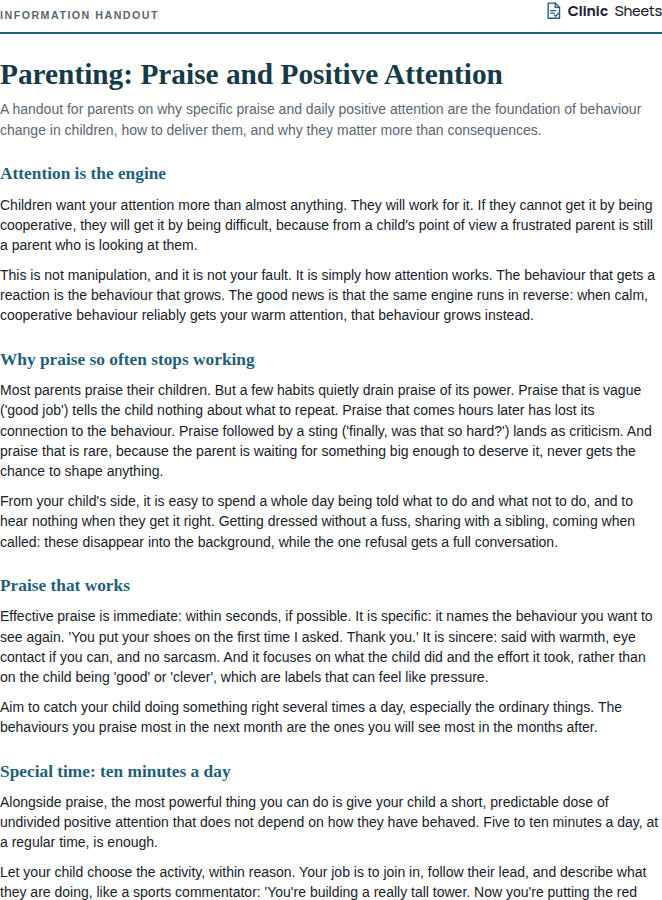
Behavioural parent training is the best-established psychological treatment for conduct problems and oppositional behaviour in young children, and the programmes with the strongest evidence, including Webster-Stratton's Incredible Years, Sanders's Triple P and the parent management training tradition described by Kazdin, Barkley, and Forehand and McMahon, share a common curriculum. They begin by strengthening the parent-child relationship through child-led play and attention, then teach parents to increase desired behaviour through specific praise and rewards, to give effective instructions, to reduce minor misbehaviour by withdrawing attention, and only then to apply calm, consistent consequences for serious misbehaviour. The sequence is deliberate: consequences work far better once the relationship and the positive strategies are in place.
This plan sets out an eight-session group built on that shared curriculum, delivered through the methods these programmes use: short teaching, video or live demonstration, role play, group problem solving and weekly home practice. It is written for facilitators who are not delivering a licensed programme but want to run a group faithful to the evidence.
The professional version includes the complete session outlines, guidance on screening families and on when a group is not enough, and a section on the challenges that arise most often, including parents who are unable to reduce criticism, disagreement between co-parents, and families whose circumstances make home practice difficult.
How to use it
- Screen families individually before the group. Confirm the child's age fits, gather a brief description of the main behaviour problems, ask about the parents' own mental health and the family's circumstances, and administer a parent-report measure such as the Strengths and Difficulties Questionnaire or the Eyberg Child Behavior Inventory as a baseline.
- Invite both parents or caregivers where the child has more than one, and where safe to do so. Consistency between adults is one of the strongest predictors of change, and the group is where they can negotiate it.
- Run the group with two facilitators, one of whom leads teaching and the other who coaches role plays and attends to parents who are struggling. Where possible, arrange childcare on site.
- Keep to the sequence. Parents often ask for consequences in session 1; explain that consequences are taught in sessions 6 and 7 for a reason, and that the earlier skills make them work.
- Use role play in every session. Parents rehearse the week's skill with a facilitator or another parent playing the child, and receive specific feedback. Watching and practising is what changes behaviour; discussion alone does not.
- Set and review home practice every week, and telephone families who miss a session. Attendance and practice are the main threats to outcome in parenting groups.
References
- Webster-Stratton, C. (2005). The Incredible Years: A Trouble-Shooting Guide for Parents of Children Aged 2-8 Years. Incredible Years.
- Sanders, M. R. (1999). Triple P-Positive Parenting Program: Towards an empirically validated multilevel parenting and family support strategy for the prevention of behavior and emotional problems in children. Clinical Child and Family Psychology Review, 2(2), 71-90.
- Kazdin, A. E. (2005). Parent Management Training: Treatment for Oppositional, Aggressive, and Antisocial Behavior in Children and Adolescents. Oxford University Press.
- Barkley, R. A. (2013). Defiant Children: A Clinician's Manual for Assessment and Parent Training (3rd ed.). Guilford Press.