Special Time: Child-Led Play
A parent exercise in which the parent spends a short, daily period following the child's lead in play, without questions, commands or corrections, to strengthen the relationship and lay the foundation for every other parenting strategy.
About this resource
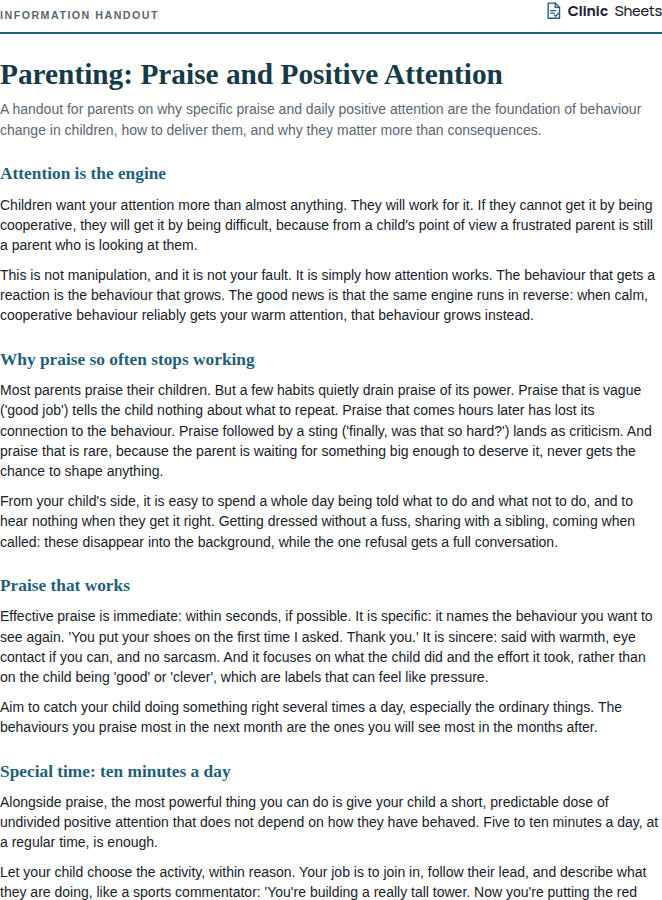
Almost every evidence-based parenting programme begins with a version of this exercise. It is the 'Child's Game' in Helping the Noncompliant Child, Child-Directed Interaction in Parent-Child Interaction Therapy, child-directed play in the Incredible Years, and 'special time' in Barkley's Defiant Children programme and in Kazdin's Parent Management Training. The rationale is the same in each. Families caught in coercive cycles have interactions dominated by instructions, corrections and conflict, and the parent's attention has become a signal for something unpleasant. Child-led play restores parental attention as something warm and valued, and a parent whose attention is valued has far more influence when limits are later needed.
The exercise is simple and precise. For a short daily period, the parent joins the child in an activity the child chooses, and follows the child's lead. The parent describes what the child is doing, reflects what the child says, praises specific behaviour, and imitates or joins in. The parent avoids questions, commands and criticism, which all shift the lead back to the adult. Minor misbehaviour during special time is ignored; if it escalates, special time simply ends without drama and is tried again the next day.
The professional version adds guidance on coaching the parent through the skills, on the common difficulty parents have in staying quiet and not directing, on adapting the exercise for older children (shared activities rather than toy play) and for children with ADHD or autism, and on what to do when a parent reports that the child does not want special time. It also notes that this exercise should be well established before consequence-based strategies are introduced.
How to use it
- Introduce special time as the foundation of the parenting work, not as an optional extra. Explain the rationale: rebuilding the value of parental attention so that praise, ignoring and consequences can work later.
- Demonstrate the skills in session if a child is present, or role-play with the parent. Practise describing, reflecting and praising, and practise noticing the urge to ask a question or give an instruction.
- Agree a realistic daily slot of about ten to fifteen minutes, one-to-one, with other children occupied elsewhere. Consistency matters far more than duration.
- Ask the parent to keep the brief practice log. Review it each session and troubleshoot: parents who find it boring, children who test limits during the time, siblings who interrupt.
- Only introduce planned ignoring, time-out or other consequence strategies once special time has been happening most days for at least a week or two.
References
- McMahon, R. J., & Forehand, R. L. (2003). Helping the Noncompliant Child: Family-Based Treatment for Oppositional Behavior (2nd ed.). Guilford Press.
- McNeil, C. B., & Hembree-Kigin, T. L. (2010). Parent-Child Interaction Therapy (2nd ed.). Springer.
- Kazdin, A. E. (2005). Parent Management Training: Treatment for Oppositional, Aggressive, and Antisocial Behavior in Children and Adolescents. Oxford University Press.
- Barkley, R. A. (2013). Defiant Children: A Clinician's Manual for Assessment and Parent Training (3rd ed.). Guilford Press.