Insomnia Severity Index: Scoring and Interpretation Guide
A clinician's guide to scoring and interpreting the Insomnia Severity Index (ISI), Charles Morin's seven-item measure of insomnia severity. Covers the severity bands, the case-detection cut-offs, treatment response thresholds, and how to use it across a course of CBT for insomnia.
About this resource
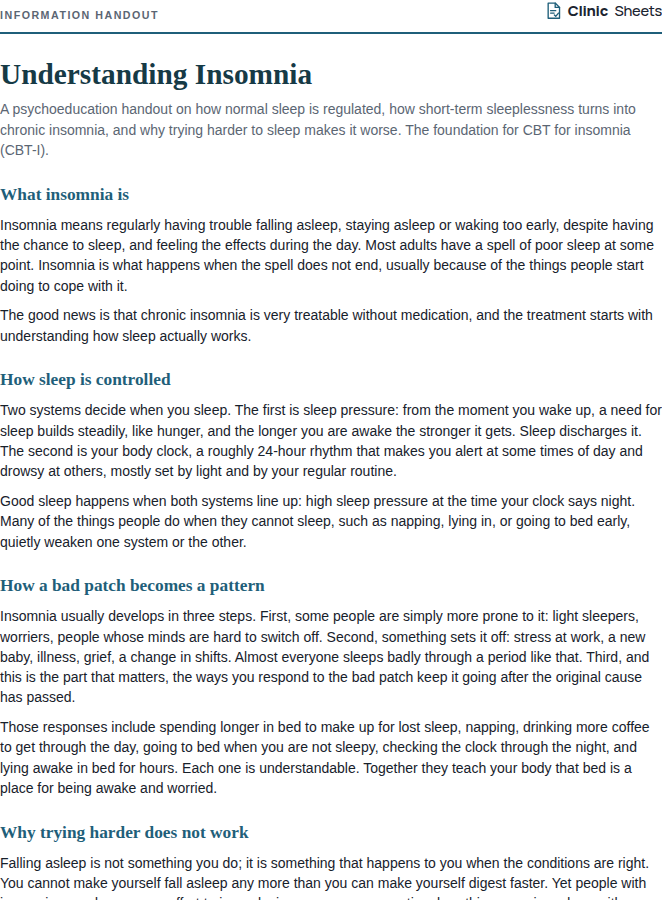
The Insomnia Severity Index was developed by Charles Morin at Université Laval as a brief self-report measure of the perceived severity of insomnia. Its seven items cover the three types of sleep difficulty (falling asleep, staying asleep, waking too early), satisfaction with the current sleep pattern, how much the sleep problem interferes with daily functioning, how noticeable the impairment is to others, and how worried or distressed the person is about their sleep. It asks about the recent past, usually the last two weeks, and takes under three minutes. It is the most widely used outcome measure in CBT-I trials and in sleep clinics.
This resource is a scoring and interpretation guide. The ISI is copyrighted by its author and is free for clinical use, but it is distributed through an official source and we do not reproduce the items. The guide describes the response format, the scoring method, the published severity bands from Bastien, Vallières and Morin (2001), the case-detection cut-offs from Morin and colleagues (2011), and what size of change counts as treatment response. It also covers the two things the ISI does not do: it does not measure sleep itself, and it does not distinguish insomnia from other sleep disorders.
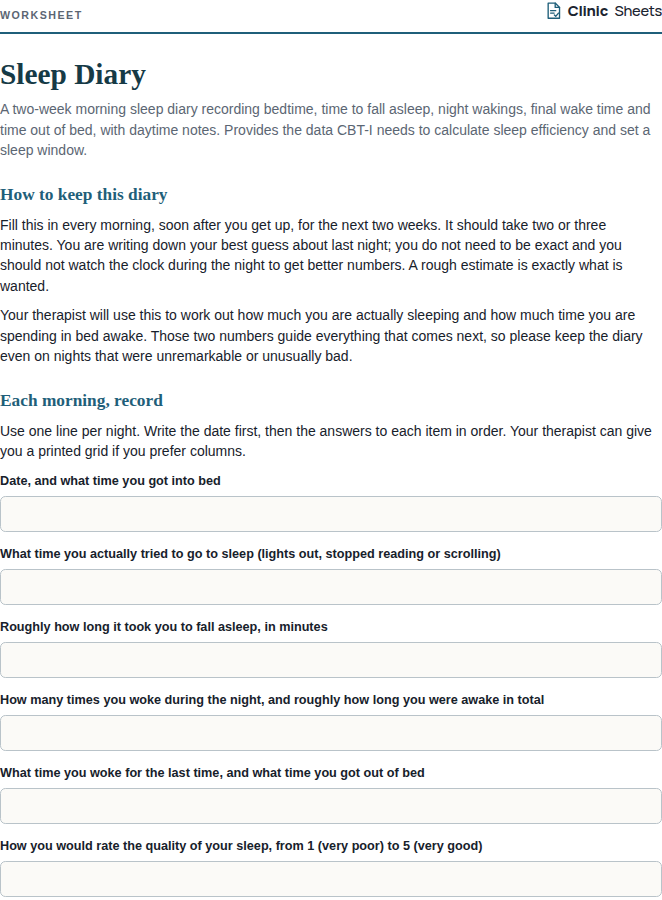
For clinicians delivering CBT-I, the ISI is best used alongside a sleep diary. The diary gives you sleep onset latency, wake after sleep onset and sleep efficiency; the ISI gives you the person's experience of the problem and its impact. Both should improve, and it is common for the ISI to lag behind the diary by a week or two, which is worth telling clients in advance.
How to use it
- Obtain the official ISI. Give it at assessment, before starting a sleep diary, so you have a baseline severity score alongside the diary data.
- Add the seven item scores for a total between 0 and 28. Place the total in the severity band. Note the item about daytime interference and the item about worry or distress separately; these are often the best predictors of whether the person will engage with treatment.
- Explain the score to the client in terms of the band ('moderate clinical insomnia') and what treatment aims for (a total below 8, or a drop of at least 8 points).
- Repeat the ISI every two to four weeks during CBT-I and at the end. Use the change thresholds in this guide to describe response: a reduction of 8 points or more suggests a moderate improvement, and a final score below 8 indicates remission on this measure.
- If the score stays high while the sleep diary improves, explore beliefs about sleep and daytime functioning; if the diary stays poor while the score improves, check adherence to sleep restriction and stimulus control.
References
- Bastien, C. H., Vallières, A., & Morin, C. M. (2001). Validation of the Insomnia Severity Index as an outcome measure for insomnia research. Sleep Medicine, 2(4), 297-307.
- Morin, C. M., Belleville, G., Bélanger, L., & Ivers, H. (2011). The Insomnia Severity Index: Psychometric indicators to detect insomnia cases and evaluate treatment response. Sleep, 34(5), 601-608.
- Morin, C. M., & Espie, C. A. (2003). Insomnia: A clinical guide to assessment and treatment. Kluwer Academic/Plenum.