Leaves on a Stream
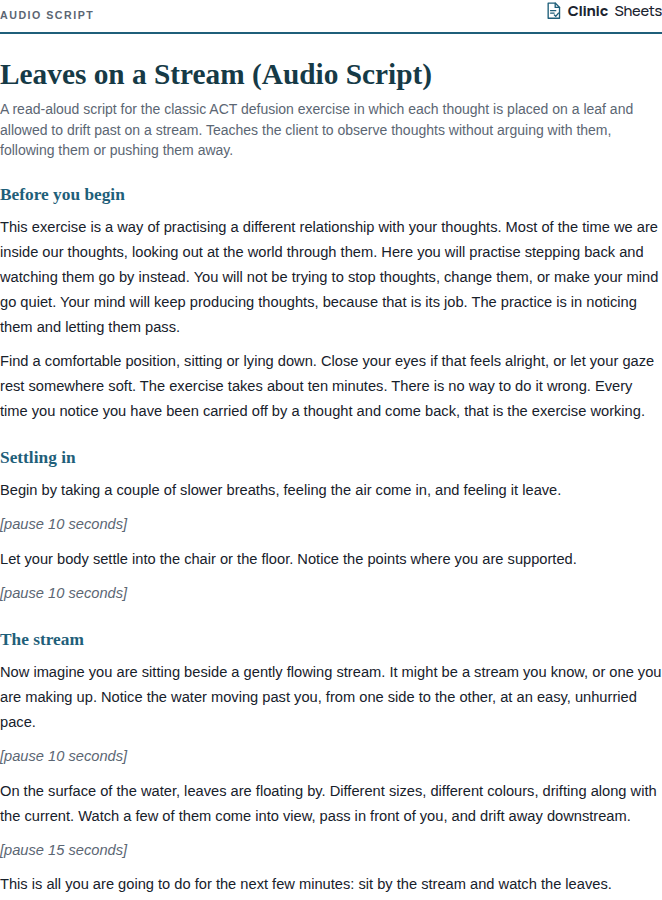
A guided defusion and present-moment exercise in which the client imagines placing each passing thought on a leaf and watching it drift downstream. A core ACT practice for loosening the grip of anxious thinking.
About this resource
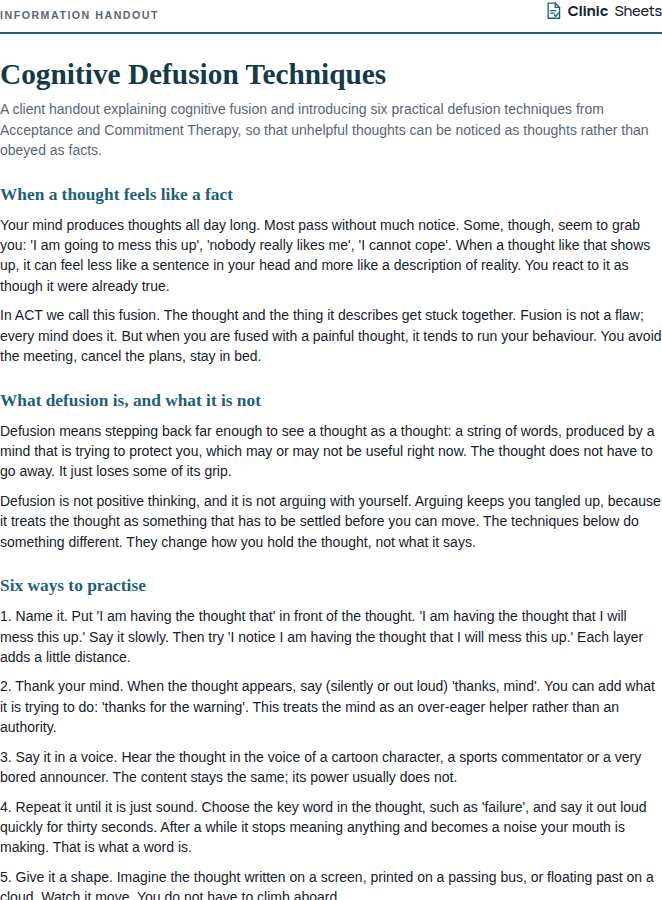
Leaves on a Stream is one of the most widely used experiential exercises in Acceptance and Commitment Therapy. The client sits quietly, imagines a gently flowing stream with leaves floating on it, and places each thought that arises onto a leaf, letting it drift out of view. The exercise trains two related skills: noticing thoughts as they occur (present-moment awareness) and observing them without engaging, arguing or following (defusion).
The mechanism is cognitive fusion. In anxiety, worrying thoughts are treated as urgent problems that must be solved, which recruits attention and keeps physiological arousal high. Placing a thought on a leaf and watching it move on gives the client repeated experience of a thought arriving and departing without anything needing to be done about it. Over time, this weakens the automatic pull to engage with every worry.
This exercise sheet gives the client the rationale, a step-by-step script they can use on their own, guidance on the difficulties nearly everyone runs into (the stream stopping, getting carried off with a leaf, judging the exercise itself), and a short practice log. It is best introduced in session, where the clinician can guide it aloud and debrief before the client practises independently.
The professional version includes a full spoken script of about five minutes, notes on adapting the image for clients who dislike water or who cannot visualise easily (a conveyor belt, clouds, train carriages), and guidance on the debrief questions that turn the exercise into learning rather than relaxation.
How to use it
- Introduce the exercise after the client has grasped the idea of fusion, ideally right after a defusion demonstration so the purpose is clear: this is practice in watching thoughts, not in emptying the mind.
- Guide the exercise aloud in session for five to ten minutes, speaking slowly and leaving silences. Include the common difficulties in the script itself ('if the stream stops, just notice that, and start it again').
- Debrief with process questions: What did you notice? Were there thoughts that were hard to put on a leaf? Did you get carried off at any point, and how did you come back? Avoid asking whether it was relaxing.
- Ask the client to practise for five minutes daily using the sheet, and to log each practice briefly. Frame missed or difficult practices as useful data, not failures.
- Once the client is familiar with the exercise, encourage a portable version: noticing a worry during the day and silently placing it on a leaf, then returning attention to whatever they were doing.
References
- Hayes, S. C., Strosahl, K. D., & Wilson, K. G. (2012). Acceptance and Commitment Therapy: The Process and Practice of Mindful Change (2nd ed.). Guilford Press.
- Harris, R. (2019). ACT Made Simple: An Easy-to-Read Primer on Acceptance and Commitment Therapy (2nd ed.). New Harbinger.
- Eifert, G. H., & Forsyth, J. P. (2005). Acceptance and Commitment Therapy for Anxiety Disorders: A Practitioner's Treatment Guide to Using Mindfulness, Acceptance, and Values-Based Behavior Change Strategies. New Harbinger.