Self-as-Context: The Observing Self
A guided exercise for contacting the observing self: the part of you that notices thoughts, feelings and sensations without being any of them. Used in ACT to loosen the grip of self-critical thoughts and anxious self-stories.
About this resource
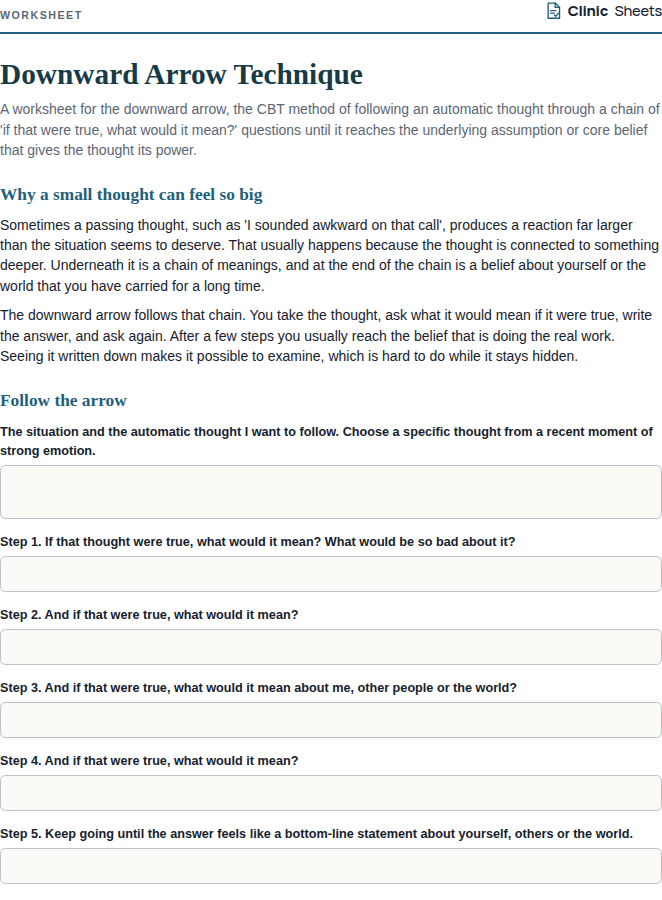
Self-as-context is one of the six core processes of acceptance and commitment therapy. It refers to the perspective from which all experience is observed: the 'I' that has been present through every thought, feeling, role and life stage, and that is not itself any of those things. ACT contrasts this with the conceptualised self, the story a person holds about who they are ('I am anxious', 'I am not good enough'). When people are fused with a conceptualised self, every experience that fits the story confirms it, and experiences that contradict it are discounted. Contacting the observing self creates a stable vantage point from which the story can be seen as a story.
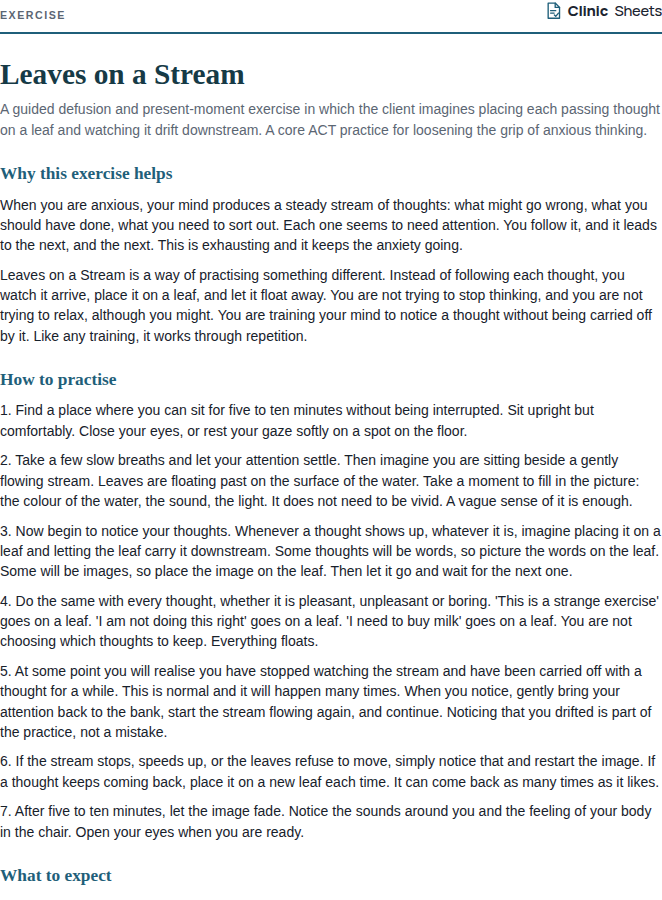
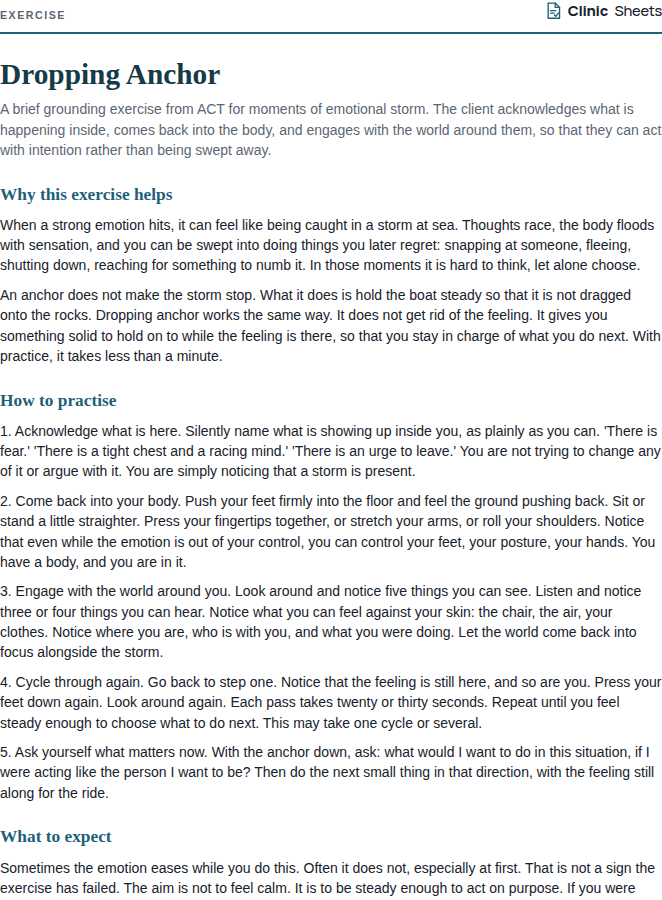
This exercise leads the client through a series of noticing steps: noticing the body, noticing thoughts, noticing feelings, noticing roles and self-descriptions, and then noticing the one who has been doing the noticing throughout. It draws on the classic ACT 'observer' exercise and on the chessboard metaphor, in which the board holds all the pieces without being on either side. It is especially useful for low self-esteem, where the client's self-story is harsh and rigid, and for anxiety, where the client fears being overwhelmed by inner experience.
The professional version includes guidance on pacing, on what to do when a client reports 'I don't get it' (which is common and not a failure), and on how the exercise links to defusion and to values work.
How to use it
- Introduce the idea with a metaphor before the exercise. The sky and the weather, or the chessboard and the pieces, both work well: the weather changes constantly and can be violent, but the sky is never harmed by it and is always there.
- Read the exercise aloud slowly, leaving genuine pauses. Ten to fifteen minutes is typical. Invite the client to close their eyes or lower their gaze.
- Do not push for a mystical or dramatic experience. The aim is a brief, ordinary noticing that there is a 'you' who observes, and that this you is not the same as the content being observed.
- Afterwards, ask what they noticed. If the client says they got lost in thought, point out that they noticed they were lost, which is the observing self at work.
- Link to the presenting problem: 'If you are the sky and the anxiety is the weather, what does that change about how you can relate to it?'
- Suggest a short daily practice of two or three minutes, using the practice log, and revisit the exercise whenever the client is heavily fused with a self-story.
References
- Hayes, S. C., Strosahl, K. D., & Wilson, K. G. (2012). Acceptance and Commitment Therapy: The Process and Practice of Mindful Change (2nd ed.). Guilford Press.
- Hayes, S. C. (2005). Get Out of Your Mind and Into Your Life: The New Acceptance and Commitment Therapy. New Harbinger.
- Harris, R. (2019). ACT Made Simple: An Easy-to-Read Primer on Acceptance and Commitment Therapy (2nd ed.). New Harbinger.