Loneliness: Building Connection Plan
A worksheet for adults who feel lonely or isolated: map current connections, identify what has been lost or avoided, and build a stepped weekly plan for rebuilding contact, starting small.
About this resource
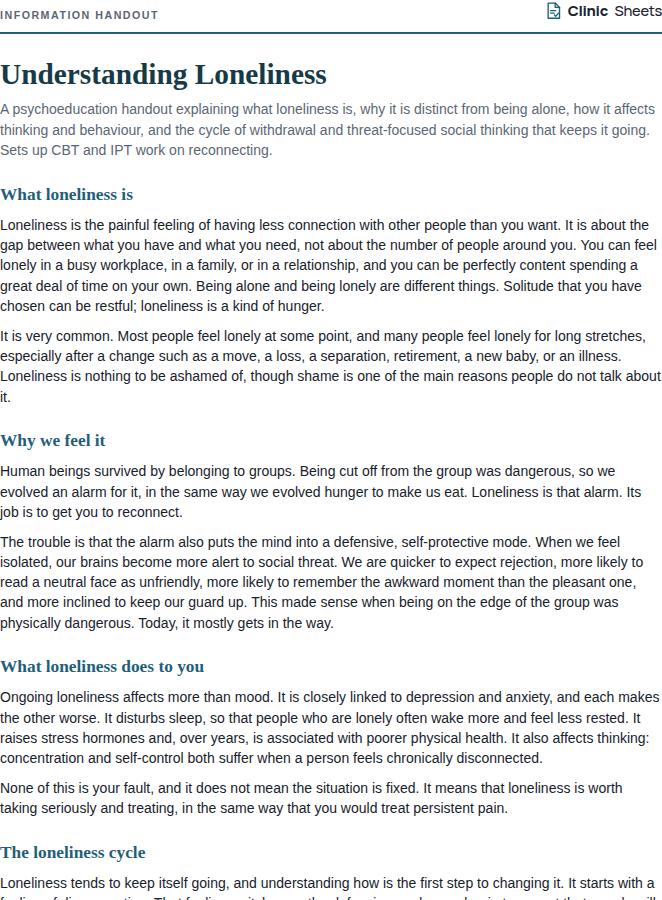
Loneliness is the gap between the social contact a person has and the contact they want. It is distinct from being alone, and it is one of the strongest predictors of depression, as well as being a common consequence of it. The two feed each other in a familiar cycle: low mood reduces the energy and confidence needed to reach out, withdrawal removes the small daily contacts that maintain mood, and the resulting isolation confirms beliefs such as 'nobody would want to hear from me' or 'I have nothing to offer'. Loneliness also carries a self-protective bias: the lonely person becomes more alert to signs of rejection and more likely to interpret ambiguous social cues negatively, which makes reaching out feel riskier than it is.
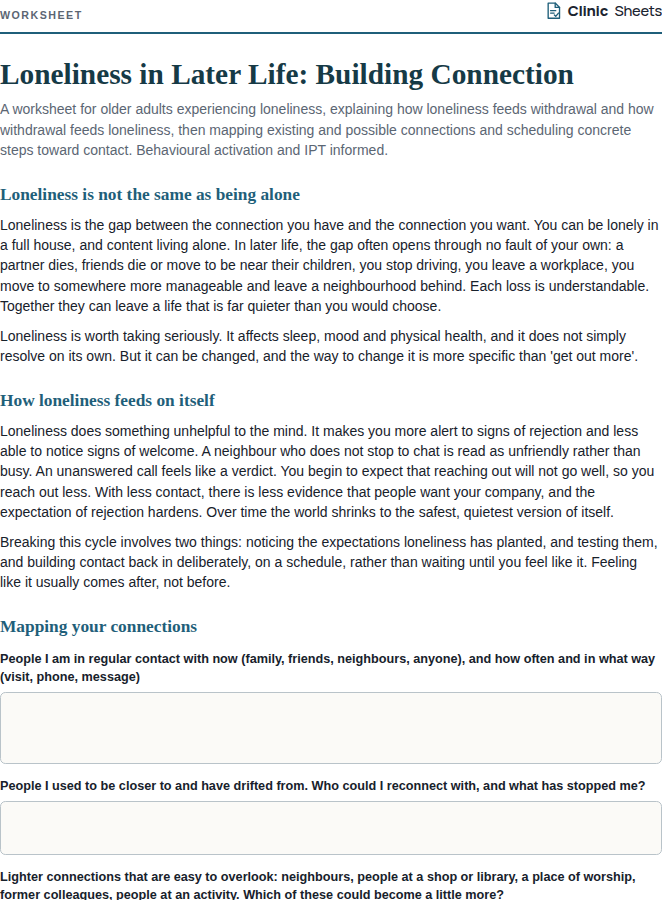
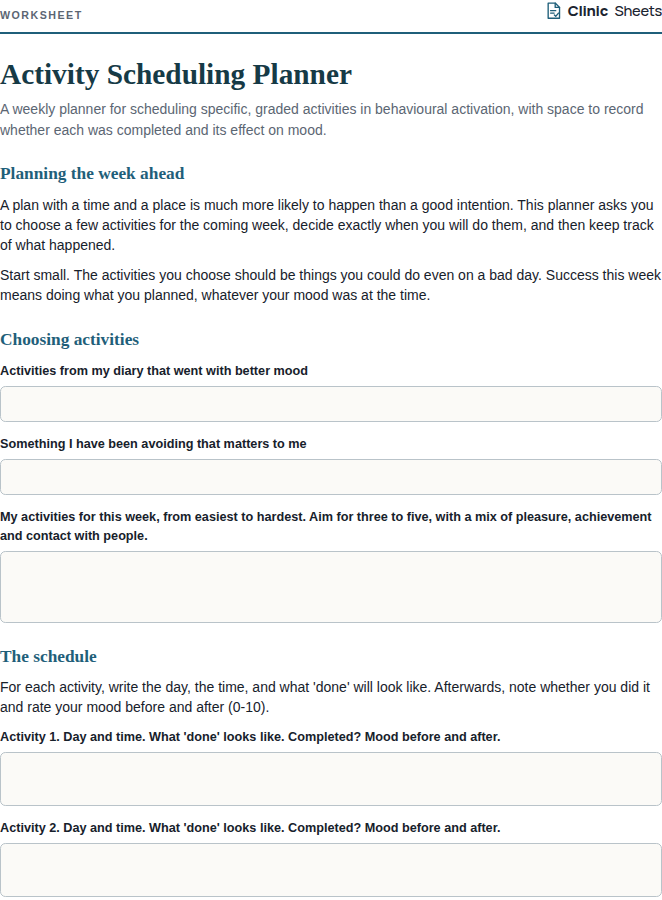
This worksheet applies a behavioural activation and interpersonal approach. Rather than treating loneliness as a feeling to be analysed, it treats connection as a behaviour to be scheduled and graded. The client maps their current network across different types of contact (close, casual, community, incidental), identifies which types have thinned and why, and builds a weekly plan of small, specific connection actions ranked by difficulty. A closing section addresses the thoughts that will show up when it is time to act.
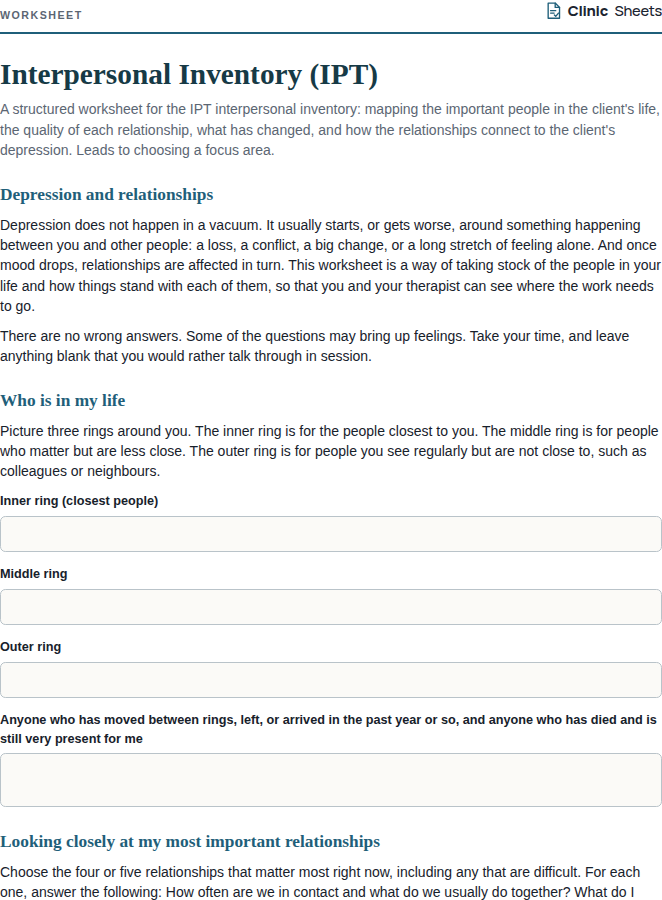
The professional version adds guidance on distinguishing loneliness driven by circumstance (relocation, bereavement, retirement, new parenthood) from loneliness driven by social anxiety or long-standing interpersonal patterns, which need different additional work. It includes prompts for the interpersonal inventory used in IPT, notes on the value of low-stakes 'weak tie' contact, and cautions against setting connection goals so ambitious that the first failure confirms the client's belief.
How to use it
- Explore the client's loneliness without rushing to fix it: when it started, what changed, and what the client believes it says about them. Distinguish between a change in circumstances and a longer-standing pattern.
- Complete the connection map together. Include incidental and community contacts (a regular barista, a neighbour, a class), not only friends and family; these are often the easiest to rebuild and matter more than clients expect.
- Identify the connections that have thinned and the reasons: time, distance, a falling out, or avoidance. Avoided contacts are usually the most valuable to plan for and the most in need of a small first step.
- Build the weekly plan with two or three actions at most, ranked from easiest to hardest. Each should be specific enough to schedule: a named person, a day, a channel, a message.
- Anticipate the thoughts that will arrive at the moment of action ('they're busy', 'it will be awkward') and prepare a response. Treat each action as an experiment whose result is data, whatever the outcome.
- Review at the next session. Focus on what was attempted rather than how it went, and add the next rung.
References
- Cacioppo, J. T., & Hawkley, L. C. (2009). Perceived social isolation and cognition. Trends in Cognitive Sciences, 13(10), 447-454.
- Masi, C. M., Chen, H.-Y., Hawkley, L. C., & Cacioppo, J. T. (2011). A meta-analysis of interventions to reduce loneliness. Personality and Social Psychology Review, 15(3), 219-266.
- Martell, C. R., Dimidjian, S., & Herman-Dunn, R. (2022). Behavioral Activation for Depression: A Clinician's Guide (2nd ed.). Guilford Press.
- Weissman, M. M., Markowitz, J. C., & Klerman, G. L. (2018). The Guide to Interpersonal Psychotherapy. Oxford University Press.