Understanding Loneliness
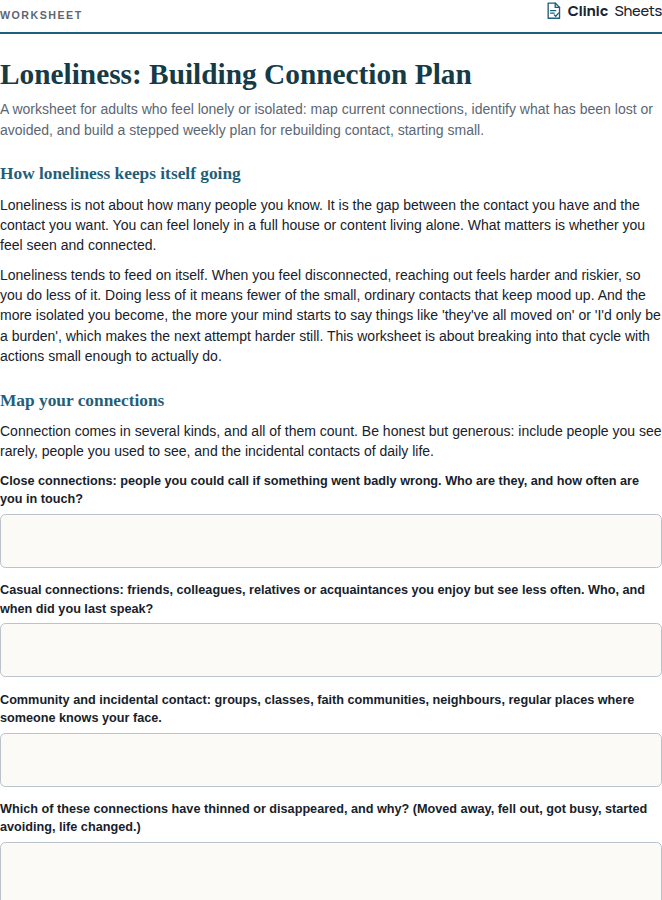
A psychoeducation handout explaining what loneliness is, why it is distinct from being alone, how it affects thinking and behaviour, and the cycle of withdrawal and threat-focused social thinking that keeps it going. Sets up CBT and IPT work on reconnecting.
About this resource
Loneliness is the distressing feeling that arises when the social connection a person has falls short of the connection they want. It is subjective: a person can be lonely in a crowd or in a marriage, and content with very little company. It is common, it is strongly linked to depression and anxiety in both directions, and a large body of research led by John Cacioppo and colleagues has shown that persistent loneliness affects physical health, sleep and cognition and is associated with increased mortality risk.
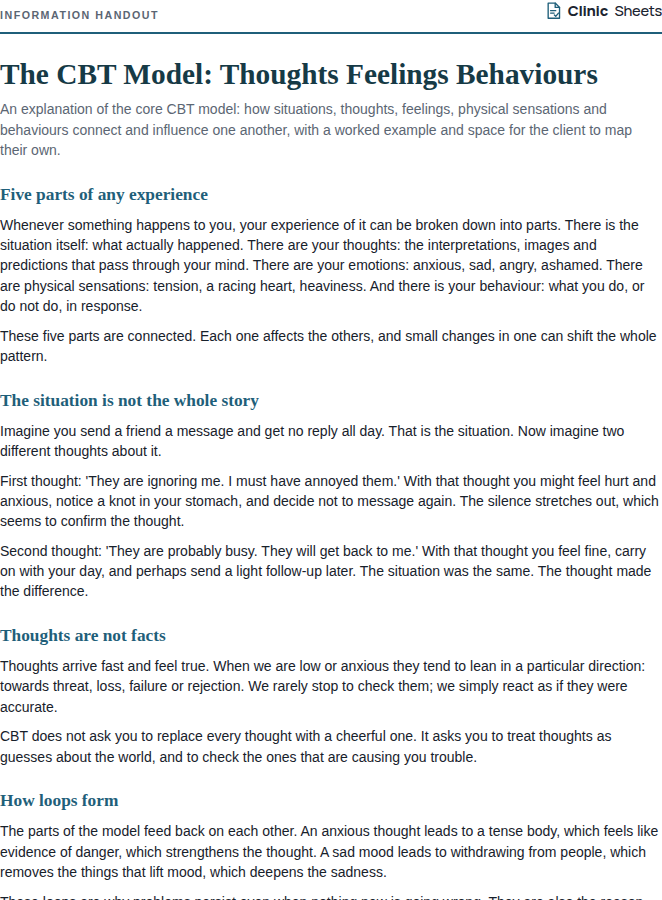
Cacioppo's evolutionary model treats loneliness as a signal, like hunger or pain, that evolved to prompt reconnection. The difficulty is that the same signal triggers a self-protective mode: the lonely person becomes more alert to social threat, more likely to expect rejection, more inclined to interpret ambiguous social cues negatively, and more likely to withdraw or to behave in ways that keep others at a distance. This creates a loop in which loneliness generates the very thinking and behaviour that prolong it. The meta-analysis by Masi and colleagues found that interventions addressing this maladaptive social cognition were more effective than those that simply increased opportunities for contact or taught social skills.
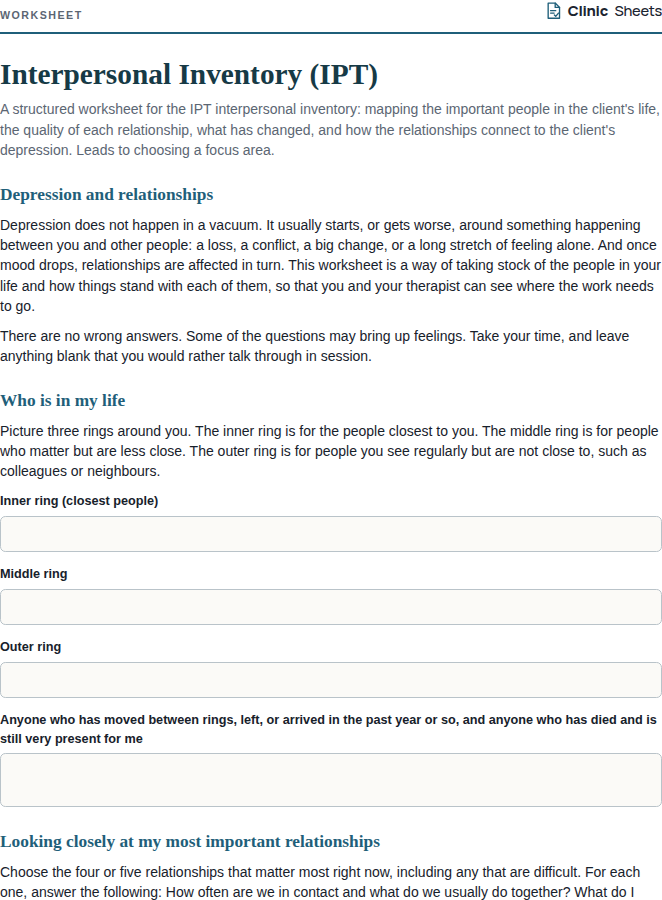
The handout presents this model plainly and without blame, distinguishes loneliness from solitude, normalises the experience, and introduces the two main levers of treatment: recognising and testing threat-focused social thoughts, and gradually rebuilding contact through activity and interpersonal work. The professional version adds notes on assessing loneliness alongside depression, on the difference between emotional loneliness (lacking an intimate attachment) and social loneliness (lacking a wider network), which point to different interventions, and on sequencing behavioural activation and cognitive work with IPT-style attention to role transitions and interpersonal deficits.
How to use it
- Use early in treatment with clients for whom loneliness is a presenting problem or a clear maintaining factor in depression. Many clients do not name loneliness spontaneously because of shame; asking directly is worthwhile.
- Read the loneliness cycle section together and ask for a recent example of a social situation that went badly or was avoided. Draw out the threat-focused thoughts and the withdrawal that followed.
- Distinguish emotional from social loneliness with the client. Lacking one close confidant and lacking a broader circle call for different plans, and the client often has a clear sense of which is missing.
- Use the final section to identify one thought to test and one small step toward contact, and link it to activity scheduling or behavioural experiments in the next session.
- Where the loneliness follows a role change (bereavement, relocation, retirement, separation), consider an IPT framing of the transition alongside the cognitive work.
References
- Cacioppo, J. T., & Patrick, W. (2008). Loneliness: Human Nature and the Need for Social Connection. W. W. Norton.
- Hawkley, L. C., & Cacioppo, J. T. (2010). Loneliness matters: A theoretical and empirical review of consequences and mechanisms. Annals of Behavioral Medicine, 40(2), 218-227.
- Masi, C. M., Chen, H.-Y., Hawkley, L. C., & Cacioppo, J. T. (2011). A meta-analysis of interventions to reduce loneliness. Personality and Social Psychology Review, 15(3), 219-266.
- Peplau, L. A., & Perlman, D. (Eds.). (1982). Loneliness: A Sourcebook of Current Theory, Research and Therapy. Wiley.