Loneliness in Later Life: Building Connection
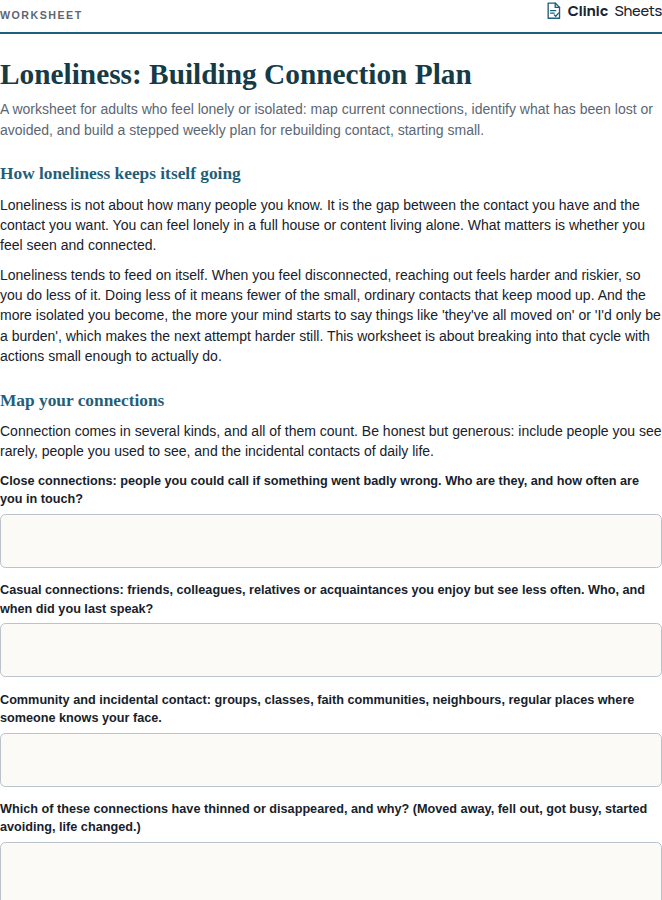
A worksheet for older adults experiencing loneliness, explaining how loneliness feeds withdrawal and how withdrawal feeds loneliness, then mapping existing and possible connections and scheduling concrete steps toward contact. Behavioural activation and IPT informed.
About this resource
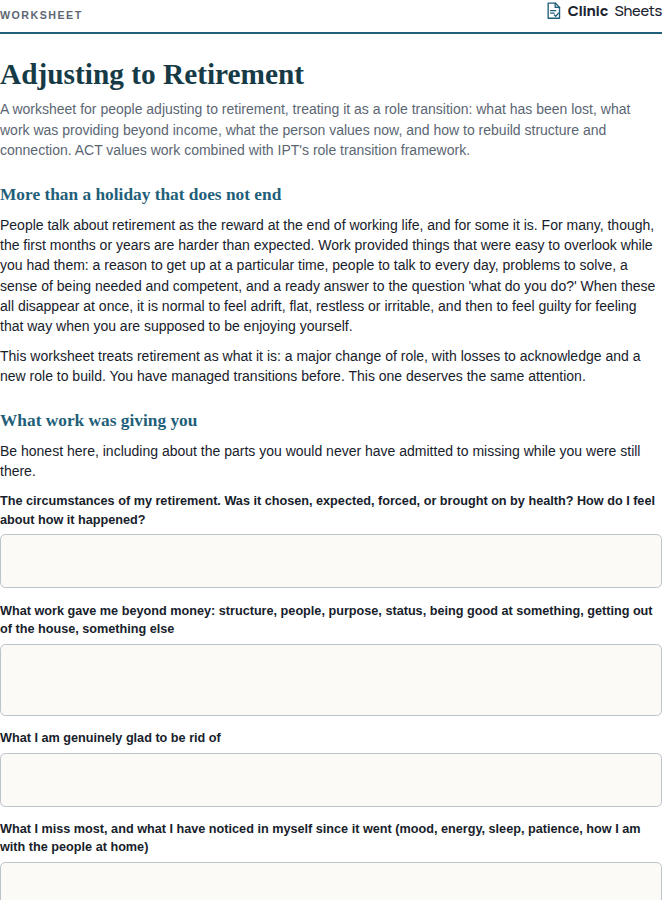
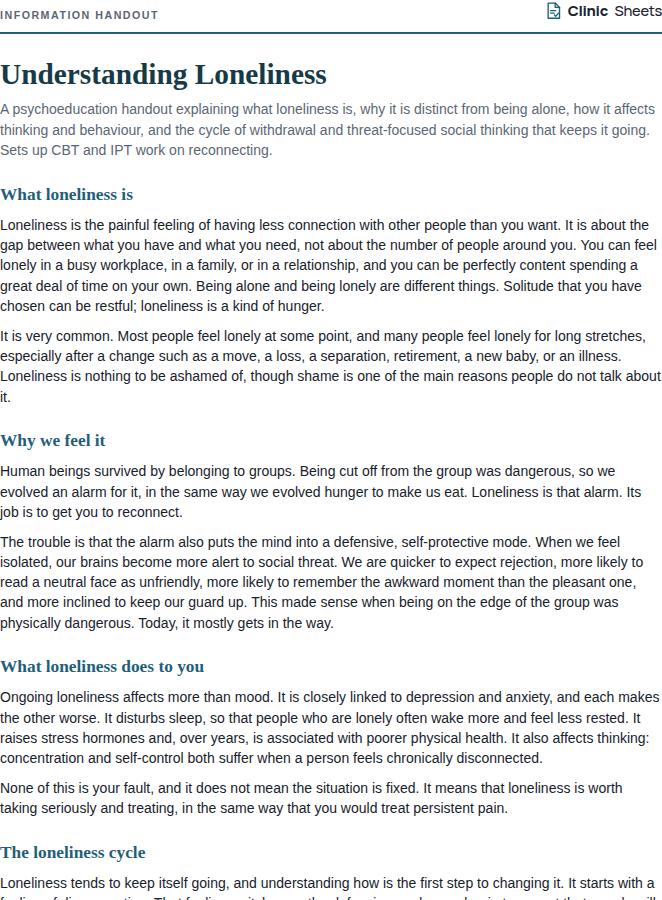
Loneliness in later life is common and consequential. Hawkley and Cacioppo (2010) review evidence that loneliness is associated with poorer sleep, lower mood, and worse physical health outcomes, and describe a self-reinforcing cycle: loneliness heightens vigilance for social threat, so that lonely people expect rejection, interpret ambiguous social cues negatively, and withdraw, which produces further isolation. In older adults, the cycle is often set in motion by bereavement, retirement, loss of mobility or driving, a move, or the deaths and relocations of friends.
Two things follow for treatment. First, simply providing opportunities for contact is not enough if the person's expectations of rejection are not addressed; Masi and colleagues' (2011) meta-analysis found that interventions targeting maladaptive social cognition had larger effects than those providing social opportunity or support alone. Second, activity has to be scheduled and reviewed rather than left to inclination, because loneliness lowers motivation to reach out. This worksheet combines both: it names the cycle and the expectations it generates, maps the person's existing and possible connections, and plans specific, repeatable contact using an activity scheduling approach.
The professional version adds guidance on distinguishing loneliness from depression, on clients whose social world has been genuinely depleted by bereavement, on transport and mobility barriers, and on hearing loss as an under-recognised driver of withdrawal.
How to use it
- Use once the client has described their current social contact in concrete terms: who they spoke to this week, in what form, for how long.
- Read the cycle section together and ask the client to identify the point at which they usually withdraw, and the thought that goes with it.
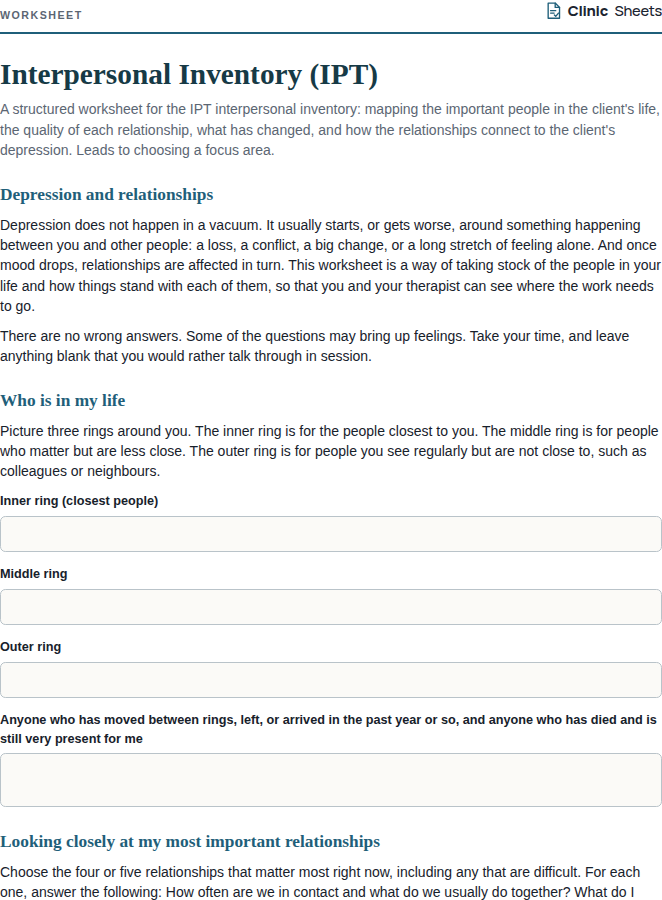
- Complete the mapping section collaboratively. Clients often overlook weak ties (neighbours, shopkeepers, former colleagues) that are the easiest to strengthen.
- Schedule contact as appointments, with a day and time, and review completion at the next session. Focus on whether it happened before discussing how it felt.
- Address practical barriers directly: transport, hearing, cost, mobility. A referral to a community service may be part of the plan.
- Screen for depression and treat it if present; loneliness and depression often coexist and each maintains the other.
References
- Hawkley, L. C., & Cacioppo, J. T. (2010). Loneliness matters: A theoretical and empirical review of consequences and mechanisms. Annals of Behavioral Medicine, 40(2), 218-227.
- Masi, C. M., Chen, H.-Y., Hawkley, L. C., & Cacioppo, J. T. (2011). A meta-analysis of interventions to reduce loneliness. Personality and Social Psychology Review, 15(3), 219-266.
- Martell, C. R., Dimidjian, S., & Herman-Dunn, R. (2010). Behavioral Activation for Depression: A Clinician's Guide. Guilford Press.