Managing Work Stress
A handout explaining how work stress builds and tips into burnout, how demands, control and support interact, and the thinking patterns and habits that keep people stuck. Includes practical starting points and a short reflection.
About this resource
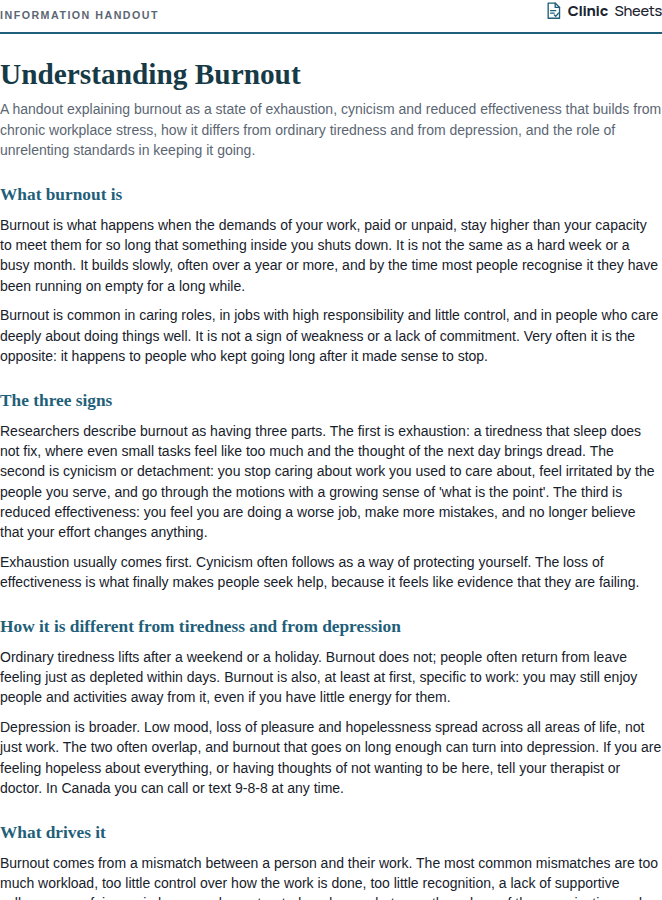
Work stress becomes a clinical concern when the demands of a job persistently exceed the resources available to meet them, and when the person's ways of coping (working longer, dropping recovery, tolerating rather than addressing problems) amplify the load. Karasek's demand-control model and Maslach's account of burnout both point to the same drivers: high demands combined with low control and low support, sustained over time, produce exhaustion, cynicism and a reduced sense of effectiveness.
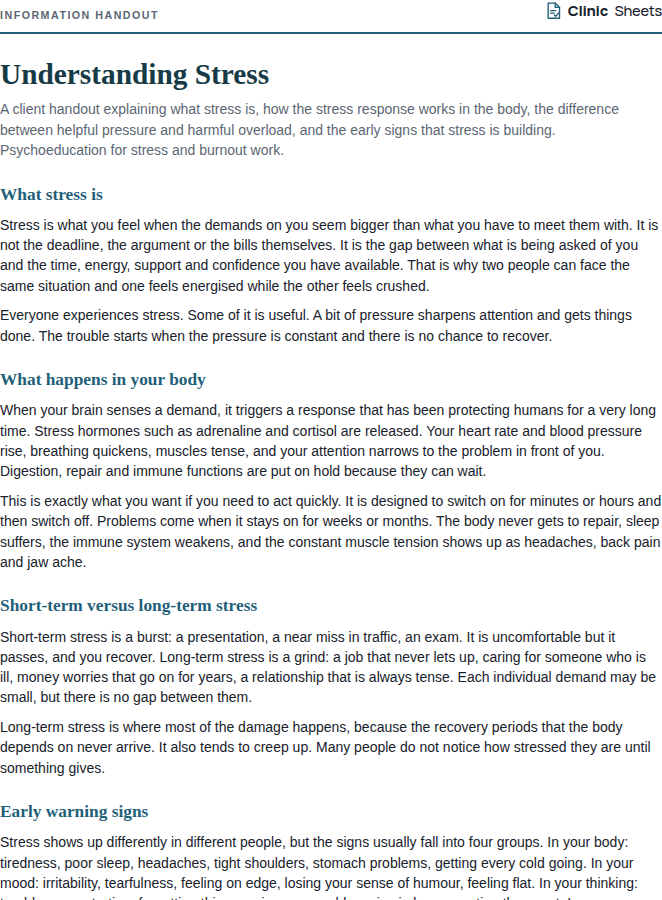
This handout gives clients a plain account of that process. It describes the difference between pressure and chronic stress, the three components of burnout, the role of recovery, and the cognitive patterns that commonly intensify work stress, particularly unrelenting standards, the belief that one's worth depends on output, and the assumption that saying no is unsafe. It closes with practical first steps and a reflection section.
The professional version adds a note on assessing for depression and anxiety that present as work stress, on when the environment rather than the individual is the primary problem, and on linking this handout to activity scheduling, cognitive restructuring and assertiveness work.
How to use it
- Use early in treatment when work stress or burnout is a presenting concern, or when work is the main context for a client's anxiety or low mood.
- Read the burnout section together and ask the client to locate themselves. Distinguish between a stressful patch that will pass and a chronic pattern that has already changed their health, relationships or functioning.
- Use the demands, control and support section to map the client's actual job. Be honest about which factors are changeable by the client and which would require a conversation with a manager, a change in role, or a change in employer.
- Identify the client's dominant stress-amplifying belief from the thinking patterns section and carry it into thought records or a schema-focused discussion.
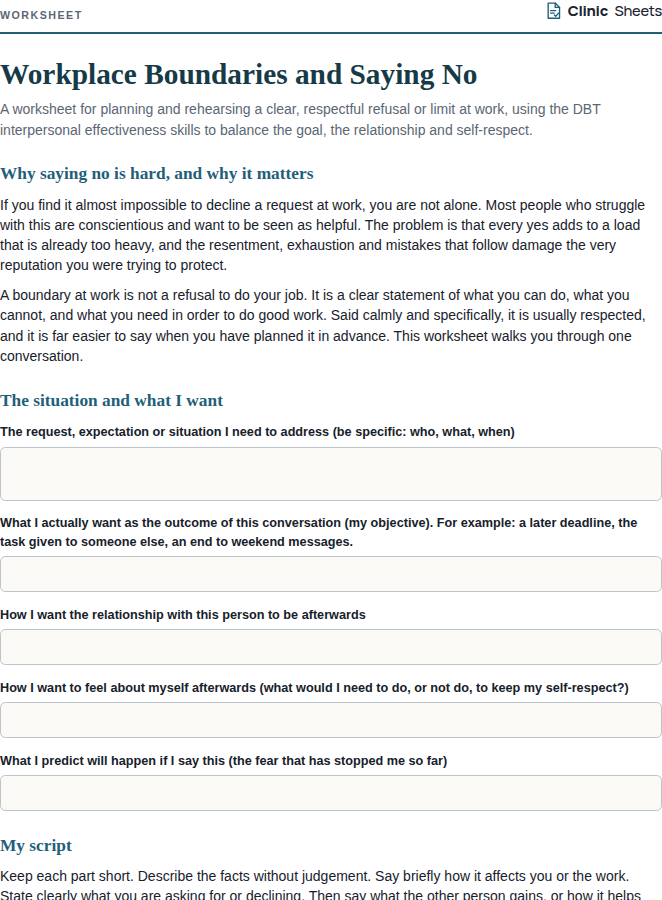
- Agree one or two concrete first steps from the final sections and review them at the next session. Follow with Workplace Boundaries and Saying No if assertiveness is the sticking point.
References
- Karasek, R. A. (1979). Job demands, job decision latitude, and mental strain: Implications for job redesign. Administrative Science Quarterly, 24(2), 285-308.
- Lazarus, R. S., & Folkman, S. (1984). Stress, Appraisal, and Coping. Springer.
- Maslach, C., & Leiter, M. P. (2016). Understanding the burnout experience: Recent research and its implications for psychiatry. World Psychiatry, 15(2), 103-111.
- Young, J. E., Klosko, J. S., & Weishaar, M. E. (2003). Schema Therapy: A Practitioner's Guide. Guilford Press.