Workplace Boundaries and Saying No
A worksheet for planning and rehearsing a clear, respectful refusal or limit at work, using the DBT interpersonal effectiveness skills to balance the goal, the relationship and self-respect.
About this resource
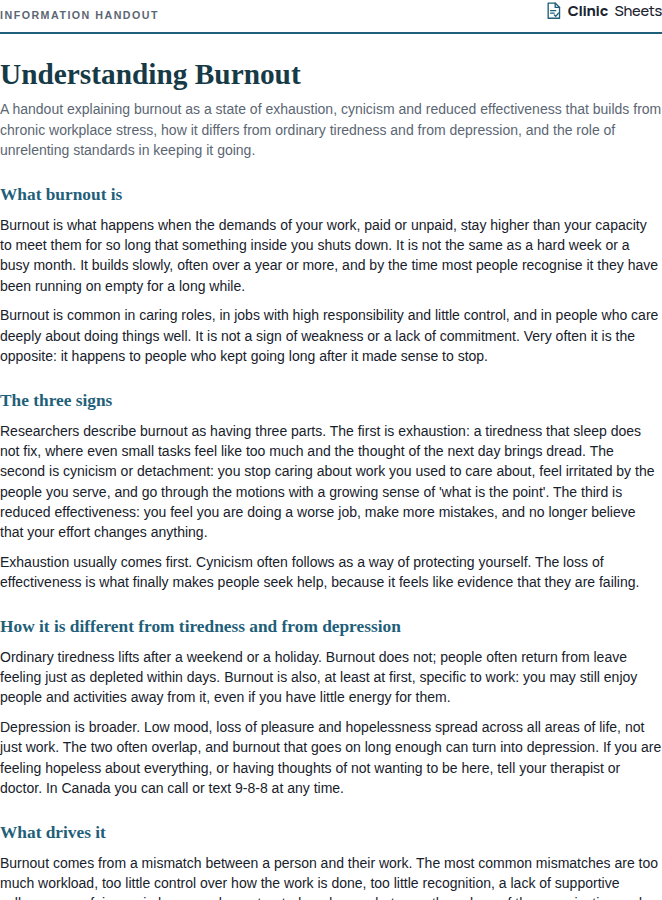
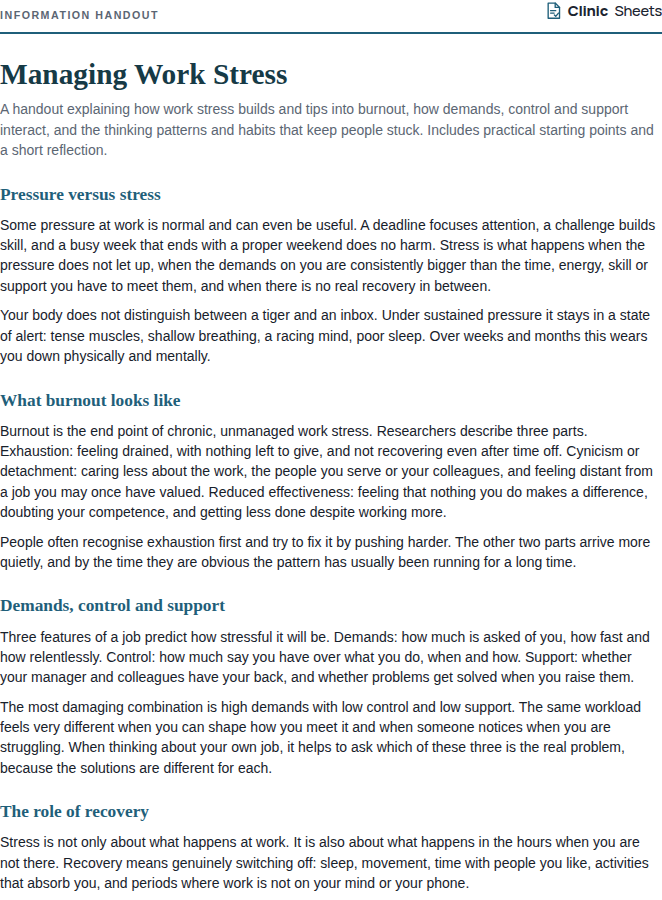
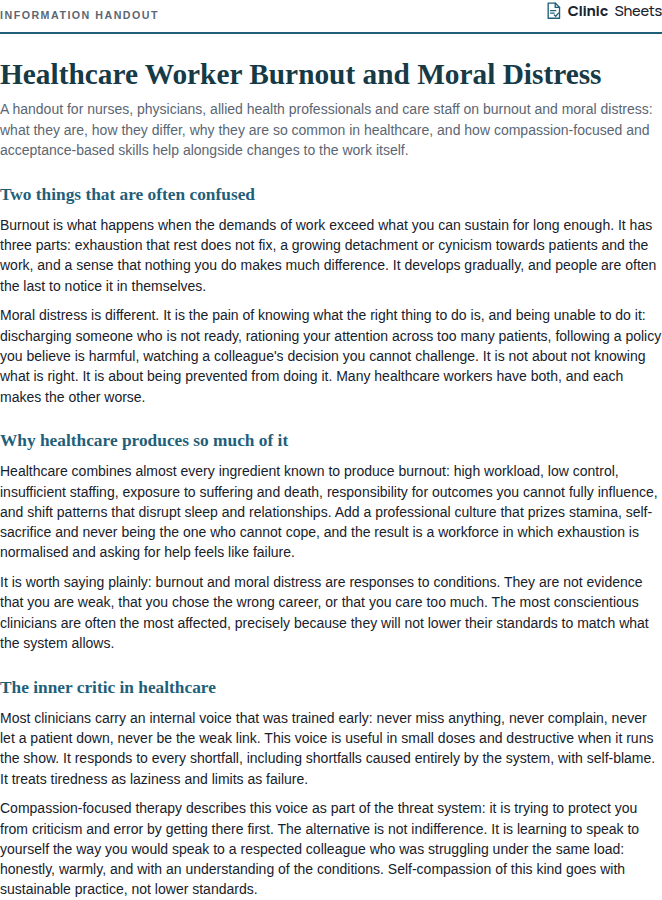
Many clients with work stress and burnout know that their workload is unsustainable but cannot bring themselves to decline a request, renegotiate a deadline or raise a problem. The obstacle is rarely a lack of words. It is usually a prediction ('they will think I am not committed', 'I will be seen as difficult', 'if I say no it will fall apart') combined with a lack of practice at doing it calmly.
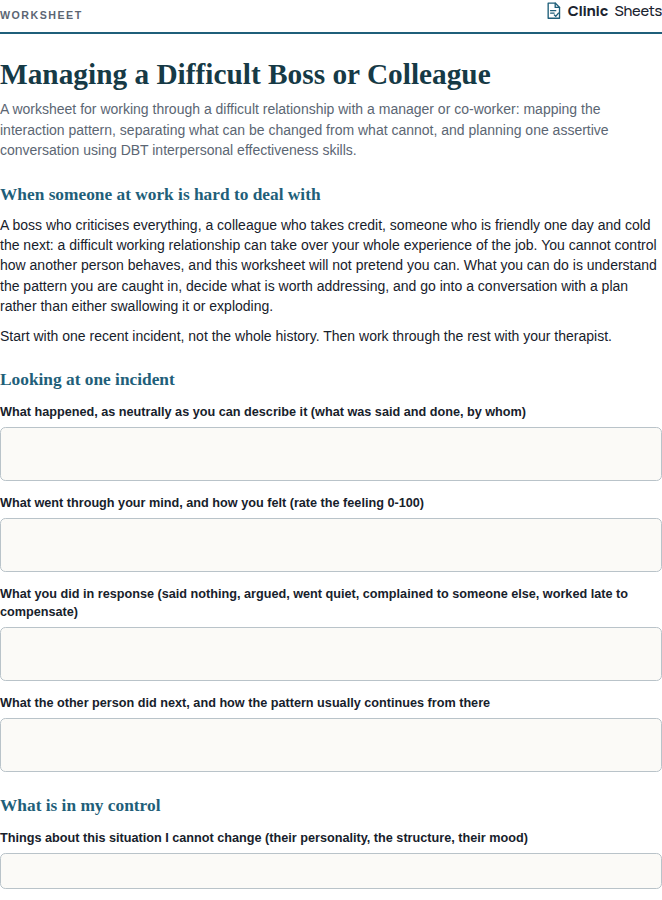
This worksheet borrows the structure of DBT interpersonal effectiveness. Before the conversation, the client identifies what they actually want (the objective), how they want the relationship to be afterwards, and how they want to feel about themselves. They then draft the request or refusal in a describe, express, assert, reinforce sequence, anticipate the other person's response, and plan how to stay on point. A final section captures the outcome so that the prediction can be compared with what happened.
The professional version adds guidance on clients whose difficulty saying no is driven by a subjugation or self-sacrifice pattern, on distinguishing assertive from aggressive and passive styles with examples, and on rehearsing the script in session through role play before the client uses it.
How to use it
- Use when a client has identified a specific work request, expectation or situation they need to decline, limit or renegotiate. Vague goals such as 'be more assertive' should be turned into one concrete conversation first.
- Work through the three priorities section together. Clients who focus only on the objective tend to come across as harsh; those who focus only on the relationship tend to cave. Naming all three keeps the script balanced.
- Draft the script in session. Keep the description factual, the feeling statement brief and the request or refusal explicit. Cut any apologising, over-explaining or hedging.
- Role play the conversation with you taking the other person's part, including a pushback. Practise the 'broken record' response: calmly restating the position without adding new arguments.
- Ask the client to have the conversation before the next session and complete the outcome section. Compare what happened with the prediction, and note any evidence that saying no was survivable.
References
- Linehan, M. M. (2015). DBT Skills Training Manual (2nd ed.). Guilford Press.
- Maslach, C., & Leiter, M. P. (2016). Understanding the burnout experience: Recent research and its implications for psychiatry. World Psychiatry, 15(2), 103-111.
- Young, J. E., Klosko, J. S., & Weishaar, M. E. (2003). Schema Therapy: A Practitioner's Guide. Guilford Press.