Metacognitive Beliefs About Worry
A worksheet for identifying and testing the beliefs a person holds about worry itself: that worry is useful and protective, and that it is uncontrollable and dangerous. Based on Wells's metacognitive model of generalized anxiety disorder.
About this resource
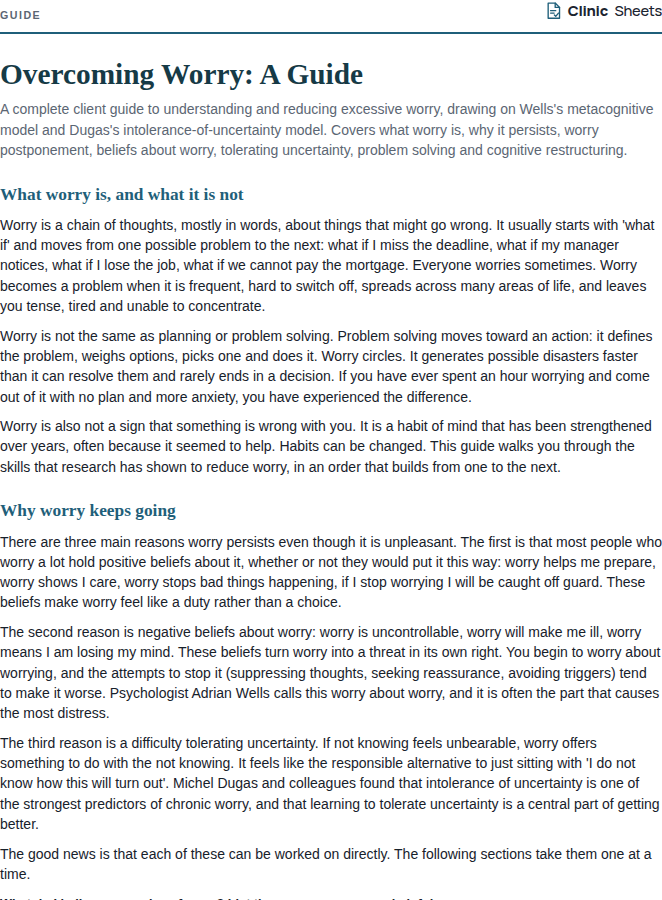
Wells's metacognitive model proposes that generalized anxiety disorder is maintained not by the content of worries but by beliefs about worrying. Positive metacognitive beliefs ('worrying helps me prepare', 'if I worry I will not be caught out') lead the person to select worry as a coping strategy in response to an intrusive thought. Negative metacognitive beliefs ('I cannot control my worry', 'worrying this much will harm me') then turn on once worry is under way, producing worry about worry, which Wells calls Type 2 worry, and the anxiety, avoidance, thought control attempts and reassurance seeking that follow. Metacognitive therapy targets these beliefs directly, and the negative beliefs about uncontrollability and danger are addressed first.
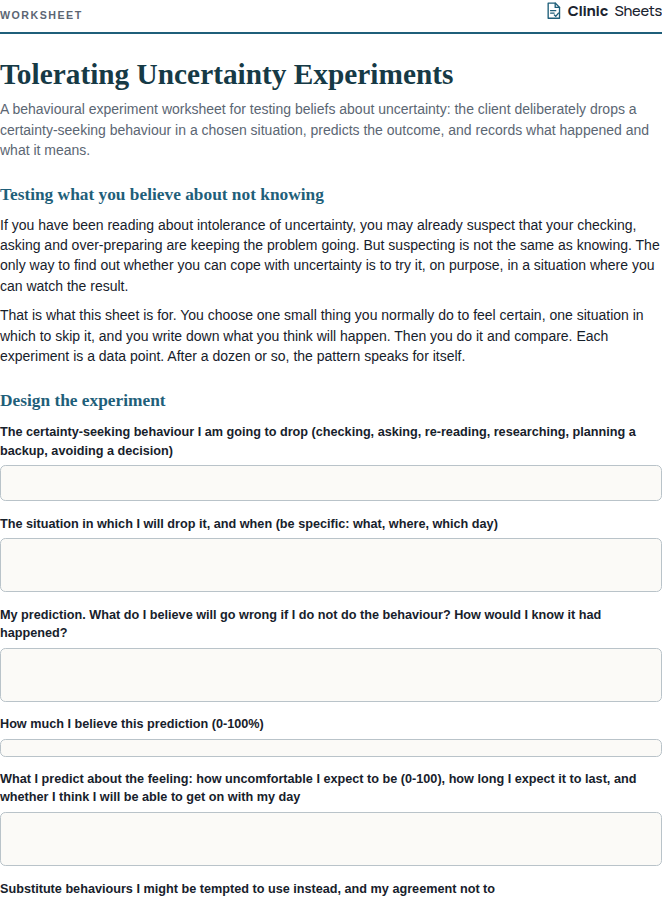
This worksheet takes the client through both sets of beliefs. It asks them to state and rate their positive and negative beliefs about worry, to examine the evidence and the logic of each, and to plan behavioural experiments, in particular worry postponement to test uncontrollability, and a comparison of worry with other ways of preparing to test usefulness. It is designed to complement attention training and detached mindfulness, and to be used across several sessions as belief ratings change.
The professional version includes the sequence recommended in Wells's treatment manual, verbal reattribution questions for each belief type, and notes on the common obstacle of clients who accept intellectually that worry is not useful but continue to believe it is uncontrollable.
How to use it
- Draw the metacognitive formulation with the client first: the trigger, the positive beliefs that switch on worry, the worry itself, the negative beliefs that produce worry about worry, and the resulting emotion and behaviour. Use a recent worry episode.
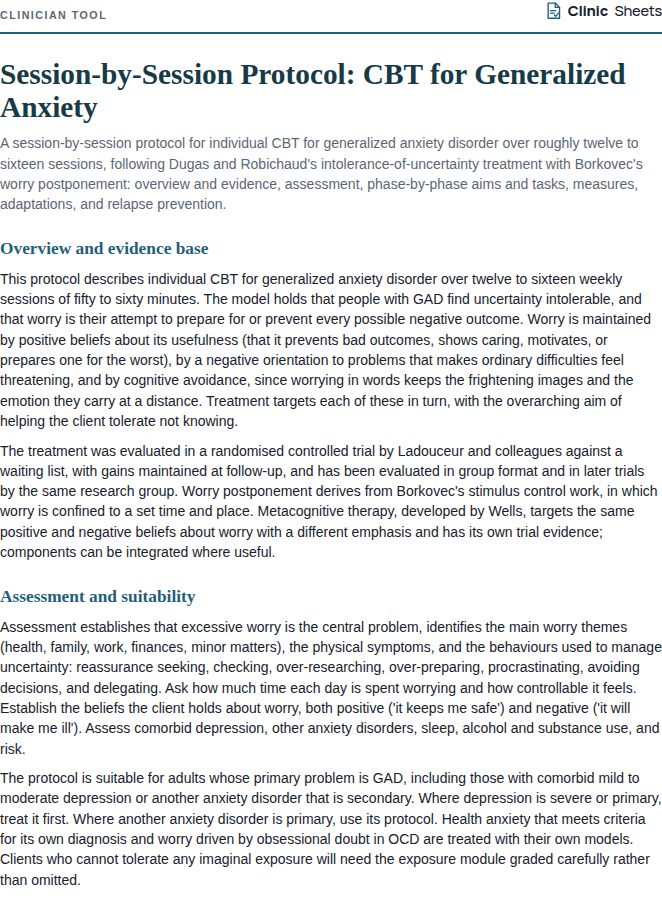
- Elicit negative beliefs about uncontrollability and danger and rate them. Challenge uncontrollability first with questions such as: if worry were uncontrollable, how does it ever stop? What happens when the phone rings mid-worry? Then set up worry postponement as an experiment: notice the worry, postpone it to a fixed period later in the day, and record whether it could be postponed.
- Address beliefs about danger with evidence review and, where relevant, an experiment in which the client deliberately worries hard for a set time to test whether harm follows.
- Only once negative beliefs have reduced, move to positive beliefs. Ask what worry has actually delivered, whether outcomes were different when the client worried less, and run a comparison: worry about one upcoming event and not another, then compare how each went.
- Re-rate all beliefs at each session and keep the worksheet as a running record. Reduction in belief ratings, rather than reduction in worry frequency alone, is the marker of change in this model.
- Discourage the client from using thought suppression or distraction during the experiments, as both are part of the problem the model describes.
References
- Wells, A. (1995). Meta-cognition and worry: A cognitive model of generalized anxiety disorder. Behavioural and Cognitive Psychotherapy, 23(3), 301-320.
- Wells, A. (2009). Metacognitive Therapy for Anxiety and Depression. Guilford Press.
- Wells, A. (1997). Cognitive Therapy of Anxiety Disorders: A Practice Manual and Conceptual Guide. Wiley.